
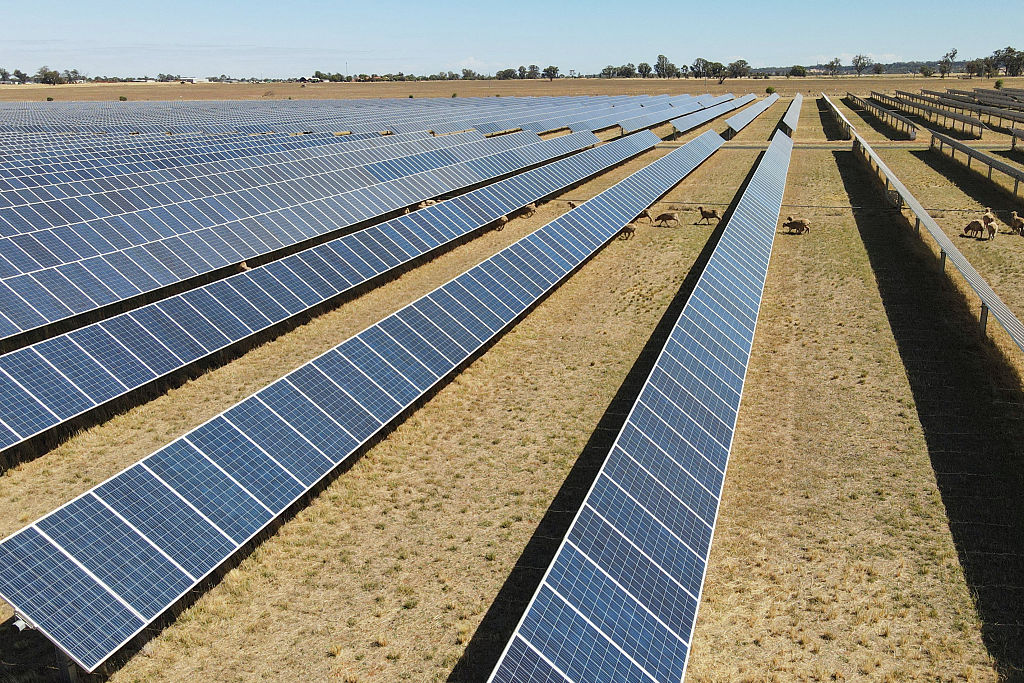


This picture taken on Jan. 19, 2026 shows an aerial view of sheep grazing at the Dubbo Solar Hub in New South Wales, Australia which contains over 30,000 solar panels deployed across approximately 50 hectares at Tom Warren’s farm on the outskirts of Dubbo. Gregory Plesse/AFP via Getty Images
Australia should introduce a nationwide ban on sending solar panels to landfill and force manufacturers to pay for collecting and recycling them, according to a New South Wales recycling startup.
Chris Mohen, the managing director of Environmental Solar Recycling Australia (ESRA), told the Senate Standing Committee on Climate Change, Energy, Environment and Water that the country’s rapid adoption of rooftop solar has created an inevitable wave of end-of-life photovoltaic waste.
The company is building a base in Bowral and a facility in Bega, both regional New South Wales, to process discarded solar equipment.
Solar panel waste will likely grow from about 59,000 tonnes this year to more than 91,000 tonnes by 2030 before approaching 1 million tonnes annually by 2035.
Despite panels containing valuable materials, including glass, aluminium, silicon and critical metals, ESRA says fewer than 5 percent are currently recycled.
Most are instead sent to landfill, stockpiled or sold through informal second-hand markets with little oversight, even into areas like Africa and the Middle East.
“On the ground, well-intentioned installers and asset holders are caught between wanting to do the right thing and a system that makes the cheapest option skip bin or landfill,” Mohen said.
“Some go straight to landfill because it’s the cheapest gate fee, some are stockpiled on farms or in sheds until there is a solution, and some are sold informally secondhand, often without proper testing or documentation.”
Mohen also said some panels could still be used despite being thrown away.
“Around 29 percent of professionally collected modules could pass rigorous testing and safely deliver a second life,” he said, pointing to opportunities in community energy projects, low-income households, remote communities, and agrivoltaic developments.
Mohen said the average decommissioned panel is only about eight years old, whereas they can last for 25 to 30 years, or even more in some cases.
Those removed early “still have full value,” he said.