
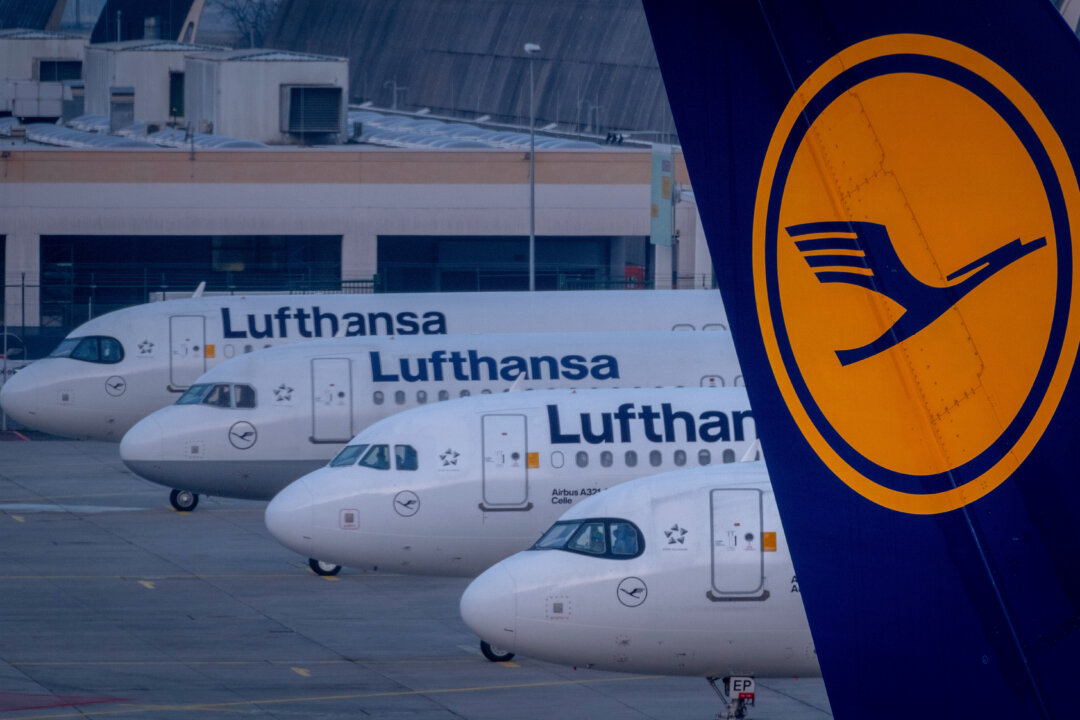

Lufthansa slashed its profit outlook on August 4, citing soaring fuel costs linked to the war in the Middle East.
The German flag carrier said it spent an extra 750 million euros ($864 million) on jet fuel during the second quarter of this year, resulting in a significant decline in its operating profit (adjusted EBIT) to 383 million euros ($441 million), down from 870 million euros ($1 billion) in 2025. “EBIT” stands for earnings before interest and taxes.
Along with the increase in fuel costs, the company said that a financial burden amounting to 150 million euros ($172 million) was caused by strikes.
The airline now expects an adjusted EBIT of 1.7 billion euros to 2.2 billion euros ($2 billion to $2.5 billion), reducing this year’s margin to 3.4 percent, down from 8.4 percent last year.
Its group net income also declined from 1 billion euros ($1.15 billion) last year to just 123 million euros ($142 million) for this year.
Lufthansa had previously forecast adjusted EBIT to come in significantly above the prior-year level of 1.96 billion euros ($2.26 billion).
Lufthansa CEO Carsten Spohr said in an Aug. 4 statement that the company was reflecting “on a challenging second quarter that was once again marked by multiple geopolitical crises and uncertainties.”
“Despite our further improvement in load factor and a significant increase in yield, we were unable to fully offset the considerable rise in fuel costs,” Spohr said. “The continued strong global demand for air travel—primarily in the premium classes—had a particularly positive impact.”
The company said that “due to the sharp rise in kerosene prices resulting from the conflict in the Middle East, fuel costs at the network airlines rose by more than 600 million euros year on year.”
Lufthansa said its capacity was also down around 3 percent in the second quarter, in part due to strike days in April, but capacity planning for the year remains unchanged and would, largely, be flat.

Passenger planes of German airliners Lufthansa and TUI pass one another at Tegel Airport in Berlin, Germany, on July 29, 2008. Sean Gallup/Getty Images
The company now expects fuel costs to be 8.66 billion euros ($9.97 billion) for the 2026 financial year, after an earlier projection of 8.9 billion euros ($10.25 billion).
In a bid to compensate, Lufthansa said it plans to retire, or temporarily ground, several aircraft to streamline operations, reduce fuel consumption, and limit exposure to unhedged fuel costs.
Lufthansa said this would include the early retirement of fuel-intensive long-haul aircraft such as the Airbus A340-600 and the temporary grounding of two Boeing 747-400s from the start of the winter flight schedule.
The company added that 86 percent of its fuel needs for this year are covered by hedging.
The news comes months after the airline announced it was axing 20,000 short-haul flights over the summer.
Lufthansa said in a statement at the time that the flights “will be removed from the schedule through October, equivalent to approximately 40,000 metric tons of jet fuel, the price of which has doubled since the outbreak of the Iran conflict.”
The carrier said that the changes would reduce the number of “unprofitable short-haul flights” across its network and will be carried out across Lufthansa Group’s six hubs in Brussels, Munich, Rome, Vienna, Zurich, and Frankfurt, Germany.
In June, Willie Walsh, director general of the International Air Transport Association (IATA), said that the global airline industry will see its profits halve this year amid rising jet fuel prices triggered by the Iran war.

A person points at a page on the Marinetraffic website that shows commercial boat traffic on the edge of the Strait of Hormuz near the Iranian coast on March 4, 2026. Julien de Rosa/AFP via Getty Images
“No sooner did we put COVID behind us than we faced aerospace supply chain failures, war in Ukraine, geopolitical tensions, and tectonic shifts in trade policies,” he said.
“And when war broke out in the Middle East in March, oil prices jumped, and jet fuel prices skyrocketed. As a result, we expect average jet fuel prices to be 70 percent higher year-on-year. That will add $100 billion to our collective fuel bill this year.”

Global airline industry body International Air Transport Association (IATA) Director General Willie Walsh attends an interview with Reuters in Doha, Qatar, on June 19, 2022. Imad Creidi/Reuters
Walsh said these circumstances are expected to cut profits by half from 2025, with net income falling to $23 billion this year from $45 billion, along with a significant dip in net margins.
In its most recent report on the energy situation, the International Energy Agency said on July 10 that “concerns over jet fuel shortages have eased in recent weeks after refiners pushed output to new highs.”
IATA’s jet fuel price monitor put the average price of a barrel of kerosene at $158.77 for the week ending July 31, a 0.8 percent reduction on the previous week.
That price still represents a 76.4 percent increase in the cost of a barrel of jet fuel from the same week in 2025.