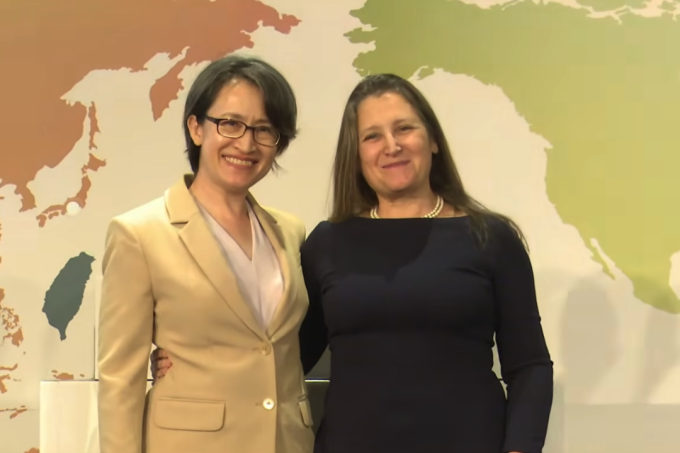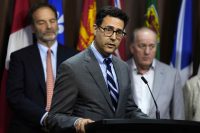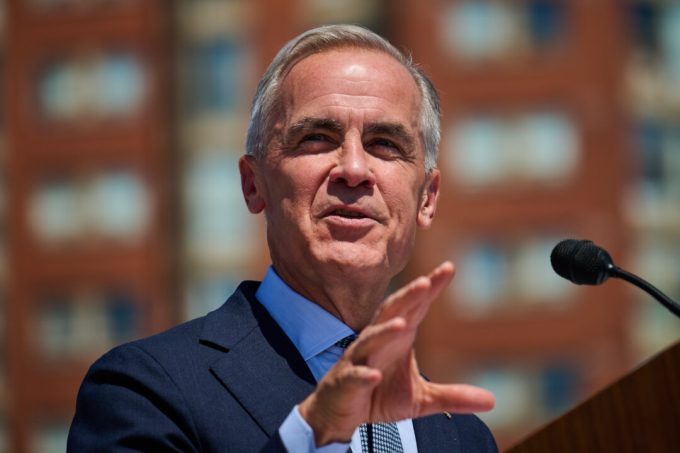

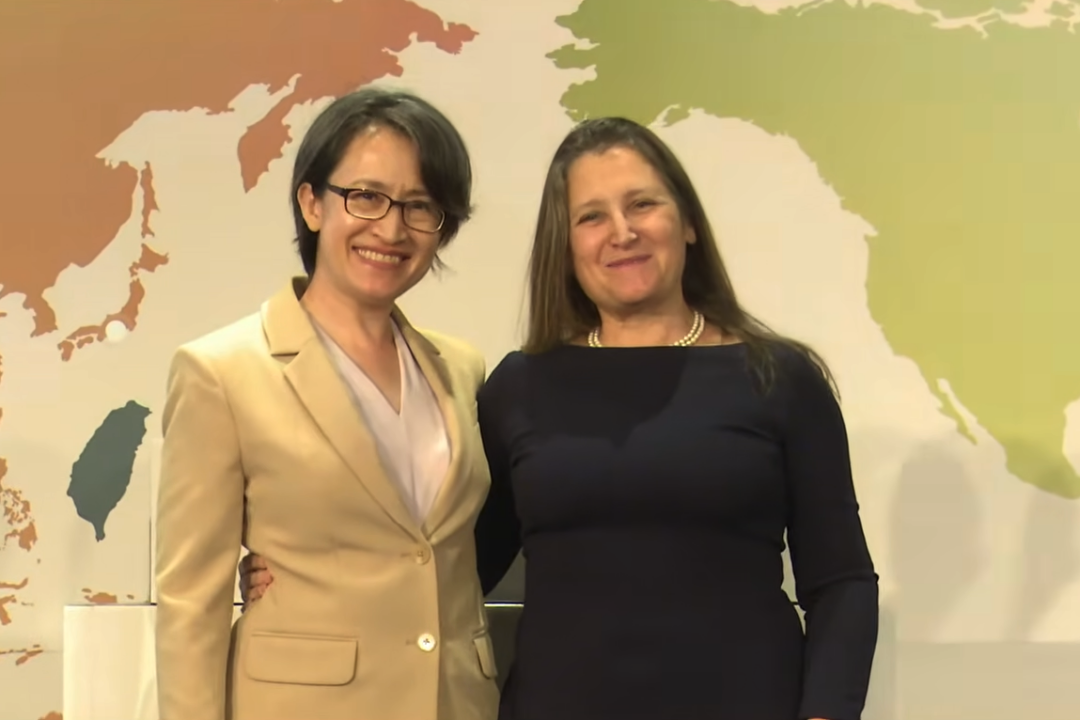

(L-R) Taiwan Vice President Hsiao Bi-khim and former Canadian Deputy Prime Minister Chrystia Freeland pose for photos at the Ketagalan Forum in Taipei, Taiwan, on Aug. 4, 2026. Screenshot via The Epoch Times
TAIPEI, Taiwan—Former Canadian Deputy Prime Minister Chrystia Freeland warned that an extraterritorial clause in China’s ethnic unity law shares a “dark kinship” with Russian President Vladimir Putin’s rhetoric before the Ukraine invasion, urging democratic countries to push back against Beijing’s latest measure.
Freeland, who served as Canada’s deputy prime minister from 2019 to 2024, made the remarks during a speech at the Ketagalan Forum on Aug. 4. The event, hosted by Taiwan’s Ministry of Foreign Affairs, focused on security issues in the Indo-Pacific.
The Chinese law, officially known as the “Promoting Ethnic Unity and Progress Law,” went into effect on July 1. It
provides
a legal basis for advancing a Beijing-defined “shared” national identity and bans acts that “undermine ethnic unity” or “incite ethnic divisions.”
Pointing to historical precedent, Freeland noted that just seven months before launching the full-scale invasion of Ukraine, Putin published an essay titled “On the Historical Unity of Russians and Ukrainians,” in which he argued that Russians and Ukrainians were “one people.”
Freeland said that Beijing adopted a similar logic to justify extending its reach beyond its borders. She pointed to Article 63 of the Chinese law, which
allows
Beijing to hold organizations and individuals outside China legally accountable for actions deemed to “undermine ethnic unity and progress” or “incite ethnic separatism.”
“Article 63 is particularly sinister for me, given its dark kinship with Russia’s malign use of linguistic, cultural, and ethnic ties to justify illegal encroachment on the sovereignty of its neighbors, including the bloody full-scale invasion of Ukraine,” Freeland said.
“The lesson of history is clear,” Freeland added.
The Chinese law has raised
concerns
in Taiwan and among overseas Hong Kong, Tibetan, and Uyghur communities. In the United States, a bipartisan group of
House lawmakers
and
senators
has introduced resolutions condemning the Chinese law.
Freeland said democratic countries should not “mince their words” about the Chinese law and should be united in voicing their opposition.
“Democracies need to state plainly and in one voice that a foreign law which assigns political loyalty on the basis of ethnicity has no force on our territories and no application to our citizens, whatever their ancestry, whatever their passport, wherever they or their parents were born,” Freeland said.
Speaking at the same event on Tuesday, Taiwan’s President Lai Ching-te also
urged
countries to unite against what he described as “malicious” Chinese law.
Taiwan Vice President Hsiao Bi-khim echoed Lai’s call during a speech at the event.
Under the Chinese law, Beijing has a “legal tool to pursue activists, academics, or critics abroad,” Hsiao said.
“This law is not a localized issue. It’s a direct challenge to universal values and the international legal order. Through vague provisions and selective enforcement, it seeks to export censorship and provide a legal pretext for transnational repression,” she added.
China’s transnational repression has been a longstanding concern, predating the enactment of the new law. Its
tactics
have ranged from physical assaults and artificial intelligence-generated sexual harassment campaigns to threats against family members in China, pressure to return to the country, censorship, and lawfare.
In Taiwan, experts have
expressed
concerns about how China’s covert overseas police stations could play a role in enforcing the Chinese law.
Spain-based nonprofit Safeguard Defenders
reported
in 2022 that the Chinese regime had established more than 100 overseas police stations in 53 countries.
“When authoritarianism extends beyond reach with impunity, there are no bystanders. Every individual and nation that treasures freedom must stand on the same front line,” Hsiao said.
“We call on democratic partners to align closely and build a united defense against expansionism and transnational repression.”