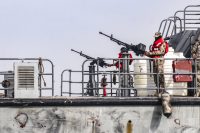

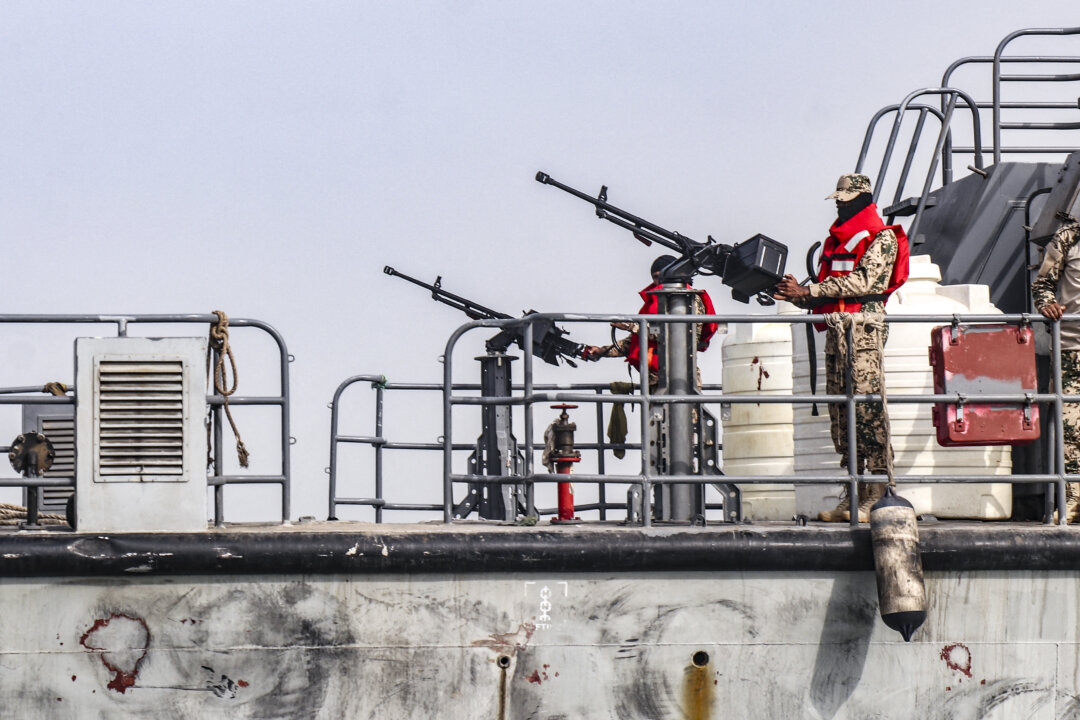


Sailors from the navy of Yemen’s Aden-based internationally recognised government stand at machine-gun positions aboard a vessel patrolling a shipping lane off Hanish Island in the Red Sea on July 27, 2026. Khaled Ziad / AFP via Getty Images
Yemen’s Houthis said they had launched a missile attack on a Saudi oil tanker off the coast of the kingdom’s Red Sea port city of Yanbu on Aug. 5.
The Iran-aligned terrorist group did not say when the attack had taken place, but their military spokesperson Yahya Saree said the vessel, named Wafa, had been hit by “a number of missiles,” in an Aug. 5 post on X.
He added that this strike took the number of Saudi vessels that had been hit since the Houthis announced a blockade of the Bab el Mandeb Strait on July 22 to eight and the number forced to turn back to 29.
Saree said the Houthis “affirm that their operations will continue and escalate in targeting Saudi oil tankers in the northern Red Sea to close all access points and prevent their passage, thus establishing a blockade-for-blockade equation, regardless of the consequences.”
Saudi Arabia has not yet commented on the Houthis’ announcement. The Epoch Times contacted the Saudi Ministry of Foreign Affairs for comment but did not receive a response before publication.
The announcement of the strike on the Saudi oil tanker comes hours after explosions were reported at Dubai’s Jebel Ali industrial zone.
Iran’s semi-official, state-aligned Mehr News Agency and state-owned outlet Press TV both reported that multiple blasts had been heard at the site in the UAE’s largest city.
Though Mehr reported there was initially speculation that this incident could have resulted from an attack launched from Yemen, the Government of Dubai Media Office said that “the fire that broke out last night in the Dubai South area resulted from an incident at a workshop, causing several trucks and caravans to catch fire,” in an Aug. 5 post on X.
“The fire was extinguished, with no injuries reported,” the office added.
The Houthis announced their blockade on Saudi shipping in response to an attack targeting the airport in the Yemeni capital of Sanaa.
The blockade parallels Iran’s efforts to constrain trade through the Strait of Hormuz after U.S. and Israeli forces attacked on Feb. 28.
Bab el-Mandeb is a narrow passage connecting the Red Sea to the Gulf of Aden and has long served as a
critical passageway
for global commerce and energy shipments.
Vessels transporting oil, container goods, and other cargo regularly pass through the strait on routes connecting Asia, Europe, and the Middle East. Disruptions could
affect markets
, increase insurance costs, and push ships toward longer voyages around Africa.
On Aug. 1, the Houthis denied reports that the group intended to impose fees on commercial vessels transiting through the strait, stating that no such decision had been reached and that traffic through the strategic waterway continues without charge.
The Houthi-run Humanitarian Operations Coordination Center, or HOCC, described its safe transit service as voluntary and cost-free.
The statement came two days after a Reuters report citing unnamed sources stated that the Iran-aligned Houthis were weighing whether or not to impose fees on ships moving through the southern Red Sea, which had already seen a
decline in traffic
, reaching its lowest levels in months by late July. That discussion followed the group’s declaration of a maritime blockade focused on Saudi Arabia the previous week.
According to the earlier report, the fee proposal had been discussed with Iranian officials during a July visit to Tehran by Houthi representatives. No timeline for implementing the fees was set.
“The HOCC categorically confirms that any individual or entity requesting the payment of money in exchange for transiting the Bab el-Mandeb Strait does not represent the Republic of Yemen or HOCC in any capacity whatsoever,” the HOCC stated.
It also warned shipping companies of unauthorized parties.
“The HOCC urges shipping companies not to make any payments or provide any information to unauthorized individuals or entities,” the statement read.
Kimberley Hayek and Ryan Morgan contributed to this report.