

Investors are getting increasingly nervous about the AI-related investment boom that is driving America’s GDP growth, sparking heightened volatility in both equity and debt markets.
Capital expenditures on AI infrastructure—software, data centers, power facilities, and computer equipment—escalated from $235 billion in 2024 to more than $700 billion projected in 2026. And analysts say that this cash outlay—already the largest investment splurge in America’s history—could be just the early stages of the investment cycle with much more to come.
Capital expenditures on AI could reach between $4 trillion and $8 trillion over the next five years, according to a May report from Goldman Sachs. JP Morgan likewise projects that AI investments will exceed $5 trillion by 2030.
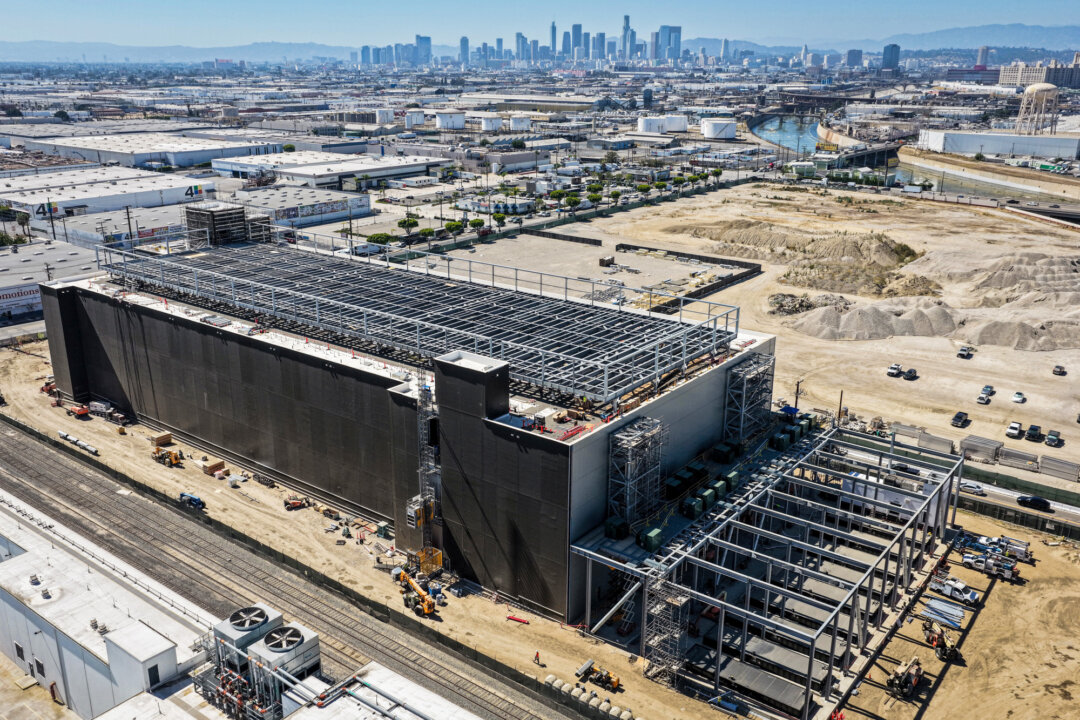
This spending spree is driven by heavyweight hyperscalers such as Amazon, Microsoft, Meta, and Google, which are locked in a race to build the next generation of AI infrastructure. But it also includes semiconductor manufacturers such as Nvidia, TSMC and Broadcom, AI model developers such as OpenAI and Anthropic, memory manufacturers such as Samsung, SK Hynix and Micron Technology, and infrastructure builders such as Oracle.
AI is now expanding from its generative phase—creating content, summarizing, and coding—to the agentic phase of workflow automation and virtual assistants. Physical AI is the third phase, including robotics and autonomous drones and vehicles.
This investment splurge is currently a critical driver of America’s economic growth.
AI-related companies accounted for about three-quarters of the S&P 500’s gains over the past year, and generated about 80 percent of the index’s earnings growth, according to a
by JP Morgan Asset Management. The bank projects that AI-related companies will generate about one-third of the total S&P 500 net income in 2026.
Memories of Dot-Com Crash
Recently, however, many investors say they are fearing a replay of the dot-com crash of 2000, which sent America’s economy into a tailspin after hundreds of billions were lost on telecom infrastructure and speculative internet startups.
“History is filled with periods in which transformational technologies attracted more investment than they could profitably absorb in the short run,” Peter Earle, senior economist at the American Institute for Economic Research, told The Epoch Times. “At the same time, investors often underestimate both the time required for new technologies to diffuse throughout the economy and the complementary investments and planning that are needed before significant productivity gains emerge.
“Some firms will undoubtedly overbuild and destroy shareholder value—some, no doubt, already have—while others will become the platforms upon which future economic growth is built.”
Heightened uncertainty about who will win or lose in this race has driven a sharp increase in volatility in the share prices of AI companies, and equity markets are not alone. Credit markets are also getting the jitters.
According to Torsten Slok, chief economist at Apollo Global Management, the cost of buying credit default swaps (CDSs), which provide insurance against default, has also increased sharply for AI companies since January, indicating growing concerns about the debt that they are taking on.
Of the more than $5 trillion in AI capital spending projected by JP Morgan, the bank estimates that
will come from issuing corporate bonds. For the major hyperscalers, five-year CDS spreads recently widened by between 10 and 40 basis points since the beginning of the year. For companies such as Oracle, which has borrowed more heavily to fund capital expenditures, the cost of a five-year CDS increased from less than 2 percent in January to 10 percent today.
Capex Putting Cash Flow in the Red
One element that had previously endeared investors to companies such as Microsoft, Alphabet, and Amazon was their ability to generate massive amounts of free cash flow from a relatively small asset base. And until recently, tech companies were able to fund capital expenditures from cash flow, but Amazon’s free cash flow has fallen substantially, while Microsoft recently reported that its free cash flow had turned negative, and Oracle announced plans to raise tens of billions in debt to pay for infrastructure investments.
Throughout the AI ecosystem, capital expenditures are rising faster than revenues, while free cash flow (cash available after operations and investments) is falling, increasing the need for outside financing and leveraging up companies’ balance sheets. Reuters reports that while AI companies are projected to generate about $340 billion more in operating cash flow in 2027 than they did in 2025, they will spend $534 billion more on investments, putting free cash flow in the red.
An analysis from PIMCO projects that over the next two years capital expenditures will consume 94 percent of hyperscalers’ operating cash flow, compared with 40 percent in 2023. And investors also worry that the cost of the AI buildout could even go beyond current projections.
Goldman Sachs states that capital costs could vary significantly, based on factors such as the choice of “chip architecture” to deliver necessary computing power, how soon chips need to be replaced, and the cost of building next-generation data centers. One report
more than 500 municipalities across the United States that have laws banning or restricting the construction of data centers.
The timing of returns is also critical. Delays in generating cash from investments could prove particularly harmful because China is rapidly catching up with AI technology and providing it cheaper, which could undercut future profits for American tech companies.
Investors Demanding Proof of Concept
For that reason, investors are now demanding evidence that the massive spending will generate sufficient profits and cash. Companies that raise doubts have seen their share prices hammered.
This was evident as tech companies reported their latest earnings. Shares of Alphabet were hit last week after quarterly results showed declining free cash flow and increasing capital expenditures, though the stock has rallied since. Shares of Meta fell by more than 10 percent after it disappointed investors.
On the upside, Microsoft shares jumped 17 percent on July 30 and Amazon stock surged by more than 13 percent on July 31, as the companies announced revenues had exceeded estimates.
And for all the volatility and risks, some analysts say there are reasons why the current infrastructure boom may not end as badly as its predecessors.
“Comparisons are useful, but they are easily pushed too far,” Earle said. “Like railroads in the 19th century or internet infrastructure in the late 1990s, AI is almost certainly a genuinely transformative technology that is attracting both productive investment and speculative excess.”
By contrast to the dot-com era, leading AI companies are operating from a position of strength, including strong balance sheets, even after taking on debt, and healthy margins.
For example, despite dramatic increases in capital spending, Microsoft reported for fiscal year 2026 that its overall profitability has remained strong, with revenues, operating income and net income all up by double digits. Company-wide operating margins were about 60 percent, while its Intelligent Cloud segment continued generating operating margins above 40 percent.
“We are only at the beginning phases of AI diffusion and already Microsoft has built an AI business that is larger than some of our biggest franchises,” Satya Nadella, chairman and chief executive officer of Microsoft, stated.
Amazon Web Services (AWS), the company’s cloud computing unit, continues to generate operating margins above 30 percent, with quarterly revenue growth up 37 percent as of June, exceeding analysts’ estimates.
“AWS is booming,” Amazon CEO Andy Jassy said in a statement, noting it was the unit’s fastest growth in 18 quarters. “Our AI and chips businesses each eclipsed run rates of more than $25 billion.”
What If AI Spending Stalls?
But concerns remain, particularly given the concentration of America’s economic health in so few companies. Given the outsized role of AI spending in national GDP growth, what would be the ripple effects if that engine stalls?
“The immediate economic effect would likely be a sharp decline in business fixed investment, which has become one of the strongest components of GDP growth over the past two years,” Earle said. “If firms conclude that expected returns have been overstated, capital spending on chips, servers, power infrastructure, and data centers could slow considerably, weighing on manufacturing, construction, and related industries.”
This doesn’t necessarily mean a recession will follow, he said, but the U.S. economy would lose a key driver of growth. Many sectors of the U.S. economy, outside of tech and AI, are currently suffering from higher interest rates, lower consumer spending and a moribund housing market, all of which are putting a drag on America’s GDP.
“The broader risk is not simply lower profits, but a reduction in economy-wide productivity gains if AI adoption fails to deliver the efficiency improvements many businesses currently expect,” Earle said.