Venezuelan Leader Delcy Rodriguez Pledges ‘Full Democracy’
 Chris SummersUpdated 3 hours Ago3 Mins read
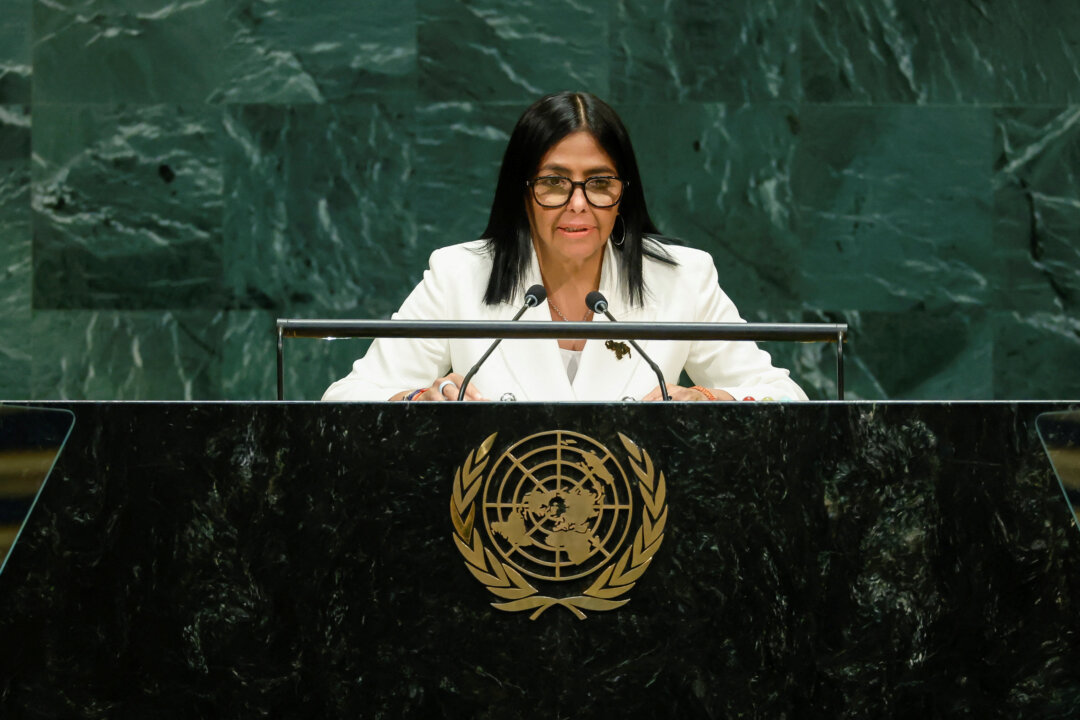
Venezuelan leader Delcy Rodríguez, who took over in January after Nicolás Maduro was ousted and detained by the United States, told the U.N. General Assembly on Wednesday that the country would transition to “a full democracy.”
“I wish to say the following loud and clear at this general assembly: in Venezuela, there will be elections,” Rodríguez said. “And in that vein, we have begun a political dialogue with sectors of the opposition which will lead to a process where everyone will compete on an equal footing.”
Rodríguez was speaking after holding her first meeting with U.S. President Donald Trump, on Tuesday night, on the sidelines of a U.N. reception.
In a statement on Telegram, Rodríguez described the meeting with Trump as historic and thanked him and his administration for providing support for Venezuela after the June 24 earthquakes, and for backing the country’s reintegration into international forums.
Rodríguez was vice president to Maduro, whose victory in a presidential election in July 2024 was widely believed to have been rigged. She is acting president of the United Socialist Party of Venezuela (PSUV).
The Trump administration did not recognize Maduro’s victory in the 2024 election and has been keen for Venezuela to hold fully democratic elections.
‘Process of Democratic Transition’
“I am delighted to announce that Venezuela has begun a process of democratic transition to ensure its rebirth,” Rodríguez told the United Nations. “This is an orderly, institutional, and verifiable process to build a country that is freer for all, more prosperous, and more at peace with itself.”
Since becoming the country’s interim leader following the Jan. 3 U.S. special forces operation that ousted Maduro, Rodríguez has improved relations between Caracas and Washington and taken measures to open up Venezuela.
Rodríguez said her government had initiated talks with the opposition, and would guarantee the participation of all political forces in elections, although she did not specify a date for a poll.
She said she was assuming a “historic responsibility.”
“That is the responsibility of taking Venezuela from uncertainty and conflict to a full democracy which is recognized by its own people and the world,” Rodríguez said.

Venezuelan Interim President Delcy Rodríguez and U.S. President Donald Trump (R) meet on the sidelines of the U.N. General Assembly in New York on Sept. 22, 2026. Venezuela Presidential Palace Handout via Reuters
She said national institutions were being prepared for the electoral process.
Venezuela’s opposition has called for the selection of an autonomous Supreme Tribunal of Justice and National Electoral Council, as part of the election process.
In December 2024, the National Electoral Council and the Supreme Tribunal of Justice—which were both closely aligned with Maduro—
declared
him the winner of the July elections, with 52 percent of the vote.
The Venezuelan opposition leader, Edmundo González Urrutia, whose supporters said he won the July 2024 election, fled to Spain in September 2024, and in January 2025, Maduro’s government offered a $100,000 reward for information leading to his arrest.
Who Might Run in Elections?
In the event of new elections in Venezuela, Rodríguez is likely to stand as a presidential candidate.
Opposition candidates may include the 77-year-old González, Nobel Peace Prize winner María Corina Machado, and possibly Juan Guaidó, although his political stock has fallen considerably since he was recognized by Trump as interim Venezuelan president in January 2019, following another disputed election.
Machado, 58, confirmed in May that she intends to stand in any upcoming election.
“It will be a process of coming together for the entire nation,” Machado said of the election. “I will be a candidate, but there may be others, of course. I would love to compete with everyone, with anyone who wants to be a candidate, of course.”
Machado left Venezuela in December 2025 to accept her Nobel Peace Prize in Oslo, and says she has since been prevented from returning to Venezuela.
When Maduro first appeared in a federal court in New York in January, he said: “I am innocent. I am not guilty. I am a decent man. I am still president of my country.”
Earlier this month, Maduro’s attorney, Barry Pollack, petitioned Judge Alvin Hellerstein of the U.S. District Court for the Southern District of New York to dismiss the drug trafficking charges he faces on the grounds that he was entitled to immunity as head of state.
Federal prosecutors have been given until Oct. 2 to respond to the motion to dismiss the indictment, and Hellerstein said he would hold a hearing on Nov. 17.
Reuters contributed to this report.


Millions of Canadians got their news from Front Page Challenge
The cast of Front Page Challenge with Gordon Sinclair, Fred Davis (standing),...
Randall Denley: Ontario’s fiscal mess isn’t just bad — it’s getting worse
On the deficit, even the Ford government’s own numbers aren’t good. Ontario’s...
Canada’s population growth continues to slow, consistent with lowered immigration targets
Canada has had its lowest year-over year population growth since World War...
‘There will be surprises’: Netanyahu departs for U.S. ahead of UN General Assembly speech
Israeli Prime Minister Benjamin Netanyahu departed for the U.N. General Assembly in...