
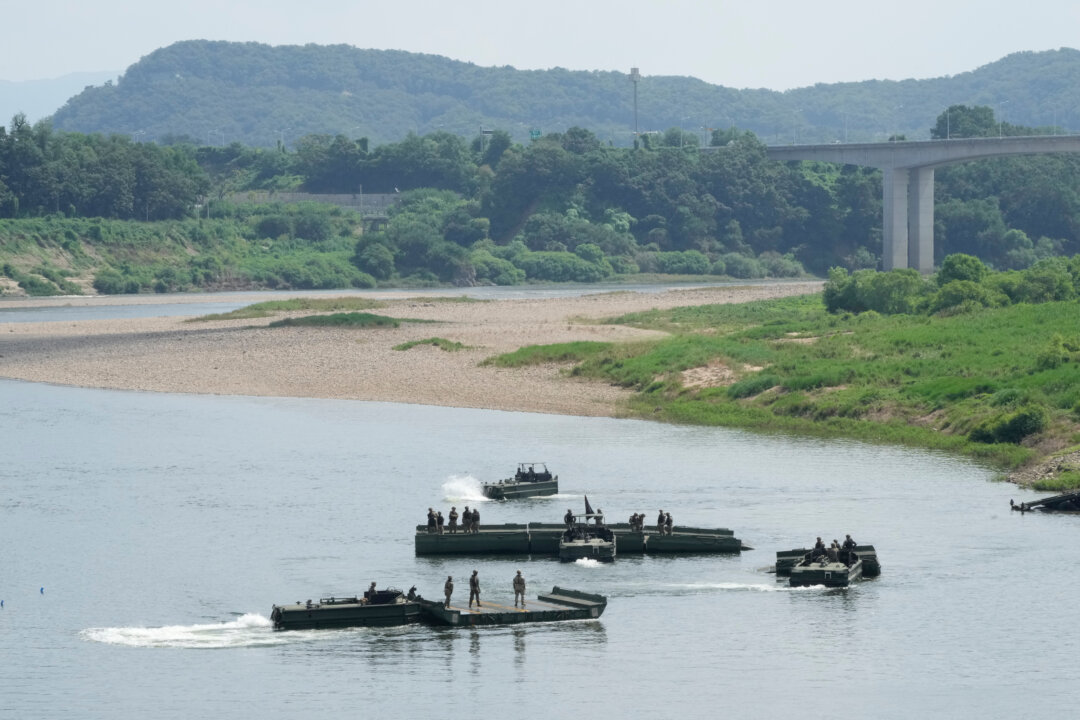
South Korea and the United States have shortened their annual Ulchi Freedom Shield (UFS) military exercise and agreed to reduce some field training after U.S. President Donald Trump directed the Pentagon to scale back joint drills with Seoul.
South Korea’s Joint Chiefs of Staff announced the changes in an Aug. 19 press release, saying they were made at the suggestion of the United States.
The exercise, which began on Aug. 17, will now run through Aug. 21 instead of continuing until Aug. 27 as originally planned.
The allies also agreed to conduct combined field maneuver training on a reduced scale while continuing consultations on the details.
The Combined Forces Command will continue operating from two wartime command centers in South Korea, CP TANGO and Camp Humphreys, while the allies work on the revised exercise plan.
“Going forward, ROK and the U.S. agreed to discuss and implement various measures to achieve the objectives of the UFS exercise and establish a combined defense posture,” the statement said.
The decision followed Trump’s Aug. 16 order directing the Pentagon to reduce joint military exercises with South Korea.
In a Truth Social post, Trump said his relationship with North Korean leader Kim Jong Un made him question the need for large-scale military exercises.
He said the exercises were not only costly, with much of the cost borne by the United States, but also sent what he described as a signal that was “totally inappropriate and hostile” toward North Korea, which he said had been “unthreatening and respectful” during his presidency.
Trump also linked the issue to broader disagreements with Seoul, saying South Korean President Lee Jae Myung had declined a U.S. request to support efforts related to the Iran conflict.
South Korean Foreign Minister Cho Hyun said on Aug. 19 that Trump’s decision appeared to serve several political purposes beyond military planning.
“I think President Trump’s message includes pressure over several pending issues concerning the South Korean government, as well as a message to North Korea and an intention by the United States to break a stalemate in the Iran war,” Cho said.
He added that Seoul had not finalized investment details of the planned $350 billion investment in the United States because officials needed to assess commercial viability and complete legal procedures.

U.S. President Donald Trump is greeted by South Korean Foreign Minister Cho Hyun upon his arrival at the airport in Gyeongju, South Korea, on Oct. 29, 2025. Andrew Caballero-Reynolds/AFP via Getty Images
South Korean Unification Minister Chung Dong-young said during the same hearing that Trump could be laying the groundwork for another summit with Kim by reducing exercises that have long been criticized by North Korea.
Point of Tension
Ulchi Freedom Shield is an annual combined exercise involving South Korea, the United States, and other allied organizations.
According to U.S. Forces Korea, the exercise is designed to strengthen the combined defense posture of the alliance through live, virtual, and field-based training across multiple military services.
The drills have long been a source of tension with North Korea.
Korean Central News Agency (KCNA), the state news agency of North Korea, published a commentary on the UFS exercises that has since been removed, saying they were pushing the Korean Peninsula “to the threshold of war.”
“These frantic exercises cover all spheres of carrying out wartime operations including the ground, sea, air, space, cyber and psychological information,” the commentary said.
It added that North Korea’s exercise of its right to self-defence would continue to completely neutralize its enemies’ military threat.

North Korean leader Kim Jong Un delivers a speech at the inauguration of the Samgwang Stockbreeding Farm in North Pyongan Province, North Korea, on Feb. 2, 2026. KCNA via KNS/AFP via Getty Images
South Korean officials stressed that the UFS exercise is not intended to heighten tensions on the Korean Peninsula.
“Above all, the most important thing is to create a peace where there is no need to fight, but to maintain that peace, we must thoroughly prepare even for the worst-case scenarios,” the South Korean president said in an Aug. 18 post on X.
He added the military should adapt the drills to reflect changes in modern warfare while maintaining strong preparedness.
Regional Security
The latest adjustment to the South Korean–U.S. military exercises comes after months of close coordination between the allies on regional security.
U.S. and South Korean officials met in Seoul on June 11 to discuss strengthening nuclear deterrence and military readiness as North Korea continued expanding its nuclear weapons program.
Senior defense officials also discussed alliance modernization, wartime operational control, and increased South Korean defense spending during a May 12 meeting at the Pentagon.

Secretary of War Pete Hegseth hosts an enhanced honor cordon and meeting welcoming South Korean Minister of National Defense Ahn Gyu-Back to the Pentagon in Arlington, Va., on May 11, 2026. Madalina Kilroy/The Epoch Times
Trump has continued to emphasize his personal relationship with Kim.
On Aug. 15, he shared a photograph from their 2019 meeting at the Demilitarized Zone and wrote, “Despite the unfriendly look on this particular picture, there are many where we’re smiling, Kim Jong Un and I get along Great!”
Kim met Trump in 2018 and 2019 during Trump’s first term, but negotiations over North Korea’s nuclear program later stalled.
Kim has also suggested that relations with Washington could improve if the United States changes what Pyongyang considers a hostile policy, although he has said North Korea will continue preparing for confrontation if that approach remains unchanged.
Reuters contributed to this report.