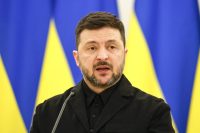

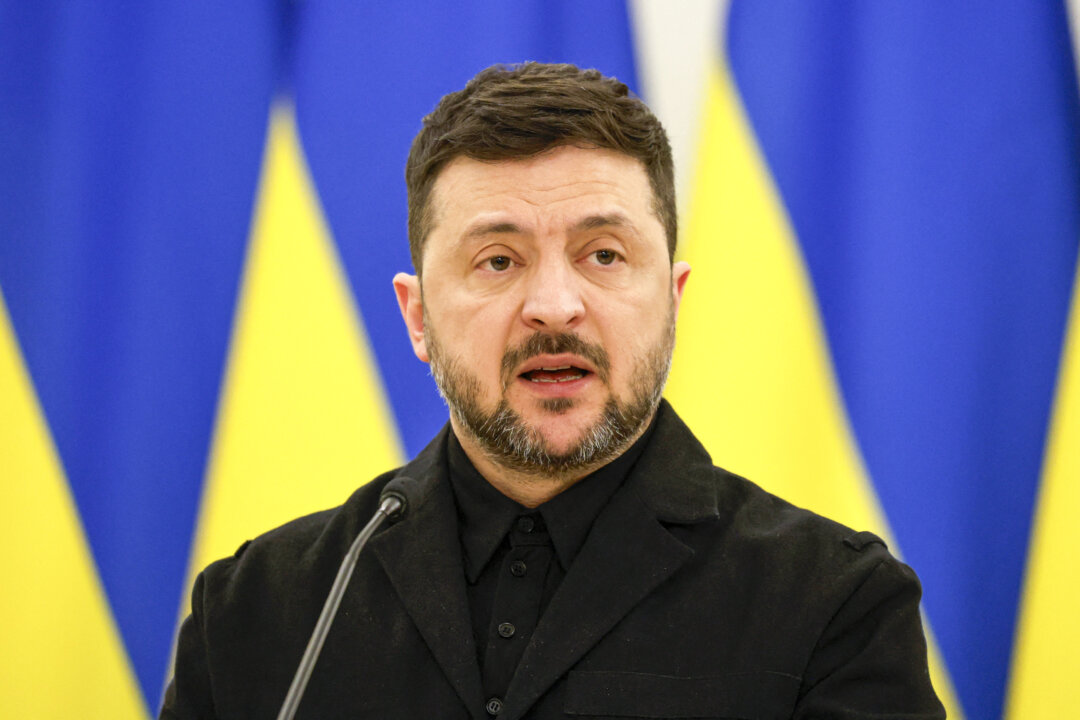

Ukrainian President Volodymyr Zelenskyy speaks during a joint press conference with Lithuania’s president and Poland’s president, after attending commemorations of the 1863 uprising, in Vilnius, Lithuania, on Jan. 25, 2026. Petras Malukas/AFP via Getty Images
Senior officials in Ukrainian President Volodymyr Zelenskyy’s office are under investigation, Ukraine’s leading anti-corruption offices announced on Aug. 19.
In a press statement, the National Anti-Corruption Bureau of Ukraine and the Specialized Anti-Corruption Prosecutor’s Office said they have begun “a special operation to expose a criminal organization that operated under the leadership of current and former people’s deputies of Ukraine, with the participation of high-ranking officials of the Office of the President of Ukraine and other persons.”
The anti-corruption officials provided few details about the nature of the investigation but said they would share more later.
Zelenskyy did not immediately offer a statement addressing the investigation, but dismissed Iryna Mudra from her role as deputy head of the Office of the President on Wednesday.
Corruption allegations have plagued Zelenskyy’s government in recent months.
Ukrainian Justice Minister Herman Halushchenko and Energy Minister Svitlana Grynchuk resigned from their posts in November, amid a mounting corruption probe. In February, Ukrainian border guards detained Halushchenko on a train out of the country, and authorities subsequently charged him in the corruption case.
In May, Ukrainian authorities also brought corruption charges against the Ukrainian president’s former chief of staff, Andriy Yermak.
Authorities announced this latest anti-corruption investigation a day after former Ukrainian Defense Minister Mykhailo Fedorov raised calls for Ukraine to hold a wartime election.
Ukraine has been under a state of martial law since Russian forces rolled into the country in February 2022. The Ukrainian constitution pauses regular elections during a martial law period.
“Democracy cannot be held hostage by Russia,” Fedorov said in a YouTube video published on Aug. 18. “Therefore, we must find a legal, safe, and realistic mechanism that will allow Ukraine to restore a full democratic process even amidst a prolonged war.”
Beyond his appeal to democratic principles, Fedorov said new elections would also provide a measure of government accountability and a check against corruption.
“We must also talk about corruption. Not because it is a buzzword, but because during wartime, corruption takes on an entirely different meaning,” Fedorov said.
Fedorov said that, in peacetime, corruption can lead to faulty roads and hospitals. In wartime, he said, corruption can lead to a failure to deliver military systems critical to a country’s defenses.
“Corruption in wartime is not merely a financial issue. It is a matter of our capability to survive and win,” he said.
Fedorov supported Zelenskyy’s 2019 presidential campaign and went on to hold multiple different offices in the Zelenskyy administration. He served as Ukraine’s minister of defense from January until his abrupt dismissal in July.
Zelenskyy’s decision to oust Fedorov fueled rare wartime protests throughout the country.
The Ukrainian president had faced similar public backlash in 2025, after he moved to curb the powers of Ukraine’s anti-corruption offices. Zelenskyy later reversed course.