
The number of Americans submitting applications for unemployment benefits unexpectedly declined last week for the first time in a month, indicating ongoing labor market stability, according to new government data.
Initial jobless claims fell by 6,000 to 206,000 for the week ending August 15, the Department of Labor said in an Aug. 20 statement. The previous week’s reading was revised upward to 212,000. Economists had penciled in a reading of 210,000.
Despite spikes this year due to seasonal factors—extreme weather and summer school vacations, for example—the number of people claiming jobless benefits remains in the historically low range of 189,000 to 230,000. Initial claims for state jobless benefits dropped last month to the lowest level since September 1969.
“Today’s US jobless claims reinforce ongoing labor market resilience,” economist Mohamed El-Erian said in a post on X after the claims data was published.
The four-week average, which strips out week-to-week volatility, edged up to 204,000 from close to 200,000.
Although their two-day meeting took place before the disappointing July jobs report, Federal Reserve officials expressed optimism that employment conditions would be stable in the near term.
“Participants generally expected labor market conditions to remain stable in the near term, with the unemployment rate staying close to current levels,” minutes from the July Federal Open Market Committee meeting stated. “Some participants viewed that the signs of modest strengthening in labor market conditions boded well for the outlook.”
The unemployment rate fell last month to 4.1 percent, suggesting economic resilience despite higher energy costs. The low jobless rate also reflects shrinking labor force participation—the lowest level since the 1970s (excluding the COVID-19 pandemic years)—driven by the administration’s immigration policy reforms and Baby Boomer retirements.
With robust activity in the broader economy, central bank officials will likely remain focused on the inflation side of the dual mandate to guide policy decisions.
While the minutes indicated the Fed could raise interest rates if inflation remained elevated, investors largely expect policymakers to leave rates unchanged at next month’s meeting.
Continuing jobless claims ticked up but are still below 1.8 million.
Recurring claims—a measure of the number of individuals currently receiving unemployment benefits—rose by 1,800 to a higher-than-expected 1.8 million.
Economists use this as a proxy for challenges workers may have in finding new jobs. It could also highlight how out-of-work people exhaust their benefits, since many states cap eligibility at 26 weeks.
‘Growth Cycle Remains Intact’
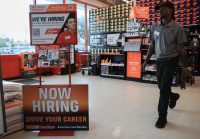
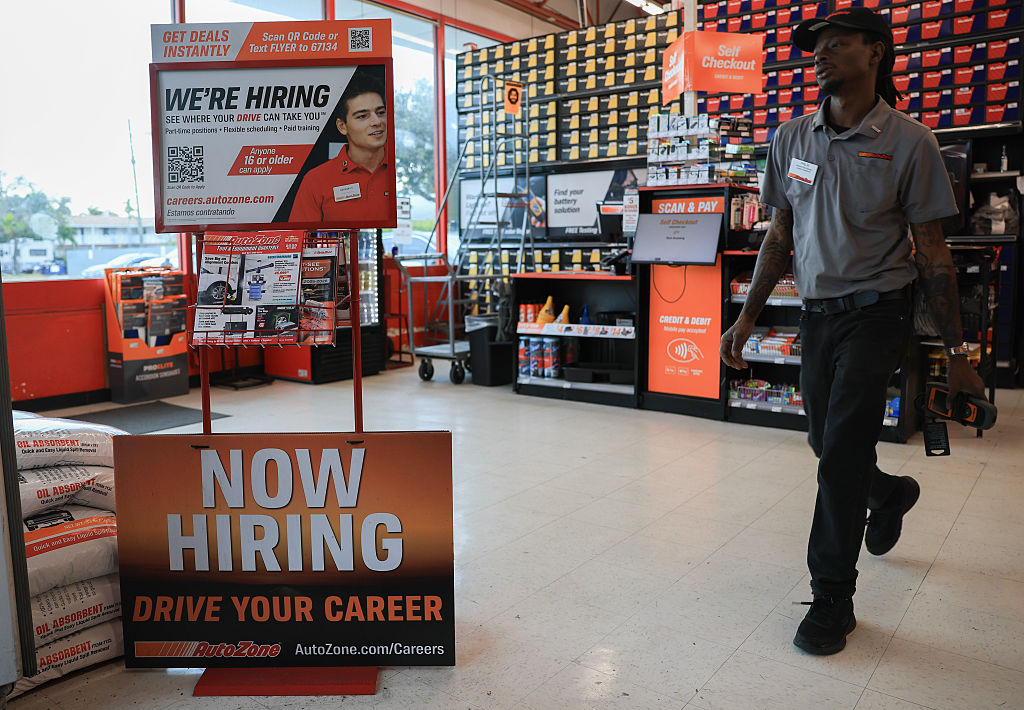
Various indicators over the past month suggest employers are on the hunt for workers. Job vacancies exceed 7 million, and small-business hiring plans are at a four-year high.
The challenge, according to the National Federation of Independent Business, is that companies are struggling to find workers to fill these vacant positions.
“Several business indicators improved last month, including hiring intentions and capital spending plans, suggesting the growth cycle remains intact,” Jeffrey Roach, chief economist at LPL Financial, said in an emailed note to The Epoch Times.
“Labor market conditions could tighten further, as the lack of qualified workers remains the single most important problem facing businesses.”

A job seeker fills out an application during the HIRE360 Diversity Hiring Expo in Inglewood, Calif., on April 28, 2026. Justin Sullivan/Getty Images
Other measurements indicate hiring has slowed this summer.
Private employers added an average of 9,500 jobs per week in the four weeks ending August 1, according to payroll processor ADP.
The worse-than-expected July jobs report showed that private businesses created 30,000 jobs. Employment losses were led by leisure and hospitality, retail, and financial services.
Payroll expansion has been modest. While this year’s average of 61,000 jobs per month is so far better than 2025’s, it is firmly below the job creation observed in 2023 and 2024.
Hiring momentum could be picking up heading into the fall. Job postings on Indeed have edged higher from their recent low.