

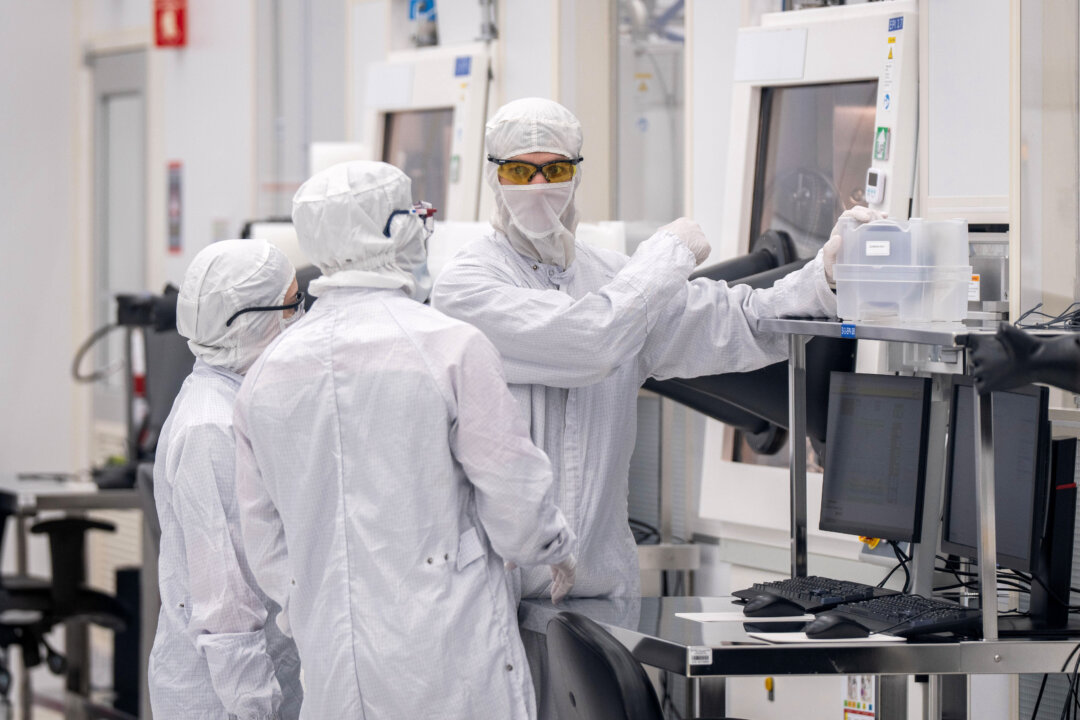

Employees converse in a clean room at a Coherent manufacturing facility where lasers are developed for transmitting data among chips, in Sherman, Texas, on June 16, 2026. AP Photo/Jeffrey McWhorter
Jane Street-backed AI chip startup Etched stated on Aug. 18 that it more than doubled its valuation in less than a month to $21 billion after raising $700 million.
The Series D funding round was led by Jane Street and included Sequoia Capital, Andreessen Horowitz, Kleiner Perkins, Blackstone, Peter Thiel, and others. Etched was valued at $10.3 billion in July after its Series C.
Founded in 2022 and with a team of more than 400 engineers, the company co-designs inference chips that help AI models run more quickly and efficiently.
In its press release, it said it’s focused on using its more efficient inference to scale frontier models. It said less than 1 percent of the world has access to these models currently.
The San Jose-based company said it shipped its first rack of chips to trading firm Jane Street, which is using the chips to support its workload.
“We tested the chip and are pleased with the early results. Etched’s unique approach to inference delivers the precision we will need to support our most demanding workloads. We’re excited to now have our own rack running in our datacenter,” Jane Street said in a statement to Etched.
Related Story

Etched CEO and co-founder Gavin Uberti said on LinkedIn that the company’s first-gen product is deterministic in that every one of the one billion-plus tokens that were run through it as a final test matched exactly.
“The round is cool and all, but I’m so excited our first customer loved their rack. Building Etched has had ups and downs—and hearing Jane Street’s positive feedback has been the happiest I’ve been in years,” he said.
Uberti also highlighted the time the company had spent on reliability, firmware, system software, and providing a better customer experience.
The company said it has secured more than $1 billion in customer contracts across AI companies and cloud providers.
Some industry leaders have publicly shifted their focus to the efficiency and cost-reduction of AI, as opposed to training the most powerful models.
One of these is Palo Alto Networks CEO
, who last month said AI tokens need to become 10 times more efficient.
“We need to see the pricing for AI come down. I think the pricing today even makes it very hard for enterprises to take the bet,” he said in a July 9 interview with CNBC. “The conversation will shift over the next six to 12 months on—not how smart the model is [or] how intelligent the model is—[but] how quickly can we deploy the models.”
Reuters contributed to this report.