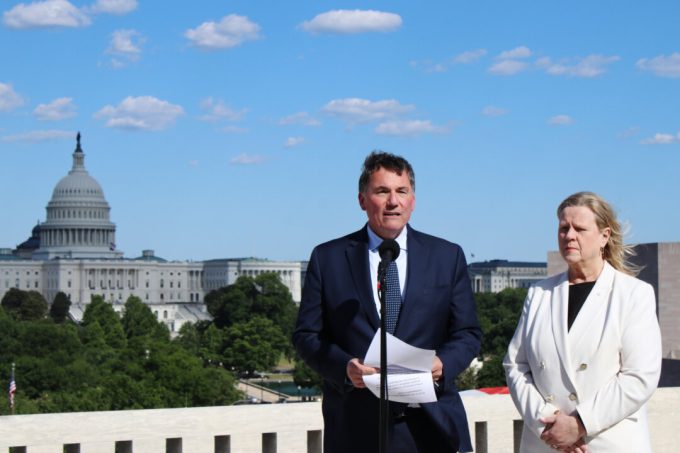

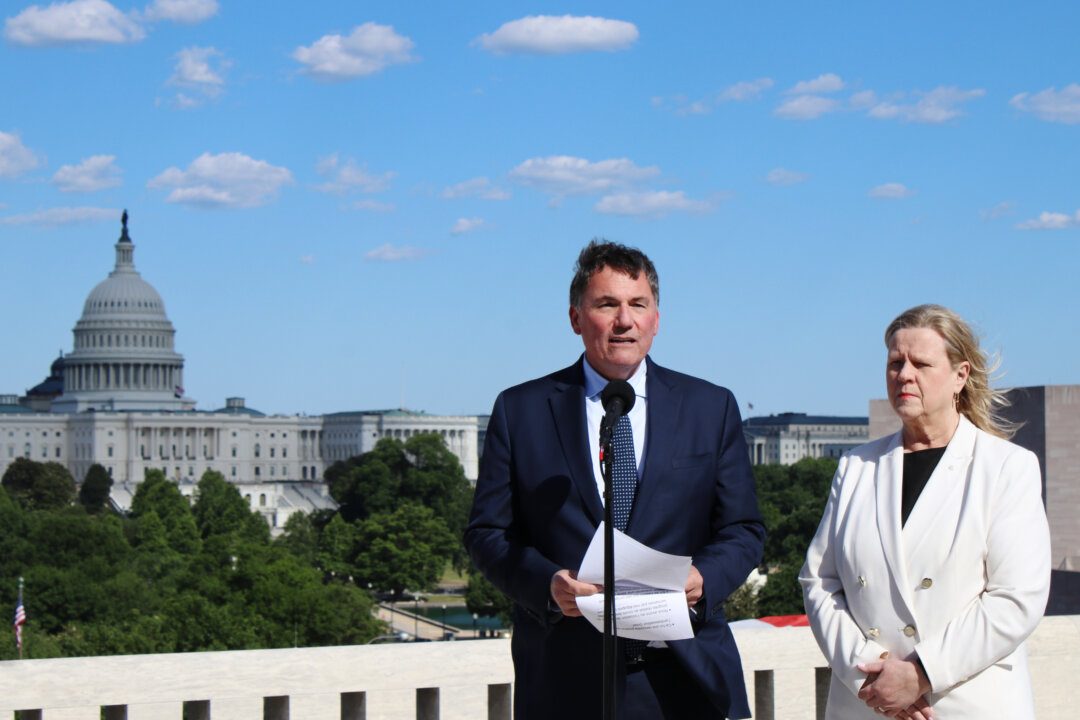

Canada-U.S. Trade Minister Dominic LeBlanc and Chief Trade Negotiator Janice Charette speak during a press conference on the roof of the Canadian Embassy in Washington, D.C., on June 2, 2026. The Canadian Press/Kelly Geraldine Malone
Canada-U.S. Trade Minister Dominic LeBlanc is returning to Washington for further trade talks, as the new Aug. 22 deadline for 50 percent U.S. tariffs approaches.
LeBlanc and Canada’s chief negotiator Janice Charette will meet with U.S. Trade Representative Jamieson Greer on Aug. 20 to work out the final details of a trade agreement.
U.S. President Donald Trump announced late on Aug. 18, just hours before the planned 50 percent tariffs on Canadian goods were to take effect, that he was delaying them for three days, saying the pause was based on his belief that Canada and the United States had reached a deal, pending the finalization of the documents.
Speaking to reporters outside Parliament on Aug. 19, LeBlanc described Prime Minister Mark Carney’s meeting with the premiers the previous day to discuss the trade negotiations as “constructive and, frankly, a very important conversation.”
He said Charette joined the meeting virtually from the Canadian embassy in Washington, because she was “finalizing the important work that we need to do over the next little while.”
Details have not been released about what Ottawa and Washington have agreed to as part of the deal. U.S. President Donald Trump told reporters on Aug. 19 that Canadian tariffs on U.S. farmers were going to be “totally eviscerated, down to zero,” and that American farmers and manufacturers in particular were going to be “thrilled” with the deal.
When asked by a reporter whether the current U.S. tariffs on Canadian goods would be lowered, Trump said, “we’re reducing it a little bit.” Later that day, he said the United States could bring some tariffs on Canadian steel and aluminum “down to a level where other countries are,” noting that Canada had been paying a higher tariff.
Carney said on social media on Aug. 19 that Canada
entered into
negotiations with the “best overall” trade terms with the United States of any country. He said the two countries were now moving towards an agreement that “reinforces that Canadian advantage,” including by securing favourable terms in key strategic sectors and providing greater certainty for the country’s future trading relationship.
Carney has not spoken to the media since Trump announced the pause on tariffs.
Following an Aug. 19 meeting between Ottawa and the provinces, both Saskatchewan Premier Scott Moe and Nova Scotia Premier Tim Houston said Carney had asked the provinces to put U.S. alcohol back on store shelves as part of a deal.
On Aug. 20, Newfoundland Premier Tony Wakeham said all the
premiers had
“agreed” to Carney’s “good faith” request for them to return U.S. alcohol to shelves.
Many provinces and territories had taken U.S. alcohol off the shelves in 2025 in response to initial U.S. tariffs, which Washington had cited as a trade irritant. Alberta and Saskatchewan resumed accepting new U.S. alcohol shipments back June 2025.
Washington has also cited Canada’s supply-managed dairy tariff-rate quota system as a trade irritant.
LeBlanc told reporters on Aug. 19 that Ottawa wanted to protect Canada’s supply management system in the final agreement and ensure it remains “entirely intact,” and that he is “confident” the trade agreement with the United States accomplishes this.
Canada’s reciprocal automotive tariffs have also been cited as a trade irritant by the United States. While Canada lifted most of its retaliatory tariffs on the United States in September 2025, it retained counter-tariffs on certain U.S. goods—including on automobiles—in response to Washington’s sectoral tariffs on automobiles, steel, and aluminum.
U.S. Trade Representative Greer had
said
on Aug. 14 that Canada needed to end its retaliatory measures in order to avoid additional 50 percent tariffs, and said Ottawa’s retaliatory tariffs were “the kind of things that China would do.”
Foreign Affairs Minister Anita Anand will also meet with U.S. Secretary of State Marco Rubio on Aug. 20 to discuss “continental security and other global priorities.”