
Illegal immigrants deported from the United States to Liberia will mostly come from Latin American countries, including Cuba and Venezuela, the West African country’s information minister said, as authorities received the first deportation flight on Thursday.
The Liberian government
on Tuesday that it had agreed to accept up to 1,200 third-country deportees from the United States over the next year in the latest of numerous deals President Donald Trump has implemented on the African continent to speed up removals.
Its statement said the deportees would come from “African and Western Hemisphere countries,” but gave no further details, while the U.S. State Department does not routinely provide details on the nationalities of deportees.
Liberia’s information minister, Jerolinmek Piah, said that “most of the people are from Latin American countries. Some from Venezuela, Cuba, Colombia, and others.”
Piah said the International Organization for Migration and the U.N. refugee agency would help provide services for the deportees, as has happened elsewhere in Africa.
Among Largest African Deals
Liberia’s agreement to accept up to 1,200 people makes it one of the largest deals that the Trump administration is known to have struck over third-country deportations to the African continent.
Washington has also made agreements with the African nations of Cameroon, Congo, Central African Republic, Equatorial Guinea, Ghana, and Sierra Leone.
Third-country deportees are those who cannot be sent back to their countries of birth, usually because they have obtained legal protection against repatriation after U.S. immigration judges ruled they were at risk in their home countries.
Rights groups and advocates have criticized third-country deportations, saying that many of the deportees were ultimately repatriated.
They have also raised concerns about deportees being sent to countries they had no connection to, and in some cases, had not heard of.
Liberia’s government said that the deportees would be received “as guests,” free to leave when they wanted and who could apply for asylum in the West African country.
None of the deportees were involved in any active criminal proceedings, the statement said.
The first flight set off from Louisiana and arrived in the capital of Monrovia at around lunchtime Thursday, stopping in Dakar, Senegal, according to the ICE Flight Monitor managed by Human Rights First.
Liberia described the deportation deal as being consistent with its history as a refuge for enslaved people and as a nation with “a long history of accepting people seeking refuge from political and other crises.”

Venezuelans deported from the United States arrive at Simon Bolivar International Airport in Maiquetia, Venezuela, on Jan. 16, 2026. Federico Parra/AFP via Getty Images
$5 Million Award
The Liberian government is not demanding compensation for taking in deportees, its statement said, but it said it would receive “support to help manage the programme and strengthen its migration system more broadly.”
Washington this year gave $5 million to Liberia for “migration management activities.”
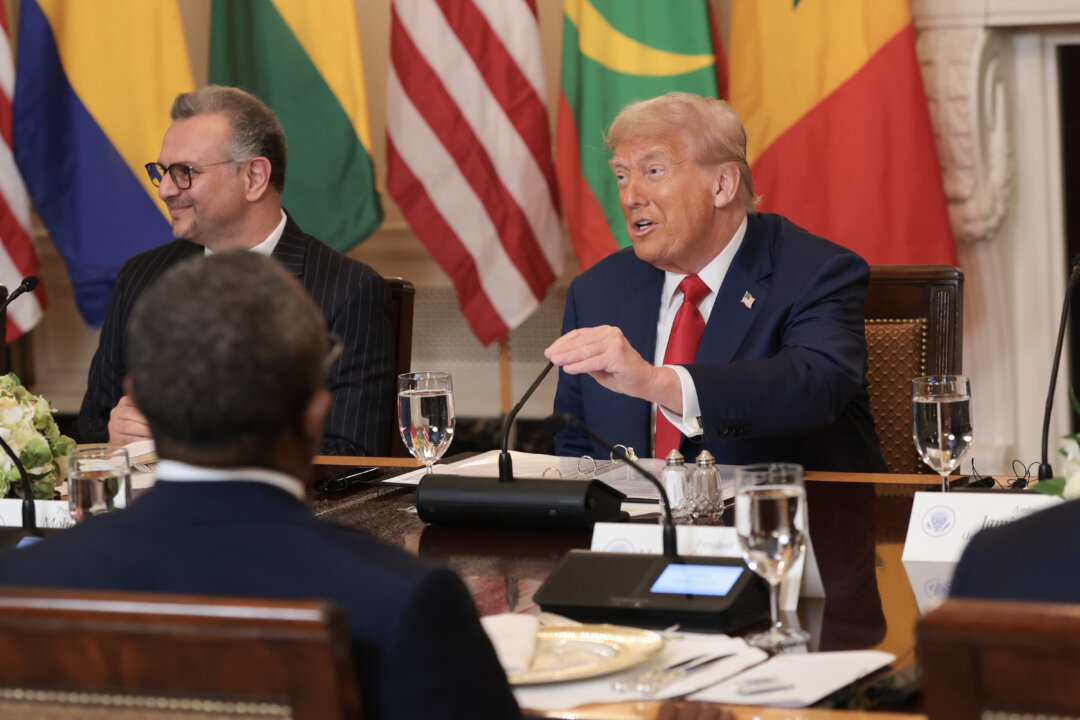
Liberian President Joseph Boakai was one of five West African leaders who met with Trump at the White House in July 2025, when the U.S. president emphasized a shift in relations from aid to trade, following the disbandment of the U.S. Agency for International Development.
Since his return to office, Trump has been pressing to speed up deportations, including by sending illegal immigrants to third countries when there are problems or delays in sending them to their home nations.

Kilmar Abrego Garcia (C) and his wife, Jennifer Vasquez Sura (L), arrive at the federal courthouse on Feb. 26, 2026, in Nashville, Tenn. George Walker IV/AP Photo
Abrego Garcia Liberia Injunction
In October 2025, Liberia said it was willing to accept
, the illegal immigrant whose wrongful deportation to El Salvador became a flashpoint in the debate over the Trump administration’s crackdown against illegal immigration.
Abrego Garcia
entered the United States in 2011, settling in Maryland where he had a family. He was accused of being a member of a foreign terrorist organization, the MS-13 gang, and was deported to El Salvador in March 2025.
The Salvadoran national was subsequently returned to the United States in June 2025 under a Supreme Court order after the Department of Justice (DOJ) acknowledged an administrative error in his deportation.
A 2019 immigration court order issued a withholding of removal—legally barring his deportation—because of concerns for his safety in his home country.
Abrego Garcia, who denies he was a member of MS-13, later faced charges of immigrant smuggling stemming from a 2022 traffic stop, to which he pleaded not guilty.
A judge dismissed the human smuggling charges in May, with the DOJ appealing the dismissal in June.
Abrego Garcia has obtained an injunction preventing his third-country removal to Liberia from the federal district court in Maryland, his lawyer, Simon Sandoval-Moshenberg, said on Thursday.
In October, the attorney described the decision to try to deport his client to Liberia as “punitive, cruel, and unconstitutional,” adding that he has no connection to the West African country.
As part of its crackdown against illegal immigration, the Trump administration has used a series of agreements to deport more than 23,000 people to 26 different countries they were not born in, according to Third Country Deportation Watch.
The majority of deportees—some 19,000—have been sent to
, according to the group, meaning that about 4,000 have been scattered across another 25 countries.
Across the
as well as Latin America and Africa, several governments have entered into agreements with the United States to house some deportees.
In June, Jamaica signed a memorandum of understanding with the Department of Homeland Security to accept up to 25 third-country deportees from the United States every two weeks.
Reuters and Aldgra Fredly contributed to this report.