
Business activity kicked into high gear this month, accelerating at its fastest pace in more than four years, S&P Global said on August 21.
August’s S&P Global Composite Purchasing Managers’ Index—a monthly survey that combines factory output and services business activity—rose to 56, from 54.5 in July.
This exceeded expectations and marked the strongest expansion since April 2022.
“US business is booming,” Chris Williamson, chief business economist at S&P Global Market Intelligence, said in a statement attached to the report.
But while manufacturing output continued to expand, momentum shifted to the services sector, which registered its strongest activity since December 2024.
The services industry’s spike reflected softer price pressures, higher staffing levels, new orders, expanded backlogs, and higher confidence.
“As reduced safety stock building and supply delays dampen factory production growth, the service sector is now playing a key role in driving a sustained US expansion, underscoring a dependency on consumer spending and financial services growth,” Williamson said.
August’s manufacturing posted its weakest growth since March, as the effects of the five-month-old war in Iran and global tariffs began to weigh on the industry.
U.S. firms witnessed higher energy-driven input costs, raw material shortages, and reduced inventory accumulation. Additionally, new orders slowed, input purchases declined for the first time since February, and supply times lengthened. But business optimism strengthened, and employment rose to a three-month high.
Overall, the data points to third-quarter annualized growth of about 3 percent, double the pace of the April–June period.
The Atlanta Fed’s widely watched GDPNow Model estimate projects 4 percent economic growth in the July-September span, fueled by consumer spending, business investment, and changes in private inventories.
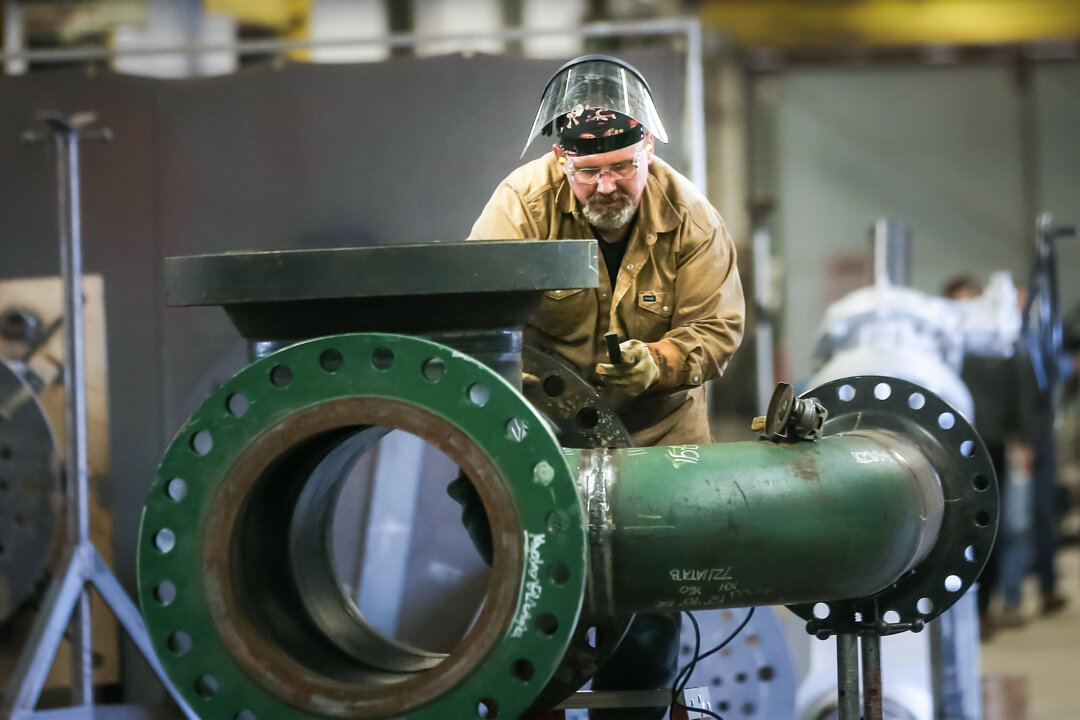
Manufacturing represents about 10 percent of the U.S. economy, down from 13 percent in 2006.
Manufacturing ‘Rebound Is Real’
Regional manufacturing activity was solid this month.
The Philadelphia Fed Manufacturing Index advanced to its highest level since April 2021, as 57 percent of surveyed firms reported stronger activity. The regional central bank’s future general activity index also climbed to its best level in more than 40 years.
The New York Fed’s Empire State Manufacturing Index, meanwhile, advanced at its fastest pace since late 2021 and surpassed market forecasts.
Hiring in the manufacturing sector has also been garnering momentum this year. Manufacturing payrolls have been steadily edging higher after last year’s sharp decline.
An increasing concern is that as more reshoring occurs, companies will struggle to fill job vacancies due to a talent shortage.
Geopolitical tensions are fueling growth in the energy sector amid higher costs. But the data also point to growth across various areas, including transportation equipment, machinery, computers and electronics, and fabricated and primary metals. Some of these industries are feeling the effects of the artificial intelligence (AI) boom.
Despite concerns about manufacturing growth being narrower than the headline figures indicate, the “rebound is real,” says Andrew Foran, an economist at TD Economics.
“After adjusting for price effects, the improvement is concentrated in transportation equipment, defense-related production, and technology supply chains tied to AI infrastructure, rather than a broad-based revival across the sector,” Foran said in an Aug. 13 research note.
“These catalysts should keep manufacturing activity on a firmer footing over the near term.”
Higher energy prices, tariff-driven input-cost pressures, and tighter financial conditions could pose headwinds to the latest factory-activity boom, he adds.
“As a result, manufacturing should remain a modest contributor to growth, but the evidence does not yet point to a self-sustaining or economy-wide industrial resurgence,” Foran said.
AI, industry experts say, will be a key contributor to the U.S. manufacturing resurgence.
An Aug. 20 report—titled “AI-Enabled Reshoring: Why America’s Manufacturing Return Requires an Intelligent Operating System”—found that 88 percent of manufacturing executives believe reshoring will depend on AI-fueled automation, analytics, or digital operations.
“The old model relied on wage arbitrage. The new model will rely on intelligence arbitrage,” Vasyl Harasymiv, founder of Applied Artificial Intelligence LLC, said in a news release. “AI is the productivity layer that enables reshored factories to compete.”