
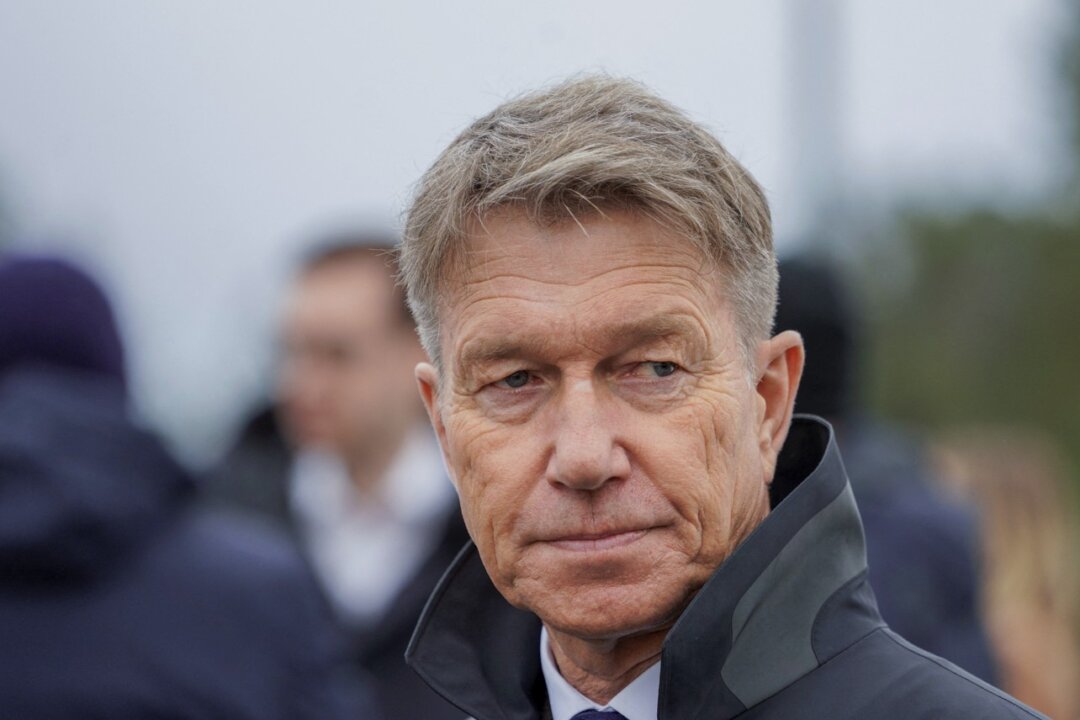
Norway will ignore the European Union’s demands for a moratorium on hydrocarbon exploration in the Arctic Circle and continue drilling for oil and gas in the Barents Sea, the country’s energy minister said.
Speaking before Norway’s biannual energy conference, which began in Stavanger on Aug. 24, Norwegian Energy Minister Terje Aasland said Oslo had a right to develop its own sovereign resources.
“In today’s geopolitical and security environment, and given the resource situation, I believe continued activity in the Barents Sea serves both Norwegian and European interests,” Aasland said.
The Barents Sea is a portion of the Arctic Ocean—named after 16th-century Dutch navigator and cartographer Willem Barents—between the north coast of Norway and Russia and the Norwegian-owned Svalbard archipelago.
Norway has been active in the Barents Sea since 1961, and there are two fields—Snøhvit, which produces gas, and Goliat, which produces oil—with more explorations planned.
The EU has a policy of opposing hydrocarbon exploration in the Arctic, which was emphasized in October 2021 with the publication of a joint communication.
In it, the EU admitted the bloc imported Arctic oil and gas, but said it wanted to end this situation.
“The [European] Commission shall work with partners towards a multilateral legal obligation not to allow any further hydrocarbon reserve development in the Arctic or contiguous regions, nor to purchase such hydrocarbons if they were to be produced,” the joint communication stated.
EU Phasing Out Russian Imports
But four months after that document was published, Russia invaded Ukraine, and the EU has announced plans to phase out oil and gas imports from Moscow altogether by late 2027.
Norway is now Europe’s largest supplier of natural gas, meeting around 30 percent of demand in the EU and Britain, which left the bloc in January 2020.

Offshore oil and gas platform supply vessels are docked at a pier in Stavanger, Norway, on Aug. 10, 2021. Nerijus Adomaitis/Reuters
Norway’s gas production was near record levels in 2025, while its oil output was back up to its highest level since 2009.
But the Norwegian Offshore Directorate said in January that production will fall from 2030 onward, unless new hydrocarbon fields in the Arctic are developed and exploited.
“If Norway is to remain a long-term supplier of oil and gas to Europe … the Arctic must be part of that discussion,” he said.
Aasland said the Barents Sea was vital if Norway was to maintain petroleum production and exports at current levels until 2035.
The EU has set carbon emissions targets for auto manufacturers to meet by 2035, in an effort to accelerate the phasing out of petrol and diesel vehicles and replace them with electric vehicles (EVs).
But the EU and Britain will both have significant demand for oil and gas up to and beyond 2035.
Aasland said oil from the Arctic will end up on the global market regardless of the EU’s position.
He also pointed out Norwegian gas can be turned into liquefied natural gas (LNG)—and exported worldwide—at a new plant near the town of Hammerfest in the far north of Norway.
Norway also produces a surplus of renewable energy from a series of hydroelectric plants and exports much of it to the EU via Sweden.
No Longer Europe’s ‘Green Battery’
But Aasland said Norway no longer saw itself as Europe’s “green battery.”
“It was a flawed idea,” he said.
The Arctic, and its deposits of minerals and hydrocarbons, has become a focus of global attention in the past two years, with President Donald Trump openly stating that he wanted the United States to control Greenland—which is part of the kingdom of Denmark—for national security reasons.
On Aug. 20, Norway said it was beefing up its forces in the Arctic, with an artillery battalion, an anti-aircraft battery, and a joint company.
“Russia’s illegal war of aggression against Ukraine and the worsening security situation underline the need to build up the Finnmark Brigade as quickly as possible,” the Norwegian Armed Forces stated, according to a translation.
Reuters contributed to this report.