
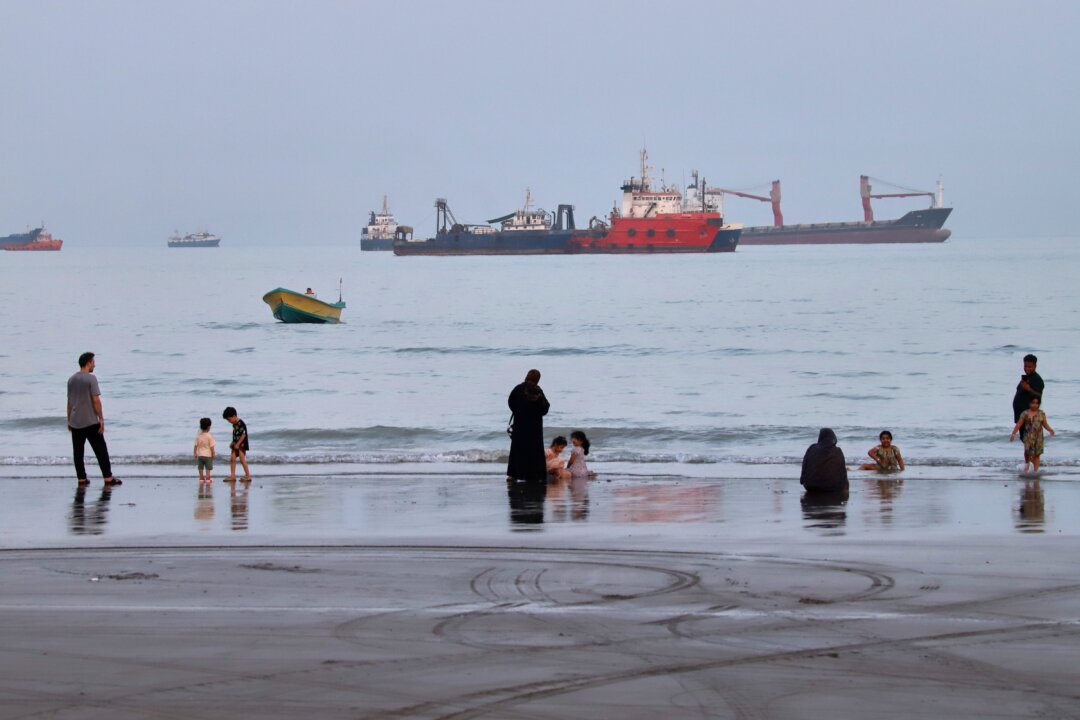
Iran and Oman have proposed jointly establishing a “temporary navigational corridor” through the Strait of Hormuz.
Iranian Foreign Minister Abbas Araghchi met with Omani Foreign Minister Badr Albusaidi in Tehran on Aug. 25 to discuss the navigation and management of the key waterway. The meeting came after Iranian Foreign Ministry spokesman Esmail Baghaei said this past week that Iran and Oman had reached an understanding on a navigation map and were finalizing a broader deal.
“The proposed framework includes the establishment of a joint temporary navigational corridor through the Strait of Hormuz and an agreement to implement a joint project to clear the Strait of mines,” the two countries said in a joint statement on Aug. 25.
The proposal came shortly after President Donald Trump said the U.S. Navy had informed him that all of the mines in the Strait’s international waters had either been removed or detonated.
Tuesday’s joint statement noted that technical negotiations between Iran and Oman regarding a permanent navigational corridor and the future administration of the Strait of Hormuz would continue. They will also address traffic management, information-sharing, and the provision of security and navigational services, according to the statement.
“Iran’s commitment to peace and stability is matched by steadfast diplomacy with our neighbors. In talks with Pakistani and Omani guests, regional solutions were stressed,” Araghchi said in a statement on social media following the announcement. “Proposed framework for new corridor, joint mine-clearing, and future management of Hormuz is [a] case in point.”
Albusaidi described Tuesday’s discussions in Tehran as “constructive dialogue” and expressed hope that the two countries would soon announce “practical arrangements” for safe navigation.
“Future management of the Strait and a permanent solution will follow in due course, as per article 5 of the Islamabad Memorandum,” Albusaidi wrote in a post on X. “Discussions with regional partners will be conducted in support of peace and cooperation, stability and freedom of navigation.”
In a Truth Social statement on Aug. 25, Trump said the United States was enforcing a “Zero Tolerance” policy on mine placement in the Strait of Hormuz, warning that any ship placing new mines would be immediately destroyed. The president also warned that the Space Force was watching “every square inch” of the Strait, the Pickaxe Mountain nuclear site, and three other Iranian nuclear sites that were hit by U.S. military strikes in June 2025.
Trump previously threatened that the United States would bomb Oman if the Middle Eastern nation interfered with the U.S. military’s naval blockade of Iranian ports. U.S. forces have redirected 71 ships, disabled three commercial vessels, and boarded two ships since the blockade was reinstated on July 14.
“If Oman gets in the way, we’ll bomb … them,” Trump told Fox News on Aug. 17.
The memorandum of understanding between the United States and Iran, signed on June 17, outlined a plan for the United States to remove its naval blockade of Iranian ports and for Iran to make arrangements for the safe passage of commercial vessels in the Strait of Hormuz.
Under the fifth provision of the memorandum, Iran agreed to hold discussions with Oman and “define the future administration and maritime services” in the strait.
The memorandum of understanding ultimately collapsed in early July after Iran carried out multiple attacks against commercial ships in the Strait. The United States and Iran repeatedly exchanged military strikes last month before Trump paused additional strikes to create space for negotiations.
After weeks of stalled negotiations, Trump said on Aug. 18 that there were no ongoing peace talks or any scheduled with Iran. He also announced that the U.S. naval blockade remained in full force and that the Strait was open and operational following the removal of mines.
Earlier this month, Araghchi indicated that Iran and Oman had entered the “final stages” of an agreement to establish a new maritime route in the Strait of Hormuz. However, Iran’s foreign minister warned that the waterway would not be reopened until the United States agreed to Tehran’s demands.
These included the United States ending the war, removing the naval blockade, lifting sanctions on Tehran, releasing blocked Iranian assets, paying damages caused by the war, withdrawing military troops, and avoiding future threats against Iran.