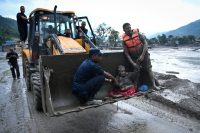

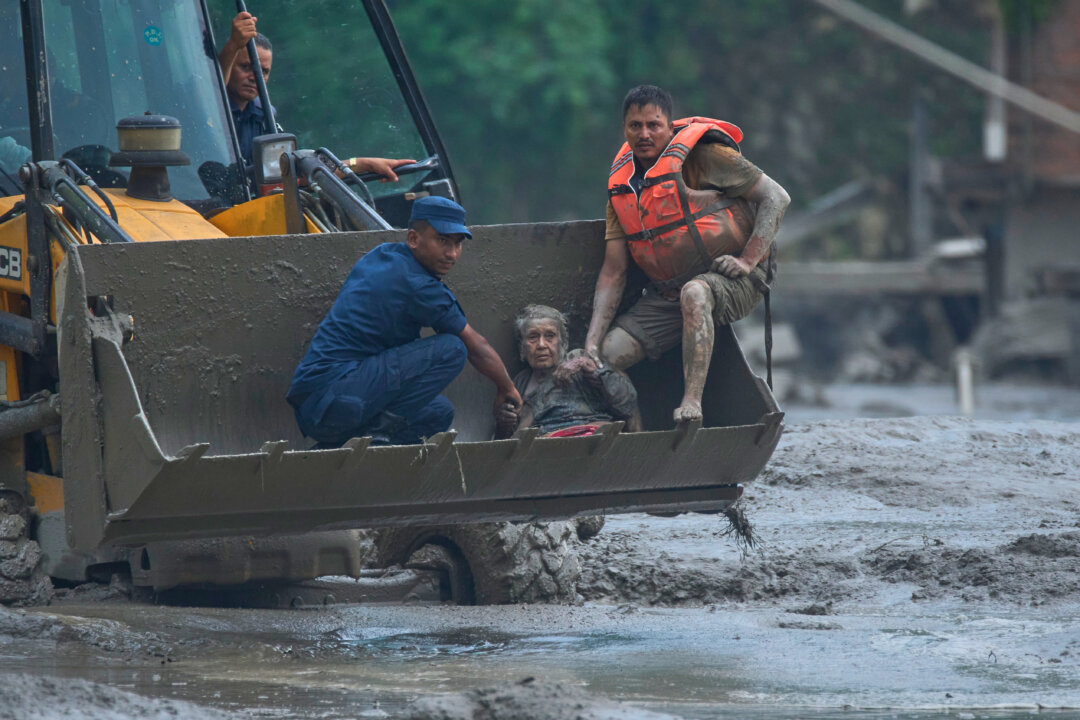

Rescuers use an earthmover to carry a victim of flash flooding to safety along the Trishuli River in Nepal’s Nuwakot district, Aug. 26, 2026. AP Photo/Niranjan Shrestha
Twenty-four Canadians are among the hundreds of missing people presumed dead in the Himalayan border area of Nepal and China after massive flash floods hit the region on Aug. 26.
Officials say at least 160 people are dead and more than 400 tourists, workers, and others—including 341 foreign nationals—are missing in the wake of the mudslide in the Tibet region’s Gyirong County. Officials also confirmed two dozen Canadians are missing.
“It was a huge gush of mud coming straight towards us. As it got closer, it kept rising higher and higher,” 68-year-old Keshav Prasad Baral told reporters while being treated at a small hospital. “I tried to grab my wife’s hand…but she was swept away by the mud. Four or five hours later, a helicopter came to rescue me. My wife is still somewhere beneath the mud. She’s gone.”
The region lies on a popular route to Kailash Manasarovar in Tibet, a site visited annually by hundreds of Hindu pilgrims from India and elsewhere, particularly at this time of year.
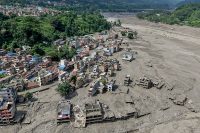
Officials warned residents in several districts to stay away from the banks of the Bhotekoshi, Trishuli, and Narayani rivers. The Bhotekoshi flooded around 9 a.m. on Aug. 26, destroying several villages and hydropower projects, officials said. At least 19 bridges were swept away.
The U.S. Geological Survey (USGS) first reported a magnitude 4.4 earthquake early that day, roughly 66 kilometres north of Kathmandu, near the border. The USGS later called it a magnitude 5.2 landslide.
“Seismicity in the Himalaya dominantly results from the continental collision of the India and Eurasia plates, which are converging at a relative rate of 40-50 mm/yr,” USGS said on its website. “Northward underthrusting of India beneath Eurasia generates numerous earthquakes and consequently makes this area one of the most seismically hazardous regions on Earth.”
Canadian support
Foreign Affairs Minister Anita Anand said on social media her department is in contact with authorities in Nepal and is ready to help Canadians in the region. She encouraged Canadians in Nepal or Tibet to register through the online Registration of Canadians Abroad service to receive up-to-date information.
“Canada stands with all those affected by the tragic flash floods along the border of Nepal and China that have caused loss of life, widespread destruction and washed away villages,” she said.
“Our thoughts are with all those affected, the families who have lost loved ones and the first responders working tirelessly under extremely difficult conditions.”
Army support
Nepal’s Prime Minister’s Office (PMO) wrote on social media that the army is conducting search-and-rescue operations for people affected by flooding in the Bhotekoshi River region, while working with other security agencies, organizations, and the public.
Eleven teams are carrying out ground-based rescue operations through the night. A large group of people has already been located and officials said they would be evacuated by air in the morning.
A total of 1,697 soldiers have been deployed and 656 troopers are on standby for further operations.
The Associated Press and Reuters contributed to this report.