
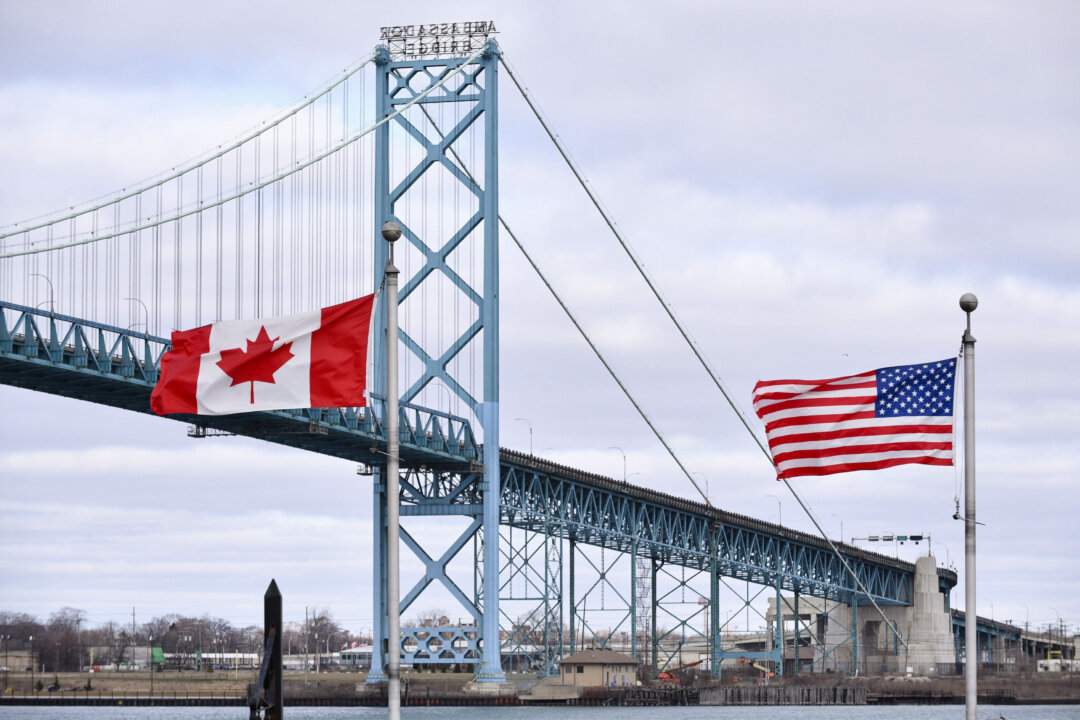

Canadian and American flags fly near Ambassador Bridge at the Canada-U.S. border crossing in Windsor, Ont., on March 21, 2020. The Canadian Press/Rob Gurdebeke
The newly imposed U.S. tariffs are expected to slash roughly half a percentage point from Canada’s GDP growth, according to a report published by BMO on Aug. 24.
The new 50 percent U.S. tariffs will apply to about C$28 billion (US$20 billion) of Canadian products, representing approximately 5 percent of goods exports to the United States and roughly 0.8 percent of Canadian GDP.
Though the number “still sounds digestible in the aggregate,” BMO economists warn that specific businesses and industry sectors will bear disproportionate shares of the impact if the new slate of tariffs are implemented in full.
The tariffs will most affect Canadian producers in the chemicals and plastics sector, with US$4.7 billion in affected exports, followed by electronics and electrical equipment at US$4.5 billion, according to BMO’s estimates. Consumer goods will face US$3.1 billion in tariffs, while forestry and wood products account for US$2.6 billion.
The bank added that the “other manufacturing” sector will absorb US$2 billion in tariff exposure, with machinery and industrial equipment close behind at US$1.7 billion. Agriculture and food products will be impacted at US$1.2 billion. The report noted that energy, potash, critical minerals, fish, and goods already subject to Section 232 tariffs won’t face the new duties.
According to BMO’s calculation, Canada’s weighted average effective tariff rate on exports to the United States will rise from about 5 percent currently to roughly 7.5 percent once the new measures take hold.
If the threatened additional 50 percent tariffs on autos and parts materialize at the start of 2027, that figure would likely climb another 2 percentage points.
The impact of the tariffs will not be felt evenly across Canada. British Columbia, Quebec, and Ontario are expected to be hit hardest, as existing U.S. duties, particularly on steel, aluminum, and lumber, have already placed additional strain on these provinces, the economists wrote.
They added that the upcoming new U.S. tariffs will impede projections the bank stated earlier on Canadian growth.
“Ahead of the trade deal deadline, we were forecasting 3.8% a.r. growth in Q2 and a slowdown to 1.3% in Q3—this development should scrub out any upside risk that was building on the latter,” the report said.
The report’s analysis points to deeper structural concerns beyond the immediate growth hit. The new tariffs apply to goods covered under the Canada-United States-Mexico Agreement (CUSMA), which BMO describes as “a major break from the current tariff environment, where 90%-plus of Canadian exports not targeted by specific levies have continued to move tariff-free under cover of the existing trade agreement.”
BMO projects that uncertainty will continue as long as the tariffs remain in effect. Though some businesses may eventually look past the tariff headlines and continue investing, the report warns that lingering questions about CUSMA’s effectiveness and the chances of a long-term trade deal could still impact investment decisions over the longer run.