

The head of National Bank says the escalations in the tariff dispute between Canada and the U.S. is making for a murky outlook, but the domestic economy seems to be handling the uncertainty relatively well so far.
“The unresolved and escalating trade conflict with the U.S. continues to create economic uncertainty and challenges for businesses across the country. At this point, it is difficult to forecast the outcome,” chief executive Laurent Ferreira told a conference call to discuss the bank’s third-quarter results Wednesday.
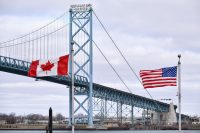
Trade tensions between Canada and the U.S. have escalated after U.S. President Donald Trump imposed 50 percent tariffs on about $28 billion worth of Canadian products over the weekend as trade talks collapsed.
On Tuesday, Ottawa announced a suite of dollar-for-dollar retaliatory tariffs on U.S. goods set to take effect Sept. 8, along with a new $7.5-billion tariff-relief package for affected businesses and workers.
Ferreira said the new tariffs on both sides of the border will affect industries, business investment and affordability, but added that so far, the Canadian economy has proven to be resilient over the past 18 months.
“While business confidence and investment are difficult in the current context, I am encouraged by the way governments and business leaders are mobilizing around Canada’s economic priorities,” he said.
Ferreira said Ottawa’s efforts to get national-interest products built and diversify Canada’s trade partners are providing the bank with opportunities to deploy money.
“Energy, power infrastructure, and the recent icebreaker contract announcement are great examples of our country moving in the right direction,” Ferreira said, referring to a commitment announced by the federal government on Monday to build six icebreakers in Quebec.
“And OSFI’s decision to lower the range for the domestic stability buffer provides additional flexibility to support Canadian businesses as they are dealing with a challenging environment,” he said
The Office of the Superintendent of Financial Institutions announced in June it was lowering the domestic stability buffer to three percent from 3.5 percent. The federal banking regulator said the move would give the country’s six largest banks greater flexibility to deploy capital.
On Wednesday, National Bank reported its third-quarter profit rose more than 20 percent compared with a year ago, helped by a strong performance across its business.
The Montreal-based bank said it earned $1.31 billion or $3.25 per diluted share for the quarter ended July 31, up from $1.07 billion or $2.58 per diluted share a year earlier.
On an adjusted basis, National Bank says it earned $3.39 per diluted share in its latest quarter, up from an adjusted profit of $2.68 per diluted share in the same quarter last year.
Revenue for the quarter totalled $4.05 billion, up from $3.45 billion a year ago, while the bank’s provision for credit losses for the quarter amounted to $246 million compared with $203 million in the same quarter last year.
Analysts on average had expected an adjusted profit of $3.22 per share and $3.87 billion in revenue, according to LSEG Data & Analytics.
The results came as National Bank works to complete its deal to take control of Laurentian’s small- and medium-sized banking portfolios. Ferreira said he continues to expect the transaction to be completed by late 2026.
John Aiken, an analyst at Jefferies, said in a note to investors Wednesday that the bank’s retail banking segment and “standout loan growth” helped it beat expectations.
“Capital markets saw the expected step-back from an exceptionally strong second quarter while come credit indigestion at Credigy reduced its contribution to well below its normal run-rate level. All in, these were solid results, and we would expect a positive market reaction today,” Aiken said.
National Bank’s personal and commercial business earned $421 million in its latest quarter, up from $370 million a year ago as revenue rose and provisions for credit losses fell.
The bank’s wealth management business earned $296 million, up from $244 million in the same quarter last year, while its capital markets business earned $442 million, up from $334 million a year ago.
National Bank’s U.S. specialty finance and international operations earned $184 million, up from $178 million last year.