
Six months after U.S. and Israeli forces commenced military strikes on Iran, Washington remains in an armed and diplomatic standoff with Tehran.
Since initiating military operations on Feb. 28, President Donald Trump has listed the U.S. objectives as destroying Iran’s navy, ending its missile production capacity, breaking up its support for regional proxies, and preventing it from attaining a nuclear weapon. The current conflict began less than a year after the U.S. military carried out a mission to bomb a trio of Iranian nuclear facilities.
Working in conjunction with Israel and other regional partners, U.S. forces carried out 38 consecutive days of strikes on Iran in an effort dubbed Operation Epic Fury.
The operation concluded on April 8, as Washington and Tehran entered into a ceasefire. The two sides agreed on a framework for further peace negotiations in June, but subsequent armed clashes have derailed talks.
Here are seven things to know as the conflict hits the six-month mark.
Tehran Shaken But Not Surrendering
In the opening hours of the conflict, U.S. and Israeli forces launched heavy waves of attacks targeting Iranian leadership and key military components. Iranian Supreme Leader Ayatollah Ali Khamenei and dozens of senior Iranian military leaders were killed in that opening salvo.
Ali Khamenei’s son, Mojtaba Khamenei, took his father’s place. The younger Khamenei was injured in the initial wave of attacks on Feb. 28, and has closely concealed his whereabouts since.
Jim Webb, a U.S. Marine infantry veteran and independent national security consultant, said the objective of these early U.S.–Israeli strikes was to initiate a rapid regime change in Tehran.
“In fact, we’ve got the exact opposite of it, where the so-called hardliners … have assumed power, and they’ve effectively militarized society even more,” Webb said.
On March 1, as Tehran reeled from the loss of its leadership, Trump called for “all Iranian patriots who yearn for freedom to seize this moment, to be brave, be bold, be heroic, and take back your country.”
Trump subsequently said the United States sought to arm Iranian dissidents via Kurdish regional partners, but no major internal uprising has manifested since. Trump said he believed the Kurdish groups instead kept the weapons for themselves.
In the initial 38 days of fighting, U.S. and partner forces reported damaging or destroying more than 100 Iranian naval vessels and numerous Iranian military aircraft. They also reported targeting several facilities Iran has used to produce, store, and launch missiles and attack drones.

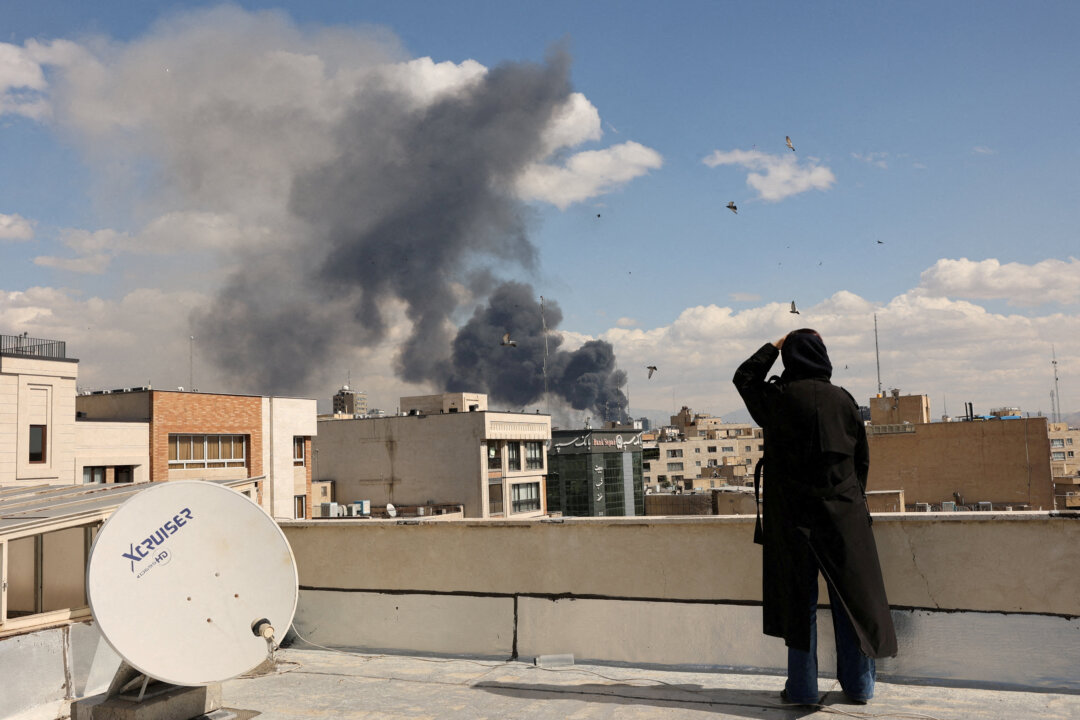
Smoke rises over the skyline following explosions in Tehran on March 1, 2026. Majid Saeedi/Getty Images
Iranian forces managed to retain missile and drone stockpiles beyond Operation Epic Fury and have used them during clashes in the continuing standoff.
“We don’t really know how many missiles they have left, but they seem to be producing plenty of them, as well as really cheap drones,” Webb said.
The U.S. Central Command (CENTCOM) declined to give a more detailed assessment of Iranian losses.
Paul Davis, a U.S. Army veteran and intelligence analyst now working as a professor at the Institute of World Politics, said U.S. operations have isolated Iran militarily, but an Iranian defeat hasn’t come as quickly and clearly as some in the Trump administration expected.
“They’re a little bit more resilient than I think some of the people around Trump had anticipated them to be,” Davis said.
US Forces Have Sustained Losses
While U.S. forces have inflicted costs on Tehran, they’ve borne their own losses as well.
As of Aug. 27, the Pentagon reported 18 U.S. troops have been killed, and 759 have been wounded.
U.S. forces have also lost aircraft. Three U.S. F-15E Strike Eagles were shot down in an apparent friendly fire incident over Kuwait on March 1.
Six U.S. Air Force airmen were killed when their KC-135 Stratotanker crashed in western Iraq on March 12. A second KC-135 was damaged but managed to land safely during that incident.
Another F-15E was shot down over Iran in April, setting off a high-stakes rescue mission to recover two downed U.S. airmen. An A-10 Warthog II attack jet and two MC-130J Commando II transport planes were sacrificed in the mission to rescue the two downed airmen.

A U.S. Air Force F-15E Strike Eagle aircraft takes off on a mission supporting Operation Epic Fury at an undisclosed location on March 9, 2026. U.S. Air Force/Handout via Reuters
CENTCOM declined to confirm the total U.S. aircraft and equipment losses thus far.
U.S. forces began amassing in the region in the weeks preceding Operation Epic Fury. More than 50,000 U.S. troops remain in the region, according to CENTCOM.
At a Senate hearing in July, Secretary of War Pete Hegseth put the U.S. costs of the conflict to that point at about $37.5 billion. The Pentagon has not provided a more recent estimate.
Weapons Stockpiles Diminished
Concerns have continued to mount regarding the U.S. stockpiles of missile interceptors and standoff munitions.
Last month, the Center for Strategic and International Studies (CSIS) estimated U.S. forces had used at least 65 percent of their Patriot missile interceptor stockpile and 38 percent of the Terminal High Altitude Area Defense missile stockpile during the conflict. CSIS figured these munitions would not be fully replaced until 2029.
CSIS also estimated U.S. forces used more than 1,000 Tomahawk cruise missiles during Operation Epic Fury before launching additional military strikes in July. The think tank figured the United States would not replace those Tomahawks until late 2030 or early 2031.

The USS Thomas Hudner destroyer fires a Tomahawk land-attack missile in support of Operation Epic Fury on March 1, 2026. U.S. Navy photo
Katherine Thompson, a senior fellow in defense and foreign policy at the Cato Institute and former Pentagon official, told The Epoch Times that the United States faces a “real overextension of its military power relative to its ability to resource its commitments” following heavy use in the Iran war and prior drawdowns for Ukraine.
“This is especially concerning for two reasons: First, the vulnerability it creates in our top-priority theater, the Indo-Pacific; and second, the continued failure to acknowledge that the United States is in fact susceptible to scarcity and hard tradeoffs in military resources,” she said.
Trump said on Aug. 6 that stockpiles of certain weapons are “tighter” but that the United States still has “massive amounts of ammunition.”
“What we’ve used is peanuts,” he also told Fox News on Aug. 17. “We have a lot of mid-level weapons.”
The Pentagon has taken steps to replenish U.S. stockpiles. This week, the Pentagon announced a $22.9 billion contract with Raytheon to boost Tomahawk production.
Hormuz Remains Contested
Control over the Strait of Hormuz has been a point of contention throughout the conflict. Iranian forces launched efforts to close the critical shipping lane in response to the initial U.S.–Israeli strikes.
Traffic in the strait has slowed over the past month following the breakdown of a U.S.-Iran ceasefire in July. Compared with 130 daily crossings before the war, there were nine confirmed crossings on Aug. 23, seven on Aug. 24, and five on Aug. 25, according to MarineTraffic, a global ship-tracking website.
Fuel prices have increased amid the wartime traffic disruptions in the strait.

The positions of ships on the Strait of Hormuz on a screen at the Maritime Information and Cooperation Centre in Brest, France, on April 27, 2026. Fred Tanneau/AFP via Getty Images
The price of a barrel of crude oil was $82.78 as of Aug. 27, up 24 percent from $66.96 on Feb. 27, according to the benchmark for U.S. oil prices. Oil prices temporarily spiked to over $114 per barrel in April.
As of Aug. 26, the average cost of a gallon of gasoline in the United States was $4.09, up from $2.98 before the war, according to the American Automobile Association.
This week, Trump said the Strait of Hormuz is operational for oil tankers to transit, with millions of barrels transported through the waterway in a day, and all Iranian mines have been cleared out of the sea lane.
“It’s a functioning strait. Yes, every once in a while there will be a drone or a rocket or something shot, but it is a very functioning strait. A lot of oil is pouring out,” the president told radio host Glenn Beck.
As transiting the waterway remains risky, the UK Maritime Trade Operations reported a commercial tanker was struck by an unknown projectile while sailing the strait on Aug. 27.
Iran has said the strait will remain closed until the United States agrees to its list of demands, which include removing the naval blockade and lifting sanctions.
On Aug. 25, Iran and Oman proposed a “temporary navigational corridor” through the strait amid the standoff.
US Shifts to Economic Warfare
After months of armed conflict, the Trump administration has shifted its strategy by expanding economic warfare to isolate Tehran.
On Aug. 24, U.S. Treasury Secretary Scott Bessent announced the administration’s Operation Economic Outcast.
The Treasury imposed additional sanctions that target dozens of companies, individuals, and ships involved in Iran’s oil, nuclear, missile, and cyber activities. Bessent also said foreign firms that continue conducting money laundering for Iran risk exclusion from the U.S. dollar system.

Treasury Secretary Scott Bessent announces new sanctions against Iran, describing them as “an economic D-Day,” in Washington on Aug. 24, 2026. Chip Somodevilla/Getty Images
Bessent did not specify the timeline for countries to adjust to this economic isolation campaign, but said the United States does not have “infinite patience.”
China has been bypassing U.S. sanctions by using small, independent refineries that import oil via shadow-fleet vessels. Small Chinese banks and nonbank intermediaries process these transactions to avoid U.S. sanctions.
Despite the U.S. blockade, Beijing continued to import oil from Iran in August, but at significantly reduced levels.
New U.S. sanctions come in addition to a U.S. maritime blockade of Iran that began in April, paused in June, and resumed in July. In an Aug. 27 statement, CENTCOM commander Adm. Brad Cooper said zero barrels of Iranian oil have exited the Strait of Hormuz since the U.S. blockade resumed in July.
Iran’s Economy Hit Hard
Economic conditions in Iran continue to deteriorate. The country faces hyperinflation and a currency crisis.
Iran’s currency, the rial, has sharply declined against the U.S. dollar. On Aug. 27, it was at a record low of nearly 1.4 million per dollar, down from 42,000 at the start of the year.
According to Beni Sabti, an Israeli military veteran now working as an Iran analyst at the Institute for National Security Studies, the U.S. blockade has had a tremendous impact on the Iranian economy.
Speaking with reporters at the National Press Club in Washington on Aug. 12, Sabti said imports are now only about 25 percent of pre-conflict levels. He added that the war has damaged Iranian ports, making it difficult to transport goods into the country.

A member of the Iranian security services stands guard during a funeral procession for IRGC Navy Chief Alireza Tangsiri in Tehran on April 1, 2026. Majid Saeedi/Getty Images
Although official data reported inflation at nearly 90 percent in July, Sabti said many Iranians believe actual inflation is much higher.
“The Iranians are suffering, but they agree to that. The people are in that place of ‘OK, we can suffer, but take this regime somehow,’” he said.
Where Public Sentiment Stands
The United States is expanding its economic warfare against Iran at a time when many Americans have grown frustrated by the ongoing conflict and months of high gas prices.
Trump’s public support has taken a hit.
The latest Reuters/Ipsos poll shows only 31 percent of American adults back U.S. military action against Iran. The same poll found that 33 percent of respondents approved of Trump’s performance in the White House.