
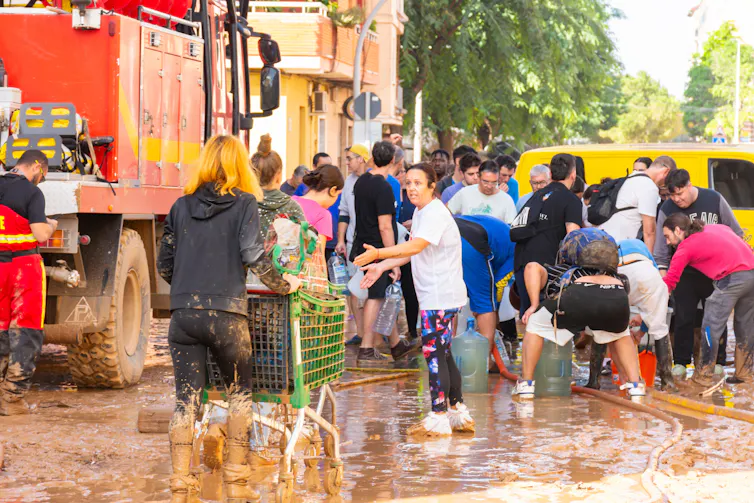
Extreme heatwaves across Europe led to significant annual deaths this summer. In Spain, floods in Valencia during 2024 killed 200 people and paralysed infrastructure. Germany’s 2021 floods highlighted severe weaknesses in early-warning communication, while wildfires in France led to large-scale evacuations and reduced air quality.
It’s easy to assume that strong institutions and technological capacity protect wealthy countries from the consequences of climate change. But evidence suggests otherwise. Well-resourced cities remain vulnerable to rapid-onset extremes. Our research across high-income countries identifies a fundamental challenge here: adaptation responsibility is frequently fragmented across governance levels.
The knock-on effects of climate-induced extremes also expose longstanding inequalities between people of different ages, genders and race, for example. Migrant, elderly and low-income communities are disproportionately affected by climate consequences. This is not simply because these communities are more exposed to the effects of extreme weather. Their vulnerabilities are also shaped by housing quality, income, health and lower political influence.
At international climate negotiations, such as the UN climate summit Cop31, adaptation is traditionally framed as something wealthy countries finance and poorer countries need. There are compelling historical and ethical reasons for this. This framing can nonetheless obscure another important reality: adaptation is a challenge for every country.
Wealth does not guarantee adaptation
In the UK, older homes are vulnerable to heat and cold extremes, while coastal areas are exposed to climate-exacerbated flooding and erosion. In East Anglia, experiences of one of Europe’s fastest eroding coastlines has resulted in lost homes and risks to national energy infrastructure, with the Climate Change Committee emphasising inadequate adaptation progress.
In Sweden, confidence in strong institutions obscures vulnerabilities. Nordic exceptionalism restrains governments from publicly acknowledging climate risks and adaptation deficits, confounded by overconfidence in technology. With one of Europe’s oldest populations, new forms of immobility and uneven exposure to heatwaves are being created. Coastal communities face increasing flooding and erosion. And the Sami Indigenous peoples are losing their livelihoods as ecological losses impact reindeer herding.
While relocation may seem a straightforward adaptation solution, it can mean losing homes, livelihoods, cultural heritage and place connections that have shaped generations. This reveals further weaknesses in how adaptation is assessed. Governments report their progress through targets and resilience indicators, yet this often overlooks communities’ losses.
The problem is not that wealthy countries lack resources, but that resources do not automatically translate into effective protection.
Adaptation is a political problem
Adaptation is often presented as a technical challenge, by improving infrastructure or early warning systems. While essential, these measures are not sufficient and fragmented governance remains a key challenge.
In Sweden, municipalities carry responsibility for local adaptation but lack national support. In the UK, adaptation efforts driven by local authorities and agencies are constrained by national-level policies and budgets. Local authorities are expected to manage growing risks without the resources, powers or national support required to act.
The EU’s emerging Framework for Climate Resilience offers an opportunity to address these shortcomings. It acknowledges needs to strengthen Europe’s preparedness. Whether stronger EU ambitions will translate to effective action remains an important question. Without engaging directly with underlying governance challenges, resilience risks becoming a political, rather than lived, reality.
As governments gather for Cop31, acknowledging adaptation failures in wealthy countries should not become an argument for reducing support to others. Quite the opposite. Recognising inequalities within wealthy societies reinforces the principle that vulnerability is shaped by political and economic conditions, not simply GDP.
Protecting European communities and supporting adaptation elsewhere are both necessary. A lack of climate adaptation in wealthy countries expose a fundamental contradiction. Societies with substantial resources risk failing their citizens over foreseeable climate risks. Addressing this requires more than technologies and targets.
Acknowledging adaptation deficits is essential for advancing global and domestic climate justice. It helps explain why adaptation remains underfunded globally, why progress is uneven and why a more honest conversation is needed.
Wealthy countries must support adaptation elsewhere and confront domestic vulnerabilities. Otherwise, adaptation advances only on paper while exposure and inequality grow everywhere. The UN climate negotiation process offers opportunities to shift this conversation, but only by recognising that every country needs to adapt and that this is a collective task.




Promethean Overviews • Trump’s AMERICAN REBUILD: Rubio GOES NUCLEAR and the ATC Meltdown
America's aging air traffic control systems, struggling power grid, and declining industrial...

Beyond DMT: why the true power of Brazil’s sacred jurema plant is social, not just psychedelic
Jurema-preta is the name of both a plant – Mimosa tenuiflora –...

How Wall Street Is Racing to Claim the Onchain Dollar
In brief Wall Street’s push into stablecoins has accelerated sharply, led by...

Bitcoin ETFs Lose $2.1 Billion in November as Outflow Streak Hits Seven Days
In brief U.S. spot Bitcoin ETFs lost about $829 million this week,...