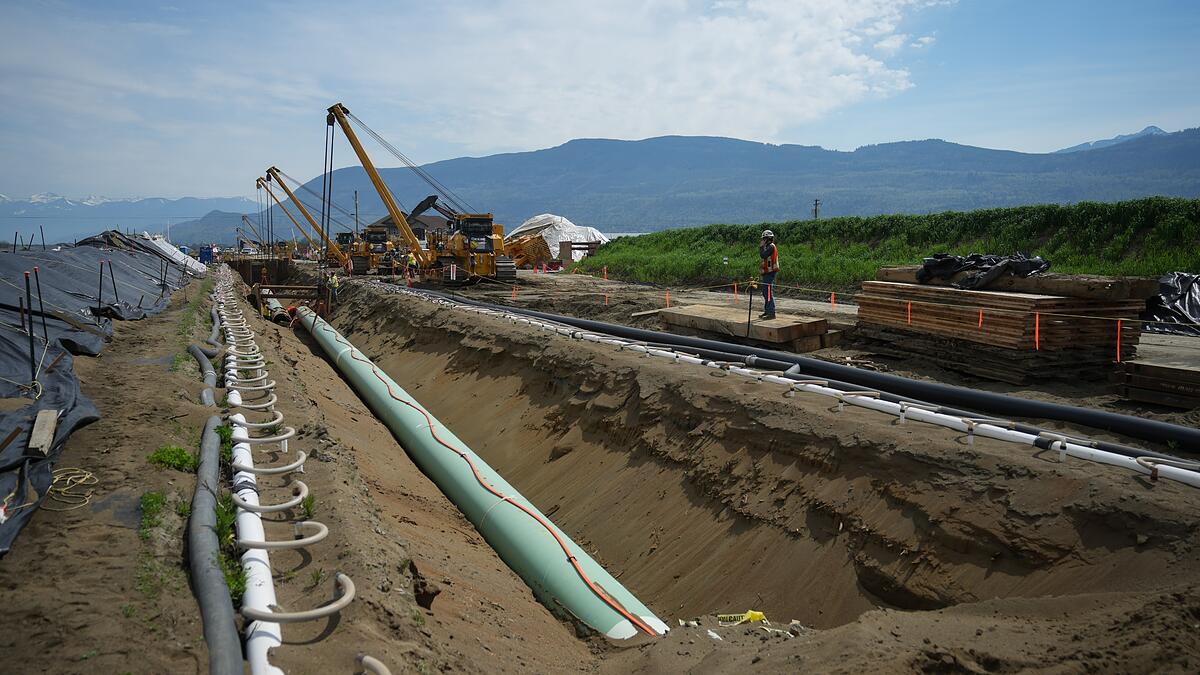
The route for Alberta’s one-million-barrel-per-day West Coast pipeline project, newly christened Pacific Link, has been described as ending in the Lower Mainland, near Vancouver. But documents show it could expand its footprint into a British Columbia region that includes busy tourist towns like Whistler, Pemberton and Squamish.
The pipeline was announced as a project of national interest by Prime Minister Mark Carney and Alberta Premier Danielle Smith on Thursday.
The pipeline plan that Alberta filed with the Major Projects Office earlier this year includes a “deviation” that “remains under consideration.” The alternate route would see the pipeline leave the Trans Mountain pipeline route north of Kamloops and travel west — through a corridor in BC’s Sea to Sky and Sunshine Coast regions.
The maps attached to the document are vague about exactly where the pipeline would go, but they show an alternate pipeline corridor that starts near the town of Clearwater, crosses the Fraser River near Lillooet, and then travels south through the Coast Range Mountains to the ocean somewhere between the Sunshine Coast and Howe Sound. They describe it as a possible route that was “considered and remains an alternate.”

The Sunshine Coast, Texada Island and Howe Sound are also labelled in the documents as “proposed terminal areas,” if a pipeline went through the region. Powell River Mayor Ron Woznow thinks it’s an idea worth considering.
“We had a mill that was the major source of employment and taxation for the city,” he said in an interview with Canada’s National Observer. “We’ve been looking at ways of redeveloping the old mill site, and given that we have a deep-water port, [a pipeline] could be beneficial for the city.”
To Woznow, the potential economic benefits outweigh the environmental risks. In his eyes, the risk of an oil spill is “very small,” while “the likelihood of a positive impact on the city and people living here is very good.”
But Chris Pettingill, a Squamish city councillor and board director with the Squamish-Lillooet Regional District, disagreed, worrying that a pipeline could negatively affect the environment and the outdoor recreation and tourism economies.
“It doesn’t seem to make any sense in terms of the terrain and the technical difficulty,” he said in an interview. “I don’t think any [pipeline] path through British Columbia is going to be easy, but this one in particular seems like an odd choice.”
‘Incredibly rugged’ terrain
Both Pettingill and Woznow said they hadn’t heard about a pipeline through the region before Canada’s National Observer contacted them. Neither had Jeremy Valeriote, member of the Legislative Assembly and now Green Party candidate for the West Vancouver – Sea to Sky riding.
“I’m shocked and pretty upset that it was even under consideration,” Valeriote told Canada’s National Observer in an interview. “Everything I’ve heard was that [the pipeline] would follow the existing Trans Mountain alignment. … This is not welcome news.”
Valeriote described the terrain in the proposed corridor as “incredibly rugged.” At present, the only way to travel through it at speed is the Sea-to-Sky Highway, which connects West Vancouver to Pemberton. But Valeriote said that corridor would be too narrow for any additional construction, especially the closer it gets to the ocean.
“No matter how creative you get, it’s still a steep-sided fjord,” he said.
And that’s just the pipeline. Valeriote also questioned putting tanker terminals in Howe Sound, citing the fragile, but recovering marine ecosystem and growing concerns about the Woodfibre LNG project that is slated to enter full operations by 2027. Further up the Sunshine Coast, he worries about an oil spill in the narrow inlets, small islands and complex ocean currents.
“It has Exxon Valdez written all over it,” he said.
Pipeline route has ‘not yet been finalized’
It’s not clear how likely development is in this alternative pipeline corridor.
In August, the Major Projects Office posted an update on its website identifying the preferred option as the 1,250-kilometre route from Brudheim, Alta., a small town about 50 kilometres north of Edmonton, to Roberts Bank.
Patrick Weiler, Liberal member of parliament for the region, declined to comment on the story, directing questions to the Major Projects Office. Pierre Cugen, a spokesperson for the office, wrote in an email to Canada’s National Observer that “the proposed route has not yet been finalized and will continue to be developed through technical review, engagement with stakeholders, and consultations with potentially impacted Indigenous communities.”
For Valeriote, that raises questions about what could happen if the federal government decides this project is in the national interest.
“What if we say yes to, in principle, a pipeline, and then suddenly, it’s no longer the Trans Mountain routing?” he asked.
Cugen explained that “if [the pipeline] is listed under the Building Canada Act, the project would remain subject to further regulatory review, consultations and conditions.”
“Any final project design, including route and terminal locations, would need to be confirmed through those processes,” he said.
October 1st 2026