As Canada grounds its wildfire satellite contract, a US project launches
 Jamie VoylesUpdated 1 day Ago5 Mins read
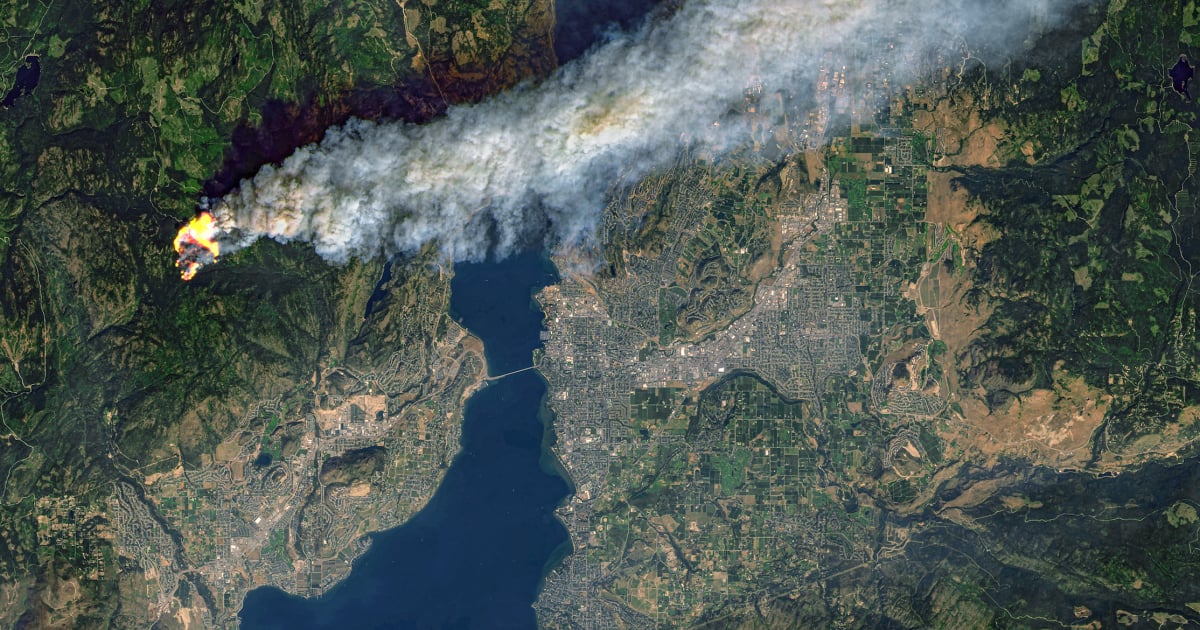
Josh Johnston, a senior research scientist at the Canadian Forest Service, grins when he shows off the tattoo on his lower arm.
As he lifts his sleeve, you can see the outline of a maple leaf, undergirded by a satellite hovering above wildfire flames — the logo of WildFireSat, Canada’s mission to launch a constellation of wildfire-monitoring satellites into space.

Johnston, who grew up in a firefighting family in northern Ontario, said fighting fires is “what our family does.” He describes WildFireSat as his father’s dream.
“I can remember in the late ’80s my father talking about how satellites were going to change the way [firefighters] do business,” he said.
The idea was simple: If wildfires could be seen from space, satellites could monitor them and send information to emergency response teams on the ground.
“But it didn’t happen,” Johnston said.
Canada has had the technology and capability to remotely monitor fire hot spots and wildfire ignitions for a long time. But Johnston — who earned his PhD in remote thermal sensing specifically to contribute to the improved monitoring of Canadian wildfires — is still carrying the family torch for the WildFireSat mission decades later.
“We started a really, really long time ago, because it’s our job, as scientists, to look 20 years ahead and say, what are you going to need?” Johnston said.
One could argue that Canada needs WildFireSat now more than ever.
But its launch, originally scheduled for 2029, has been complicated by a canceled contract and upstaged by alternative wildfire satellite systems that recently reached orbit.
As the 2026 fire season adds to a pile-up of devastating fire seasons, climate change is lengthening and intensifying the conditions that enable severe wildfires. And as Johnston waits for a mission, firefighters wait for better information and governments wait for improved emergency response systems, communities across Canada grow weary of smoke and evacuations. Climate change isn’t waiting at all.
WildFireSat gets underway as wildfires worsen
According to scientists who closely watch the data, wildfires have become “faster, bigger and more severe” in recent decades.
After years of planning, WildFireSat received a major boost in 2022, when the federal government committed $169.9 million for the Canadian Space Agency (CSA), Natural Resources Canada and Environment and Climate Change Canada to deliver and operate the wildfire-monitoring satellite system.
In 2023, CSA awarded a contract to Spire Global, Inc., to deliver a constellation of seven microsatellites. The satellites, equipped with infrared sensors, were intended to provide observations at key times of day. They can detect even low-intensity, smouldering fires, which can be common in Canada’s boreal forests. The data would help fire managers assess fire behaviour and make decisions when wildfires and smoke threaten communities.
That year, it turned out, would be the most devastating wildfire season on record.
Canada’s 2023 fire season was the most destructive yet. Fires started unusually early and burned more than 17 million hectares — more than six times the long-term average. The entire community of Yellowknife was evacuated, along with two-thirds of the Northwest Territories.
A study led by Piyush Jain, a research scientist at the Canadian Forest Service, found climate change played a major role in the extreme fire weather conditions. The average temperature from May to October 2023 was 2.2 degrees C warmer than the 1991–2020 average.
“2023 was a harbinger of the sort of fire seasons we might expect under continued warming,” Jain said.

Every year since the devastating 2023 fire season, the factors leading to more fires — warmer temperatures, dried-out vegetation that fuels fires — have led to similar devastating fire seasons.
For Johnston, who maintains close personal and professional ties with the firefighting community, the changes in wildfires have been astonishing.
“The fire seasons we’ve been seeing in Canada are just so far beyond what we were anticipating,” he said. “The stark reality of what ‘worse’ looks like is a hard thing to swallow.”
WildFireSat mission stalls as another satellite program launches
For Jain, who originally trained as a physicist, analyzing the 2023 wildfire season brought home the human consequences behind the data.
“As a data guy, I sit down and look at the weather and, you know, numbers for area burned and other metrics of fire activity,” he said.
But Jain and his team also examined evacuations, injuries and deaths, structures lost and the harmful health effects of wildfire smoke. The human toll was enormous.
Against that backdrop, a sudden halt to the mission raised new questions.
Spire Global received a stop work order for the microsatellites in March and the contract terminated by the federal government on April 23, 2026 for undisclosed reasons.
At the Space Canada 2026 Horizons conference on May 20, CSA President Lisa Campbell acknowledged the termination while discussing a broader shift in how the agency approaches procurement.
“Speed matters,” she said. But, she added, “if we see that capabilities are emerging, or a project isn’t on time and on target, we have to be very business-minded about it.”
No company has been named to replace Spire and no launch provider has been announced for the revised WildFireSat mission. Instead, CSA is gathering input from Canadian industry through a request for information, due this week.
The government says that it intends to deliver the capability around 2029, but the termination introduces schedule uncertainty.
“The Government of Canada is currently engaging with Canadian industry and working closely with stakeholders to determine the best path forward for launching a mission that will deliver the wildfire monitoring capability needed to protect Canadians” said CSA representative Sandrine Masella in an email to Canada’s National Observer.
Less than three months after Spire’s contract was terminated, another purpose-built wildfire satellite system, called FireSat, took a major step forward — in the United States.
On July 7, three FireSat satellites built by Muon Space for the nonprofit Earth Fire Alliance launched from Vandenberg Space Force Base in California.
Backed by a public-private-philanthropic partnership that includes Google.org and the Bezos Earth Fund, FireSat is providing a satellite constellation dedicated to detecting and monitoring wildfires around the world. A prototype satellite launched in 2025 has already returned wildfire data, including images of the recent Nipigon 6 Fire in Ontario and the Beef Trail Creek Fire in British Columbia.

A question of timing
The new FireSat mission comes at a consequential time.
At the 2025 G7 summit in Kananaskis, Alta., the federal government announced plans to expand the mission beyond Canada, with the goal of providing wildfire data to international partners.
But that expanded ambition coincides with uncertainty over who will build the WildFireSat microsatellites, while FireSat is already providing wildfire data and is expected to become fully operational in the coming months.
For those who have waited years for WildFireSat, including Johnston, the uncertainty is testing patience.
“I don’t mean that as in no one’s beating on my door, but in general, people are looking at what’s going on in the world [with worsening wildfires] and waiting,” he said.
Johnston sees FireSat and WildFireSat as potentially complementary systems. Combining observations from multiple satellites could give fire managers more frequent information as conditions change. But for that to happen, Canada still must deliver on the WildFireSat mission.
“We need to deliver on what we promised,” Johnston said. “This is the moment for us to all be working together.”
After decades of waiting, Johnston still believes the Canadian satellites depicted on his arm will make it into orbit.
“The mission is going to happen,” he said. “We are on the cusp.”





War as a Business Plan: Ukraine, Iran, and the Global Industry of Profitable Conflict
Modern warfare has undergone a grotesque transformation. What once was a last...

Canada unveils more sign-based retaliation against the U.S.
A sign on display during a B.C. Premier David Eby news conference...

Afternoon front page: The importance of teaching Canadian history; is Trump escalating the trade war?; and more
Wounded Canadians take cover behind a pillbox during the Battle of Passchendaele...

Cannabis-smoking Ontario stabber gets day passes despite ‘significant threat’
Article contentGhawar had been treated by a psychiatrist for anxiety and depression...