
Article content
The following is adapted from a speech delivered by Ben Mulroney to the Jewish Federation of British Columbia in Victoria Sept. 17.

THIS CONTENT IS RESERVED FOR SUBSCRIBERS
Enjoy the latest local, national and international news.
- Exclusive articles by Conrad Black, Barbara Kay and others. Plus, special edition NP Platformed and First Reading newsletters and virtual events.
- Unlimited online access to National Post.
- National Post ePaper, an electronic replica of the print edition to view on any device, share and comment on.
- Daily puzzles including the New York Times Crossword.
- Support local journalism.
SUBSCRIBE FOR MORE ARTICLES
Enjoy the latest local, national and international news.
- Exclusive articles by Conrad Black, Barbara Kay and others. Plus, special edition NP Platformed and First Reading newsletters and virtual events.
- Unlimited online access to National Post.
- National Post ePaper, an electronic replica of the print edition to view on any device, share and comment on.
- Daily puzzles including the New York Times Crossword.
- Support local journalism.
REGISTER / SIGN IN TO UNLOCK MORE ARTICLES
Create an account or sign in to continue with your reading experience.
- Access articles from across Canada with one account.
- Share your thoughts and join the conversation in the comments.
- Enjoy additional articles per month.
- Get email updates from your favourite authors.
THIS ARTICLE IS FREE TO READ REGISTER TO UNLOCK.
Create an account or sign in to continue with your reading experience.
- Access articles from across Canada with one account
- Share your thoughts and join the conversation in the comments
- Enjoy additional articles per month
- Get email updates from your favourite authors
Sign In or Create an Account
or
Article content
I’ve got a list as long as my arm of numbers detailing the rise of Jew-hate in Canada. But you don’t need the numbers. You have the experience.
Article content
Article content
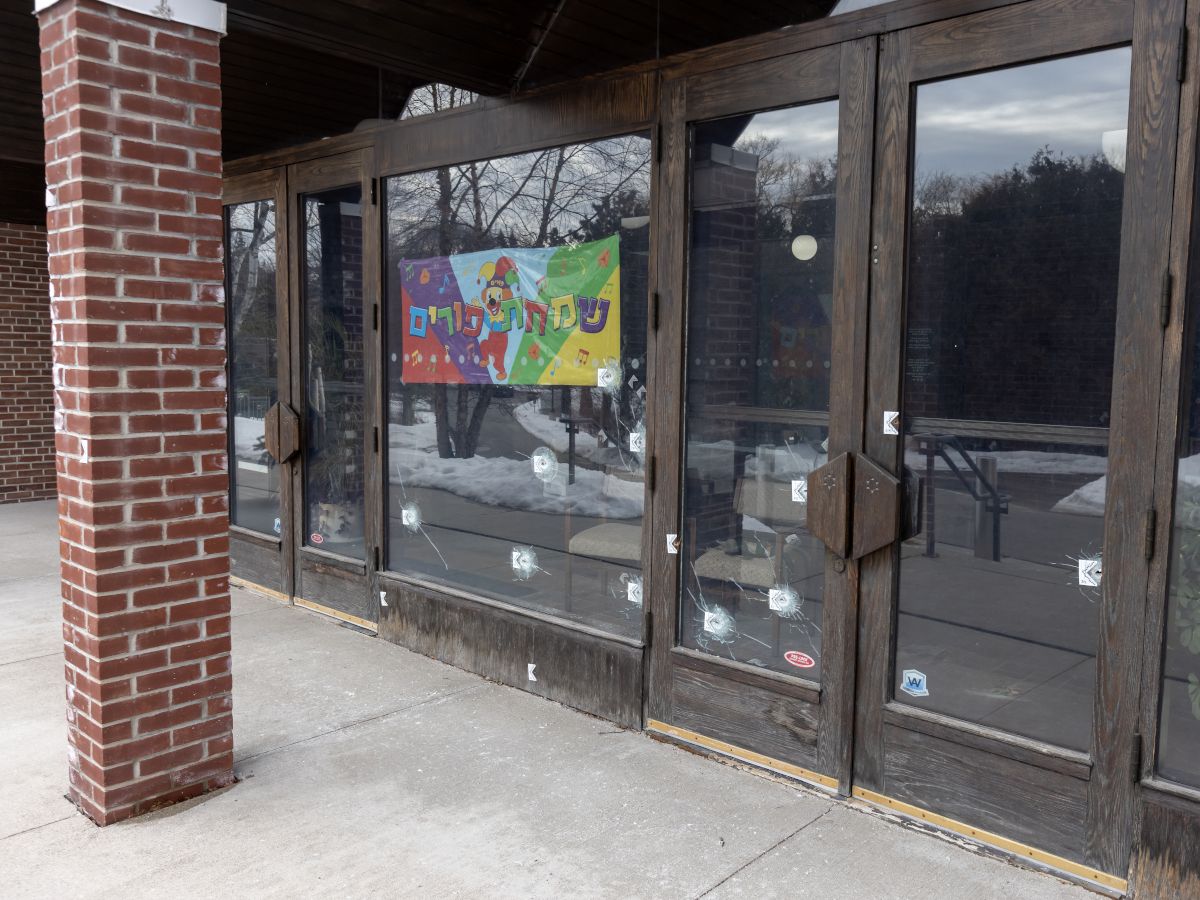
On a Saturday morning in August of last year, congregants arriving at Temple Emanu-El — on a day when a 13-year-old boy was having his bar mitzvah in that building — found a message written on a pillar at the entrance. It called Jews evil. It called them child-killers. It promised revenge. In May 2024, someone poured accelerant on the front doors of a synagogue on Oak Street in Vancouver and lit it; the congregation put it out, and their rabbi said afterwards it could have been a pile of cinders. In a Vancouver neighbourhood, people chalked hate on the sidewalks for months, put a Jewish resident’s name on a sign, posted his cross-street online and told him to his face: “We know where you live.”
Article content
Article content
In a survey of Jewish British Columbians last year, 61 per cent said they now avoid wearing anything that identifies them as Jewish in public. A Star of David. A kippah. Sixty-one per cent. In Canada. In this decade.
Article content
By signing up you consent to receive the above newsletter from Postmedia Network Inc.
Article content
That is not a Jewish problem. When one per cent of the country has to hide who they are to walk down the street, that is a Canadian problem — a problem for every one of us, because a country that will tolerate this for one group will eventually tolerate it for another. It always has.
Article content
Last November, I went to Israel. I went with a delegation hosted by the Israeli government, and I’ll say that plainly, because it’s true, and because some people have worked very hard to make it sound like a secret. It wasn’t.
Article content
We went everywhere. The Knesset was a sight to behold. And Jerusalem — nobody prepares you for how beautiful it is, or for how much history is stacked, soaked and stained in every stone.
Article content
In the old city we went to the Church of the Holy Sepulchre, built on the place where Christians believe Jesus was crucified and buried. Six different Christian churches share that one building. Greek Orthodox. Roman Catholic. Armenian. Coptic. Syriac. Ethiopian. And they do not always get along. Every chapel, every lamp, every stretch of floor belongs to somebody, and nothing can be changed unless all of them agree. There is a wooden ladder on a ledge above the front door that has been sitting there since at least the 1700s, because nobody can agree on who gets to move it.
Article content
Article content
And then there is the front door.
Article content
Article content
For centuries, the keys have been held by two Muslim families. Every morning, a Muslim man unlocks the holiest church in Christianity, because he is the one person every Christian in that building trusts to be neutral.
Article content
That is not harmony. It is something better than harmony. It is people who disagree about almost everything making an active choice, every single day, that the doors are going to open anyway.
Article content
Then we went all the way south, to Kibbutz Nir Oz, where the Bibas family lived. Where Shiri Bibas and her two little red-headed boys, Ariel and Kfir, were taken from their home, never to come home. You walk through that kibbutz, past the homes, once full of laughter and love, now … not, and you understand that no photograph can hold what happened there.
Article content
And then we went north, to Metula, right on the border with Lebanon. After October 7 the whole town was evacuated, and more than half the buildings were damaged by rocket fire.
Article content
But the moment I think about most did not happen at a border, or at a memorial. It happened in a coffee shop.
Article content
I sat down with a man from the Druze community named Bahij Mansour. The Druze are a small minority in Israel — an Arabic-speaking people with their own faith, whose sons serve in the Israeli army.
Article content
This man had done all of it. Twenty years in uniform. Twenty-four more in his country’s foreign service — the Israeli mission at the United Nations, the embassy in Amman, ambassador to Angola, ambassador to the Dominican Republic. For a stretch of it he ran the interfaith department of Israel’s foreign ministry, which meant that Israel’s dealings with those six quarrelling churches in Jerusalem ran across his desk.
Article content
And then he went home. Back to Isfiya, the Druze village on Mount Carmel where he was born, to run for head of the local council. It was the same job his father had held. And his grandfather before him, in 1959. After the army and the foreign ministry, he said he wanted to give something of himself to his village.
Article content
And at one point in our conversation, he stopped talking like a man with a title, and he just talked.
Article content
I’m paraphrasing, but not by much. He said: Do I think Israel treats my people fairly all the time? Of course I don’t. Do I think we get overlooked? That we are too often pushed to the margins? Absolutely I do. But I fight for my people inside the system. Because the system is this country, and this country is mine, too.
Article content
Article content
And I’m not breaking a confidence, because he has since written it himself, under his own name, in an Israeli newspaper. We are here, he wrote — in blood and in identity. And we are tired of being on the margins.
Article content
And I sat there, and I thought: I know this conversation. I’ve heard it before. At home.
Article content
I could just as easily have been listening to a Black-Canadian. Or an Indigenous-Canadian. Someone who will tell you, with complete honesty, that this country has not always treated their people fairly and still falls short — and who will also tell you they are going to fight for their people from inside it, because this country is theirs, and it can be made better.
Article content
That is not a contradiction. That is what belonging sounds like in a democracy. The right to criticize your country without anyone questioning whether you belong to it.
Article content
He was holding two things at once. Critical and loyal. Impatient and grateful. Both at the same time, and without apology.
Article content
There is a loud group in this country, and they have decided that you have to choose. That standing with the Jewish community means standing against someone else. That if you show up at a synagogue, you have taken a side against a mosque. That if you say a Jewish child should be able to wear a Star of David to school, you have said something about a war 9,000 kilometres away.
Article content
Article content
I want to say this as clearly as I know how.
Article content
That is a false choice. It is a manufactured choice. And it is a lie.
Article content
To stand for the safety and dignity of the Jewish community is not to stand against anyone. Not against Palestinians. Not against Muslims. Not against anyone who grieves, and there is a great deal to grieve. You can hold the humanity of every child in that region in your heart and still say, without hesitation, that nobody should be writing on the door of the oldest synagogue in Canada. Those are not competing positions. One of them isn’t even a position. It’s just decency.
Article content
The people who insist otherwise are doing something very specific. They take the fact that someone is Jewish, or stood beside a Jew, and infer a position from it. Because you are this, you must believe that. Because you stood there, you must support this. And then they hold you responsible for a belief you never expressed and a position they cannot prove you hold.
Article content
Think about what that is. Assigning a person a set of opinions based on their ethnicity, and then punishing them for it. There is a word for that, and we used to know what it was.
Article content
I know a little bit about this. A few months after I came home from Israel, a coalition of groups announced a boycott of every program I host. Now, I’m a broadcaster. I say things out loud every day. People are entitled to disagree with me, to change the channel and to tell their friends to change the channel. That is how a free country works, and I’d defend their right to do it.
Article content
But a lot of what came my way, in my inbox and online, wasn’t necessarily about things I had said. It was about where I had been. That I went. That I stood in Nir Oz. That I sat in a coffee shop and listened. From that alone, people decided they knew exactly what I believed about everything, and exactly what kind of person I must be.
Article content
And here is what I want you to understand. I’m a public figure with a microphone and skin as thick as a rhino. I can take it. The Jewish student in this city who gets the same treatment because of the Star of David around her neck does not have a microphone. The shop owner doesn’t. The kid walking to school doesn’t. If this is what people will do to someone with a platform, imagine what they are doing to people without one.
Article content
Article content
A chant is not an argument. A slogan is not evidence. An inference is not proof. And the moment we let people be made responsible for what a mob assumes they think, we have abandoned the thing that made this country work in the first place.
Article content
My father said something about this more than once, including in the last speech of his life, and I think it was the wisest thing he ever said about it. Antisemitism, he said, “is born in ignorance and nurtured in envy.” Ignorance and envy. Not politics. Not geopolitics. Something much older, and much more emotional, primal, dressed up in whatever clothes the era provides.
Article content
More than 30 years ago, on a beautiful summer day in Montreal, I had plans. My plans were to spend a few hours by my father’s pool. Instead, I ended up in the basement of a synagogue, listening to him give a speech, which, and I didn’t know it at the time, planted a seed in me that probably changed my life.
Article content
The speech had a title. “Israel is the new Jew.” And its argument was that antisemitism was changing its shape. That the people who could no longer say what they meant about Jews would find a way to say it about Israel instead, and that we had better learn to recognize it when it came.
Article content
Article content
That was the late 1990s. When nobody was talking about it that way.
Article content
More than three decades later, on Nov. 9, 2023, a month after October 7, he stood up in New York to accept an award from the World Jewish Congress. He was not well. It was the last public speech of his life. And it was, in every way that mattered, the same speech. The one from the basement. “Israel,” he told them, “has become the new Jew.”
Article content
I tell you this because it means he did not arrive at that view in the emotion of the moment. He had been warning about it for more than three decades. He saw it coming when it was still a long way off.
Article content
In that last speech he said that to that day, as a Canadian, he could not watch footage of Jewish mothers and fathers and children being sent to the gas chambers without feeling sorrow, and loss, and guilt. Guilt, because this country’s door was closed to them when it mattered. And he ended with a line I am going to steal, because he would have wanted me to.
Article content
“Keep the faith,” he said, “in the trying days to come.”
Article content