
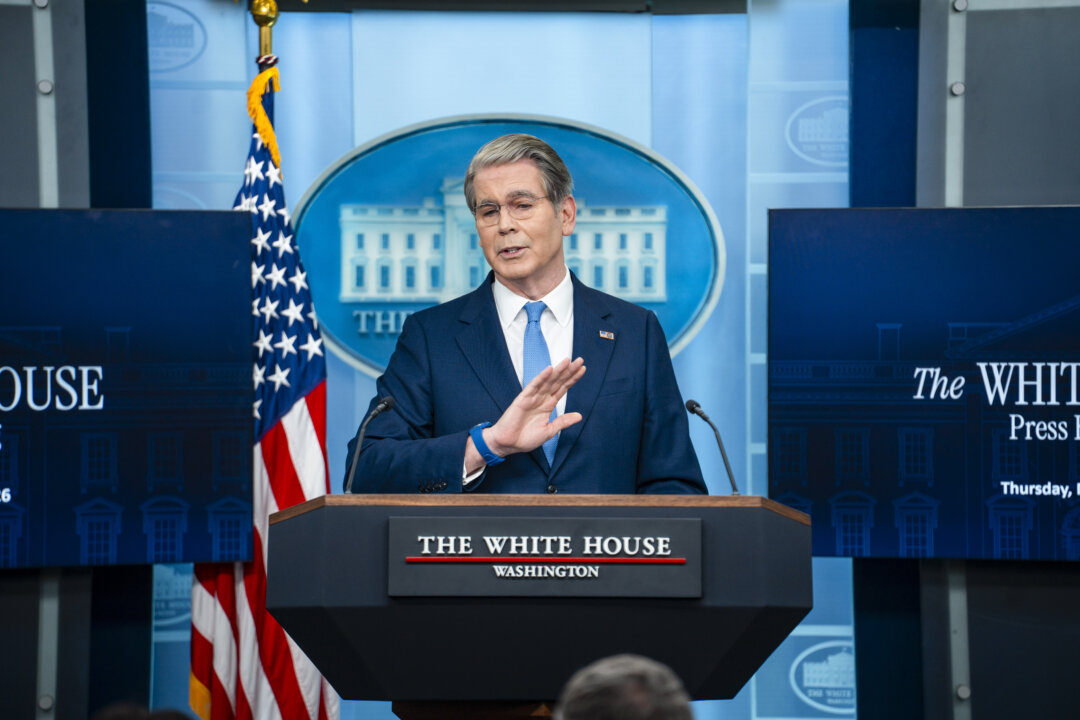
Treasury Secretary Scott Bessent warned on Aug. 23 that an “economic D-Day” is coming for the Iranian regime, with the United States taking strong measures to sever Tehran’s economic lifelines, including imposing consequences on Iran’s trade partners.
Bessent said in a social media post that under President Donald Trump, the U.S. military has dismantled Iran’s military capabilities and destroyed nearly all of its military factories and buried its nuclear program.
The United States and Israel began their offensive campaign to prevent a nuclear-armed Iran in late February when they launched strikes against the Iranian regime and its military. Tehran retaliated by attacking Middle Eastern nations that host U.S. bases and attacking international maritime traffic in the Strait of Hormuz.
“We are now entering the endgame,” Bessent said. “At dawn begins an economic D-Day—the single greatest financial offensive ever marshaled against an adversary.”
He said Trump has created the conditions for the United States to use all of its agency, authority, and tools to cut off Tehran’s financial lifelines until Iran is completely isolated.
“The Islamic Republic has subsisted by dressing extortion as security guarantees,” he said. “Under President Trump, that era is over. And those who fear the danger of defying Tehran ought not to discount the cost of testing Washington.”
Bessent made the comments ahead of a scheduled press conference on Aug. 24, where he is expected to announce further U.S. sanctions targeting Iran and its trading partners.
In an Aug. 23 op-ed for the Financial Times, Bessent suggested that Washington would target nations that purchase and transport Iranian petroleum but did not provide details.
“In short, these countries calculate appeasement of the regime to be the safer course. But they would do well to consider the consequences of sustaining it,” he wrote.
Secretary of Iran’s Supreme National Security Council Mohsen Rezaee threatened on social media that if Iran is targeted for economic isolation, it will block oil shipments through the Persian Gulf and the Strait of Hormuz, and “regard any country’s participation in or support for America’s economic war against the Iranian people as an act of war.”
Iranian President Masoud Pezeshkian on Aug. 23 defended the memorandum of understanding signed between the two nations in mid-June as the best option for ending the current situation, which he described as “neither war nor peace.”
He noted that nearly six months into the war, Tehran has been unable to attract investment, highlighting the economic pressure caused by the conflict.
“There is not a single provision in this agreement that amounts to capitulation,” Pezeshkian said in a speech explaining his support for the memorandum of understanding, which was published by state-run IRNA. “The supreme leader sets the policies, and we will follow that path.”
The deal called for the full reopening of the strait and provided for a 60-day window for negotiations, which ended Aug. 16, to end the war and resolve the outstanding issues related to Iran’s nuclear program.
Negotiations between the two nations to fully reopen the Strait of Hormuz have faltered, with Iran threatening to continue restricting maritime traffic until the United States agrees to end its naval blockade of Iranian ports, withdraw its troops from the region, and lift its sanctions on the regime.
Trump told reporters on Aug. 21 that he believes Iran is ready to reach an agreement, but that any deal must include terms acceptable to the United States—which he has previously said means Tehran cannot be allowed to have a nuclear weapon.
“They would love to make a deal, but they’re not ready to make the right deal in my opinion,” the president said.
The Associated Press contributed to this report.