CFIA Confirms Bird Flu Cases in Manitoba, Canada’s First Autumn Infections
 Jason G. AntonioUpdated 3 hours Ago1 Mins read
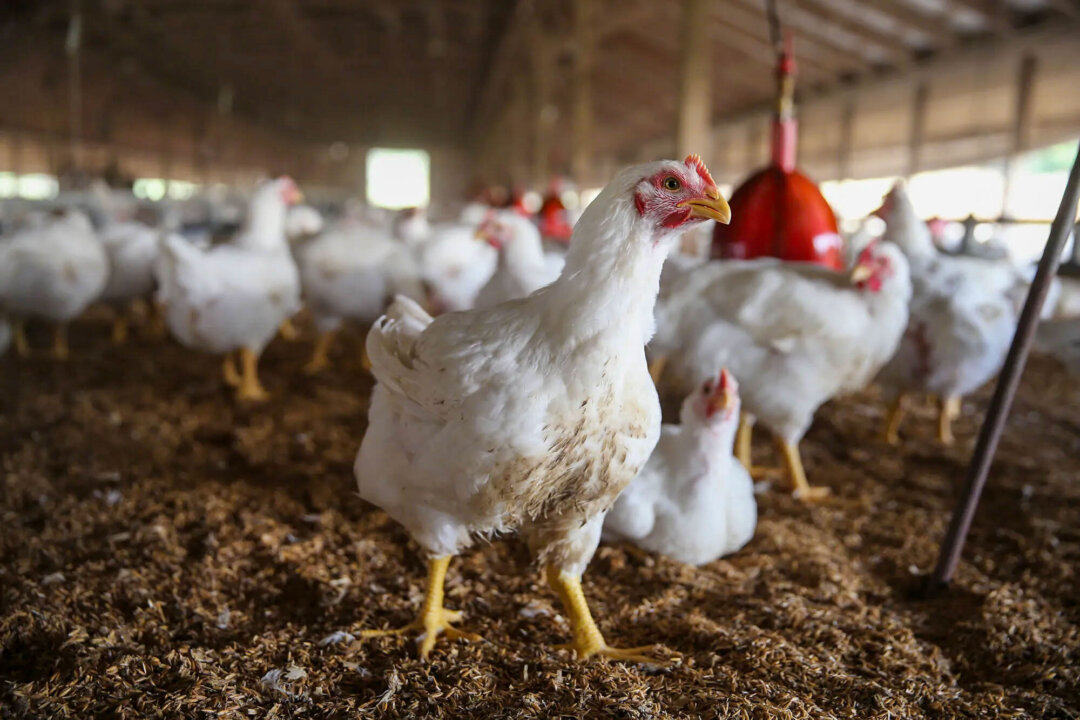

Chickens gather around a feeder at a farm in a file photo. Scott Olson/Getty Images
Manitoba’s first cases of bird flu this year have all occurred in September, with a federal agency detecting six cases and declaring primary control zones for the affected areas.
The Canadian Food Inspection Agency (CFIA) said that it detected a case of highly pathogenic avian influenza (HPAI) on Sept. 10 in the Rural Municipality of De Salaberry, prompting it to declare a primary control zone (PCZ) on Sept. 11.
The order affects commercial and non-commercial birds and captivity-raised birds used for racing, exhibitions, zoological collections, competitions, or pets, including day-old poultry and hatching eggs, eggs and other products or by-products of such captive domestic poultry, and anything exposed to such birds.
Commercial poultry includes chickens or turkeys raised on a premises with 1,000 or more birds on site, while non-commercial poultry includes similar birds raised in flocks of fewer than 1,000.
The CFIA then detected two more cases of avian influenza on Sept. 21 in the Rural Municipalities of Cartier and Rockwood, while three more cases were detected on Sept. 22 in the Rural Municipalities of Rhineland, Bifrost-Riverton, and Woodlands. PCZs were imposed on the five areas on Sept. 23.
All six cases have occurred on commercial properties.
Since January, the CFIA has detected more than a dozen avian influenza cases across the country and imposed—and then revoked—primary control zones in Quebec twice, in Ontario once, in British Columbia twice, in Saskatchewan six times, and in Alberta three times.
“The Canadian Food Inspection Agency (CFIA) is responding to detections of highly pathogenic avian influenza (HPAI) and low pathogenic avian influenza (LPAI), subtype H5, in domestic birds in Canada,” the agency said.
“Avian influenza is not a food safety concern,” the CFIA added. “There is no evidence to suggest that eating cooked poultry or eggs could transmit the virus to humans.”
In recent years, the most common avian influenza virus in domestic birds in Canada has been subtype H5N1, the agency said last year.
H5N1, a highly pathogenic avian influenza virus that evolved in domestic birds in 1996, is circulating in Canada and worldwide, the federal agency said. It has caused an unprecedented global outbreak in its size and duration and was first reported in Canada in December 2021.
A dashboard on the CFIA website says that avian influenza has affected more than 17.5 million birds since 2021.






Jay-Z rape accuser now says the accusations were false and she never met him
Jay-Z had dismissed the rape accusation as a "fictional tale." Photo by...

Trump, Xi end state visit that was long on pomp, but short on progress
U.S. President Donald Trump and First Lady Melania Trump with President of China Xi...

Canada signs preliminary agreement buy six Saab GlobalEye radar planes
A model of GlobalEye, Saabs Airborne Early Warning & Control aircraft platform...

Key Takeaways From Trump–Xi Summit
WASHINGTON—President Donald Trump and Chinese leader Xi Jinping wrapped up their summit...