Chaos Persists Across France Amid Student Protests
 Etienne FauchaireUpdated 1 hour Ago4 Mins read
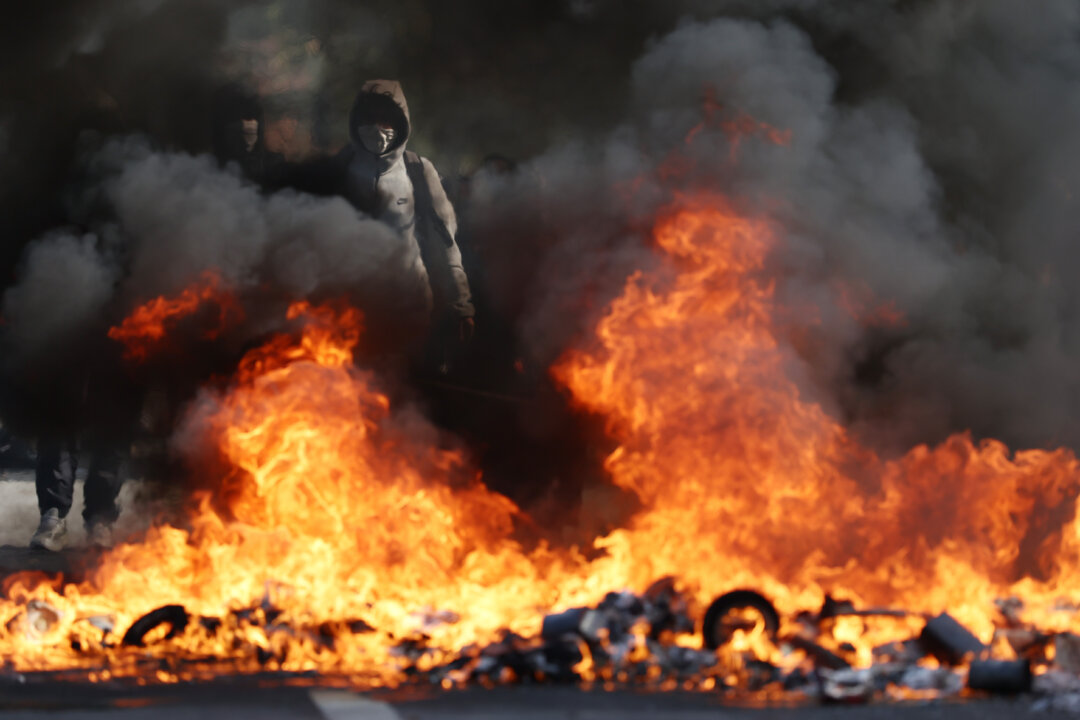
PARIS—France’s spiraling high school protests were again engulfed in violence on Oct. 2 as fires burned outside schools, projectiles were thrown at police, and clashes erupted across the country.
In the eastern city of Belfort, a police commander was beaten unconscious near a high school on the morning of Oct. 2. Prosecutors opened an attempted murder investigation into the attack, which interior minister Laurent Nuñez denounced on TF1 as “unspeakable savagery.”
In La Ciotat, a coastal town near Marseille, a teacher at Lycée de la Méditerranée was doused with gasoline and kicked while attempting to calm a tense confrontation, the Aix-Marseille education authority told The Epoch Times. A police vehicle was also doused with gasoline, though it did not ignite.
Early that morning, a fire was set at the entrance of Lycée Roger Verlomme, a public high school in Paris’s 15th arrondissement, charring the front door, melting the intercom, and burning bicycles parked outside. Regional council representatives told The Epoch Times that it was one of three major fires reported at high schools across the Paris region that morning.

Charred entrance of Lycée Roger Verlomme in Paris’s 15th arrondissement, after a fire during the school blockades, on Oct. 2, 2026. Etienne Fauchaire/The Epoch Times
Police and gendarmes made 5,000 arrests nationwide since Monday, according to Nuñez. Urban violence broke out around 158 schools in France, with attacks on police officers, teachers, journalists, and bystanders, he said.
On Oct. 1, Education Minister Édouard Geffray said 170 students and 65 education staff members had been injured since the protests began. The latter figure included 40 school principals. More than 100 high schools had also sustained serious damage, he said.
The unrest stems from protests that started last month in the Paris suburbs, where students first rallied against teacher shortages and dilapidated school buildings. As the incidents have grown more serious, the government has described the movement as urban violence.
Who Is Behind the Blockades?
Prime Minister Sébastien Lecornu’s office said on Oct. 1 that French intelligence services view the protest movement as allegedly “a maneuver organized by LFI and its ultra-left proxies.”
LFI, or La France Insoumise (France Unbowed), is the party founded by Jean-Luc Mélenchon, a far-left political figure in France known for his support for the regimes of countries including China, Cuba, and Venezuela.
LFI denies responsibility for the violence.

A Young Communist Movement of France banner and a cardboard sign reading “The police is crushing us,” marked with a hammer and sickle, on the netted wall of Lycée Jacques Decour in Paris, on Oct. 1, 2026. Etienne Fauchaire/The Epoch Times
Another network of activist groups and social media accounts has helped amplify the protests online, French outlet Le Point reported.
Among them is RED Youth, a far-left collective that campaigns against “Islamophobia.” The group, along with social media accounts affiliated with LFI, has sought to mobilize young people around the protests.
RED Youth was among the organizations that founded the Génération EDR collective in 2025. Other participants included the USL, the since-dissolved Antifascist Young Guard, and Muslim Students of France.
A French government report published in May 2025 described Muslim Students of France as the youth branch of the Muslim Brotherhood network in France.
The Muslim Brotherhood is designated as a terrorist organization in a number of countries. Meanwhile, the United States designated some of its regional branches as terrorist groups.
One widely circulated montage was posted on Instagram by Shahin Hazamy, a French Iranian influencer who describes himself as an independent journalist, a description contested by the French justice system. “Police violence against high school students reported in several cities during the blockades,” the caption read.
The video received about 1 million views within hours. By Oct. 2, the public counter on the post showed more than 5 million views.
A court in Bobigny, outside Paris, convicted Hazamy on Sept. 10 of glorifying terrorism over a social media post published on Oct. 7, 2023, the day of the Hamas-led terror attack on Israel. He received a 10-month suspended prison sentence and has appealed the conviction.
Hazamy was described in a 2025 French parliamentary report as “an influence agent of the Islamic Republic of Iran.”
What the Protests Are About
After meeting Education Minister Édouard Geffray on Oct. 2, student organizations said that they would continue their mobilization, and that the government had failed to offer “concrete measures.”
A nationwide demonstration is scheduled for Oct. 6.
The two leading student unions, the Student Union and the High School Students’ Union, are calling for a large protest against “economic insecurity and social and racial discrimination in selection.”
In high schools, they point to “overcrowded classrooms, insufficient numbers of staff and teachers, and deteriorating learning conditions.”
At the university level, the unions condemn admissions procedures that they say amount to “a system of social and racial sorting.” They also denounce “a logic of national preference” directed at foreign students, who pay higher tuition fees and receive less state financial aid than French citizens.
‘Manifestation of Two Frances’
France has a long history of street protests, stretching back more than two centuries from the French Revolution of 1789 and the insurrections of 1830, 1848, and 1871 to the student unrest and nationwide strikes of May 1968.
Ivan Rioufol, a French journalist and author of “The Coming Civil War,” told The Epoch Times that he sees the unrest as “the manifestation of two Frances, of two French youths.”
One, he said, is a “peaceful France,” which he contrasted with another “multicultural” France that is “very visibly guided by political movements such as La France Insoumise and by Islamists.”

Protesters shout during a high-school protest in Saint-Denis, north of Paris, some holding poles aloft as the crowd chants “everyone hates the police,” on Oct. 1, 2026. Etienne Fauchaire/The Epoch Times
Rioufol attributed the unrest to what he called a “twofold blindness” in French society.
The first, he said, was the failure of successive governments to tackle what he called “cultural, civic, and national separatism,” which he attributed to what he described as uncontrolled immigration and the difficulty of integrating people from different cultural backgrounds.
The second failure, he said, was a refusal to see what he called an ideological takeover of the French education system by the far left, a process he traced back to the Communist Party gaining control of it after the Liberation at the end of World War II.

Chinese University Fires Law Professor After She Allegedly Questions CCP’s All-Male Top Leadership Body
Delegates during the closing session of the 14th National People's Congress (NPC)...
US, Australia Halt Consular Services in Brazil Before Presidential Election, Citing Security Concerns
Security personnel stand outside the U.S. embassy after consular services were suspended...
Brisbane Olympics Organisers Put Positive Spin on Emblem Blunder
A general view is seen as "BNE 2032" is displayed on a...
One Nation Unveils Crime Policy Ahead of Victorian Election
One Nation Leader Senator Pauline Hanson (left) with Warren Pickering (right) announces...