
The Chinese regime is courting Indonesia to expand its influence in the South China Sea, spurring Tokyo and Canberra to bolster defense ties with Jakarta to counter Beijing’s maritime ambitions.
Beijing and Indonesia held the inaugural China-Indonesia Comprehensive Strategic Dialogue Mechanism and the Second Ministerial Meeting of China-Indonesia Joint Foreign and Defense Dialogue in Jakarta on Aug. 21.
Chinese Foreign Minister Wang Yi and Defense Minister Dong Jun, alongside Indonesian Foreign Minister Sugiono and Defense Minister Sjafrie Sjamsoeddin, agreed to deepen defense and military ties.
Wang and Sugiono separately pledged to advance cooperation in energy and mineral resources, according to readouts from the Chinese Ministry of Foreign Affairs.
Sjafrie said the two sides discussed a joint munitions factory in Indonesia slated to open by 2027, a project that could involve China sharing technology to manufacture rockets, missiles, and ammunition.
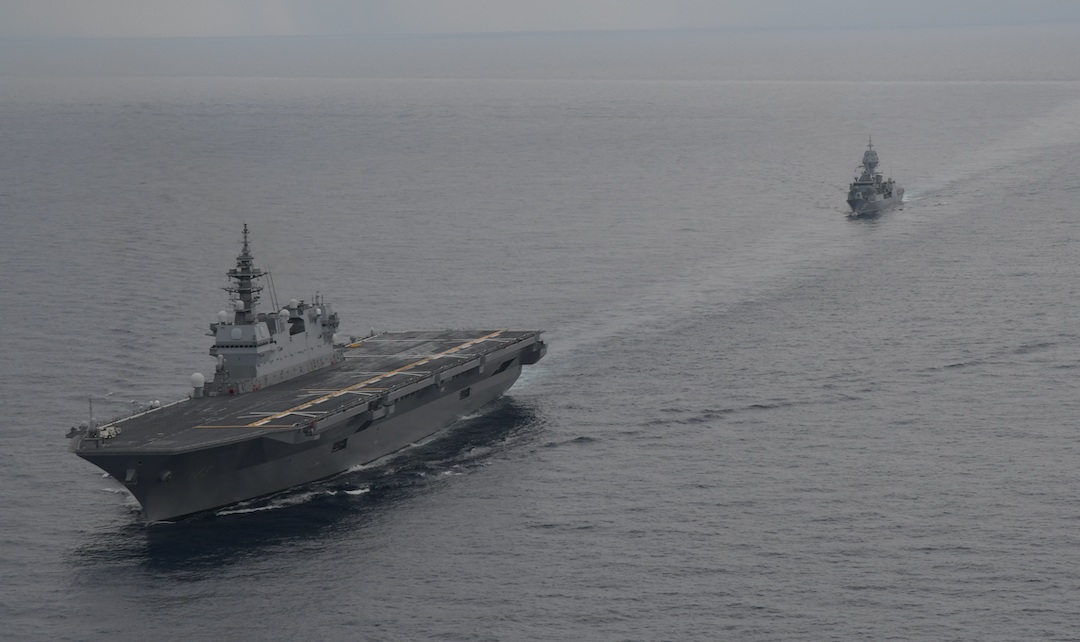
Days following the meeting, defense chiefs from Indonesia, Japan, and Australia held their first-ever virtual gathering on Aug. 26 to strengthen trilateral defense cooperation, according to a press release by Japan’s Defense Ministry.
The ministers “confirmed their commitment to working together among the three countries in order to jointly contribute to regional and global peace and stability,” it said.
“Beijing’s approach is a strategic balancing act in military diplomacy, aimed at fracturing Southeast Asian countries’ support for the Philippines’ stance in the South China Sea,” Su Tzu-yun, researcher and director of the Division of Defense Strategy and Resources at Taiwan’s Institute for National Defense and Security Research, told The Epoch Times.
Tensions between Beijing and Manila have
in recent months in the South China Sea—a disputed waterway where the regime asserts sovereignty over virtually the entire area, while several Southeast Asian nations claim parts of it.

A China Coast Guard ship (R) and a Philippine Coast Guard vessel are seen from the Philippines’ BRP Cabra during a supply mission in disputed waters of the South China Sea on Aug. 26, 2024. Jam Sta Rosa/AFP via Getty Images
Su said that Canberra and Tokyo view Beijing’s move as linked to its “gray-zone”
—aggressive and coercive actions designed to intimidate an opponent yet remain below the threshold of warfare—and see their support for Jakarta’s non-aligned neutrality as a way to help buffer the Indo-Pacific against the regime.
“Australia signed a defense pact with Indonesia in 2024, while Japan is deepening cooperation with Jakarta through defense equipment, maritime security, and capacity building,” Su said.
“This creates a multi-layered deterrence framework that prevents Beijing from easily resorting to force or further expansion.”
Isolating Taiwan
During the meetings, the two countries agreed on expanding joint exercises, personnel training, and maritime security.
Jakarta also supported China’s “reunification” with Taiwan, the Chinese readout states.
“Indonesia firmly adheres to the one-China policy and supports China’s cause of reunification.”
Days ahead of the meetings, the two sides
their first naval operation off Taiwan’s east coast, drawing condemnation from Taipei.
The Chinese Communist Party (CCP) has never ruled Taiwan, but it refuses to renounce the use of military force to annex the self-governed democracy.
It has also stepped up military drills around the island since then-U.S. House Speaker Nancy Pelosi’s 2022
to Taipei.

A member of the People’s Liberation Army stands as YJ-20 hypersonic anti-ship missiles are displayed during a military parade to mark the 80th anniversary of the end of World War II, in Beijing, China, on Sept. 3, 2025. Tingshu Wang/Reuters
Kei Koga, an associate professor at the School of Social Sciences at Nanyang Technological University in Singapore, said Beijing’s growing military links with Jakarta are primarily aimed at countering U.S.-led alliances, rather than posing an immediate threat to Taiwan.
“China is trying to check that Indonesia is not drifting toward Western allies and partners,” Koga told The Epoch Times.
However, Su said that Beijing’s outreach to Jakarta poses a long-term diplomatic threat, laying the groundwork to
future jurisdictional claims over the waters around Taiwan.
“Since Taiwan’s surrounding sea lanes intersect with the shared maritime security interests of the United States, Japan, and the Philippines, this does not directly escalate the military risk for the island,” he said.
“Instead, the danger lies in a political encirclement around Taipei, as more Southeast Asian countries align with Beijing’s narrative on ‘reunification.’”
In August, Taiwan’s Ministry of Foreign Affairs condemned Cambodia, Thailand, and Malaysia for separately endorsing Beijing’s claim over Taiwan, warning that backing the regime’s potential use of force to annex the island “seriously endangers regional peace and stability.”
Securing Dominance
Beijing and Jakarta said that broadening energy and mineral cooperation “serves their common interests,” with the latter pledging a “fair, transparent and friendly business” environment for Chinese firms.
The assurance comes after Jakarta’s tightening of nickel mining quotas and proposed tax hikes, which prompted the China Chamber of Commerce in Indonesia to protest in May, describing the policies as having “severely damaged” the country’s business environment.
Indonesia is the world’s largest producer of nickel—a strategic metal vital to Beijing’s electric vehicle and military aerospace industries—and accounts for about 60 percent of global output.

Workers use excavators during an exploration for nickel ore, a critical component in electric-vehicle batteries, on Wawonii Island in southeast Sulawesi, Indonesia. Adek Berry/AFP via Getty Images
Koga said Beijing is doubling down on its agreements with Jakarta to secure its dominance in the critical minerals sector.
“Indonesia lacks the skills, technology, and resources to extract and utilize these critical minerals, so they cooperated with China,” he said.
“But once Indonesia gains more technology, it could diversify its risk of overreliance on China, a scenario the regime wants to prevent.”
Su said the CCP’s push is designed to gain the upper hand in its rivalry with Tokyo.
“Chinese state-owned enterprises are perceived as exploitative in Indonesia. Meanwhile, Japan has imposed anti-dumping duties on Chinese stainless steel,” he said.
“Through the cooperation, Beijing aims to cement its interests in Indonesia and counter Japan.”
However, Su said Indonesia’s hedging diplomatic approach would prevent China from expanding its reach with ease.
“While Indonesia is unlikely to join an anti-China bloc, this imposes considerable political and geographic costs on Beijing,” he said.