China’s Push for Chip Self-Sufficiency Risks Deepening Its Technology Isolation: Experts
 Michael ZhuangUpdated 2 hours Ago5 Mins read
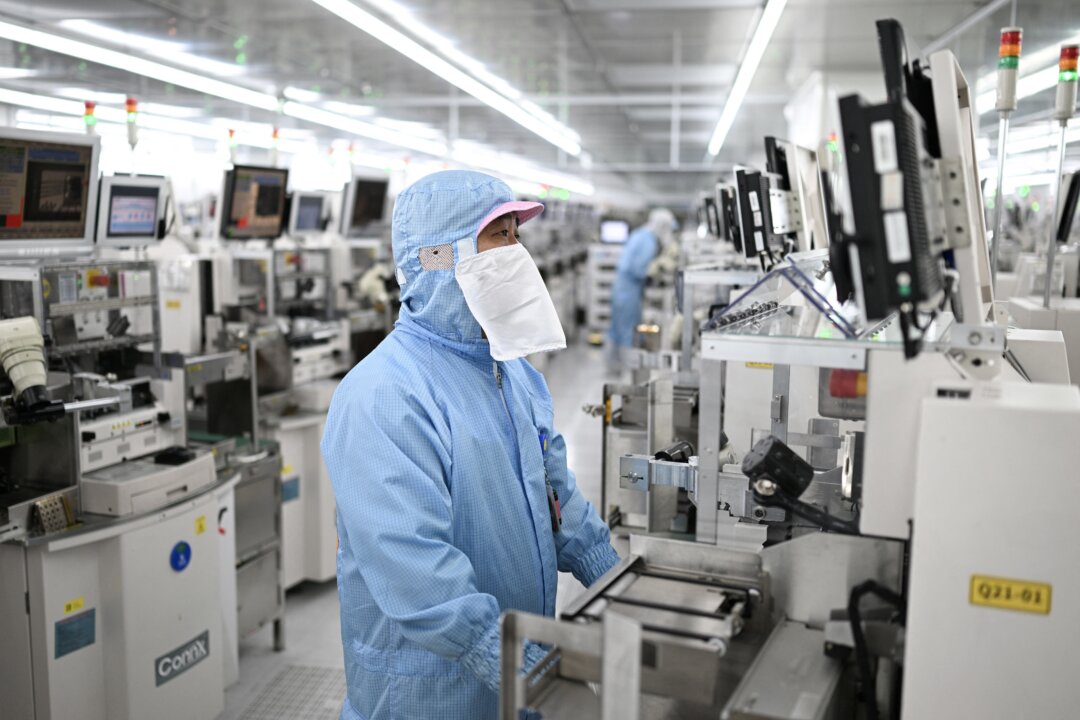
Beijing is investing heavily in domestic chipmakers amid tightening U.S. chip controls, but experts warn the initiative risks isolating China’s tech sector rather than closing the gap with the United States.
Chinese companies remain constrained by weaknesses in advanced manufacturing, semiconductor equipment, and software ecosystems, according to some industry insiders who spoke to The Epoch Times.
They say that efforts to replace imported technologies with domestic alternatives could also impose high costs on Chinese companies as they attempt to build systems outside the global tech supply chain.
A Chinese political analyst—speaking to The Epoch Times on condition of anonymity for fear of reprisal—said the Chinese Communist Party’s (CCP’s) demand for self-sufficiency in semiconductor manufacturing has effectively turned into a political task for local authorities and state-controlled companies.
“Under the CCP’s so-called chip self-sufficiency order, local governments and companies controlled by [the regime] are all burdened with political tasks, developing the chip industry at all costs and creating a Great Leap Forward-style false prosperity,” he said.
In the late 1950s, then-CCP leader Mao Zedong initiated the Great Leap Forward campaign, ordering the entire country to prioritize industrialization to “surpass Britain and catch up with America.” But the campaign ended in disastrous failure, causing approximately 30 million people to starve, with some historians putting that number at more than 45 million.
Chinese AI Chipmakers Race to Raise Capital
The push is already reshaping China’s AI chip industry.
China’s AI chipmaker Shanghai Enflame Technology is advancing plans for an initial public offering (IPO) in Shanghai, while Moore Threads, Montage Technology, and Biren Technology have already entered capital markets. The four companies, together with Huawei, are working to develop computing platforms intended to provide alternatives to products from Nvidia, the dominant supplier of advanced AI chips.
The Chinese AI chip market is worth about $90 billion, but Nvidia’s share has fallen from near-total dominance a few years ago to about 55 percent today, according to a Reuters review of market intelligence data from IDC.
Enflame, which has received investment from Chinese technology giant Tencent, is seeking to raise about $900 million through its planned IPO.
The Chinese political analyst warned that pouring vast capital into chips risks creating an industry that looks good on paper but lacks international competitiveness, ultimately driving China toward “technological isolation.”
The analyst said state subsidies and government pressure boosted sales numbers, but those figures did not necessarily reflect actual competitiveness.
“Sales have surged year over year,” he said, but this “simply cannot conceal the stark reality that they lack real international competitiveness.”
Chinese state media Global Times reported on Sept. 8 that China’s semiconductor exports surged 103.9 percent from January to August this year.
Due to the Chinese authorities’ past record of manipulating data, it is difficult to assess the veracity of that figure.

A billboard showing a semiconductor chip at the Chinese International Supply Chain Expo in Beijing on June 26, 2026. Kevin Frayer/Getty Images
Software Remains a Major Hurdle
Chinese companies are also competing with one of U.S.-based Nvidia’s most important competitive advantages: its software ecosystem.
Moore Threads and other Chinese chipmakers are developing products designed to support programs originally written for Nvidia’s CUDA platform.
CUDA includes programming tools, software libraries, and development environments, and has long been a major barrier to competitors seeking to challenge Nvidia in the AI chip market.
Chinese chipmakers are building software conversion tools to run Nvidia-designed code on their own chips, aiming to make it easier for tech companies and developers to switch to domestic hardware.
However, industry testing suggests that compatibility remains difficult.
An AI-model developer in China’s Jiangsu Province told The Epoch Times, on condition of anonymity for fear of reprisal, that his company has been testing Chinese-made computing chips in recent years.
Jiang said the company encountered compatibility issues during initial testing, and even after fixing them, the chips still failed to deliver sufficient computing performance.
“Now, after spending huge amounts of money developing chips, another problem we face is that the cost is higher than buying foreign chips. If [our] products cost more than U.S. and Japanese chips, who will buy them?” he said.
“The software is also not good enough. This is not something that can be solved just by throwing money at it.”
The difficulty extends beyond individual chip specifications, according to a semiconductor researcher in Nanjing, the capital of Jiangsu, who goes by the alias “Qin” out of fear of reprisal.
He told The Epoch Times that Beijing is attempting to establish a computing platform separate from Nvidia’s CUDA ecosystem and major global open-source tech communities.
On the surface, Qin said, the effort is presented as competition between tech ecosystems. In practice, it risks creating what he called a “digital Iron Curtain” that separates Chinese researchers and companies from the world’s leading tech ecosystem.
“Abandoning the globally universal development ecosystem means extremely high conversion costs, system reconstruction risks, and personnel training costs,” Qin said.
“The CCP, for the sake of regime security and confrontation with the free world, is willing to hold the entire industry hostage and force domestic companies to pay for this inefficient and backward ‘backup ecosystem.’”

Nvidia CEO Jensen Huang introduces Vera Rubin, a next-generation AI data center platform, and Rubin Ultra, a next-generation AI GPU architecture, at the company’s annual developers conference in San Jose, Calif., on March 16, 2026. Josh Edelson/AFP via Getty Images
Export Controls Add Pressure
The push for self-sufficiency comes as the United States and other Western countries tighten controls on the export of critical technologies to China.
In January, the U.S. Department of Commerce’s Bureau of Industry and Security (BIS) adjusted its licensing review policy for exports of advanced chips to China, including Nvidia’s H200 and AMD’s MI325X, citing national security.
Exporters must show that transactions will not reduce the supply of semiconductors to U.S. customers, and products exported to China must undergo third-party performance and security testing in the United States.
On May 31, BIS issued enforcement guidance reiterating that exporters seeking to provide advanced computing products to companies headquartered in China, Russia, Iran, North Korea, or Macau must obtain licenses even when the products are shipped to a third country.
China’s semiconductor industry also
faces
restrictions on access to advanced lithography machines, other manufacturing equipment, and key materials from the Netherlands, Japan and the United States.
A semiconductor industry insider in Zhejiang Province told The Epoch Times, on the condition of anonymity for fear of reprisal, that Beijing’s aggressive push for producing domestic chips could ultimately encounter the same structural problems that have undermined previous politically driven industrial campaigns.
“It is like the plot of the Great Leap Forward in 1958, when steel was smelted on a massive scale, and people smashed their pots and pans to make steel,” the industry insider said.
Mao’s campaign to outproduce British steel mobilized millions into building crude “backyard furnaces.” Lacking iron ore, local authorities seized and melted down cooking pots, utensils, and farming tools.
“Now, the same story is playing out again in the chip sector,” the insider said.
“Before long, the West will cut off China’s channels for obtaining relevant technologies, including related software and auxiliary materials.”
Ye Zilong contributed to this report.





China’s Advanced AI Push Could Upend Taiwan Strait: Analysts
The Chinese regime’s push to reach artificial general intelligence (AGI) first could...

25 Dead After Foreign-Flagged Cargo Ship Catches Fire in Eastern China
Firefighters' vehicles park near a cargo ship after it caught fire at...
Putin Wants to Make a Deal on Ukraine: Trump
Russian President Vladimir Putin shakes hands with Jared Kushner, U.S. President Donald...
US Military Strikes Suspected Drug Boat in Caribbean, Killing 3
U.S. military forces struck a suspected drug-smuggling boat in the Caribbean Sea...