China’s Advanced AI Push Could Upend Taiwan Strait: Analysts
 Jarvis LimUpdated 2 hours Ago5 Mins read
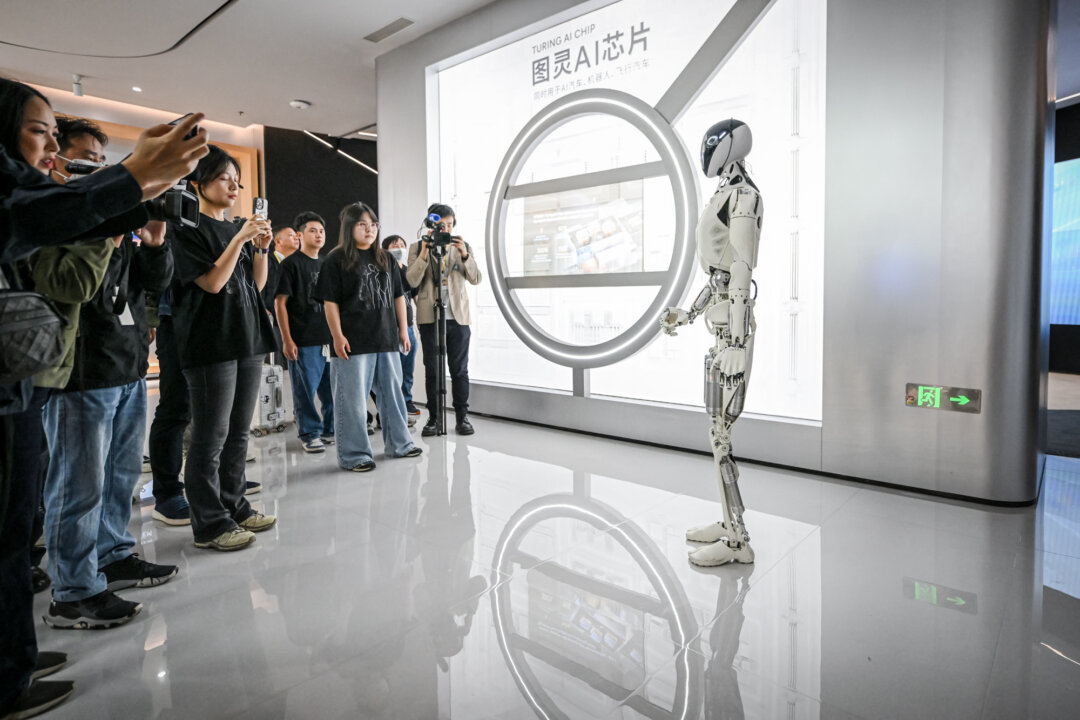
The Chinese regime’s push to reach artificial general intelligence (AGI) first could drastically transform the Taiwan Strait and force the United States into swift countermeasures, experts warn.
AGI is generally defined as an artificial intelligence (AI) system capable of matching or surpassing human-level cognitive performance across the vast majority of tasks and domains.
Raymond Greene, director of the American Institute in Taiwan, said on Sept. 9 that a Taiwan Strait conflict would devastate the global economy more severely than World War II, prompting President Donald Trump’s administration to make peace in the Indo-Pacific a top priority, Taiwan’s national Central News Agency reported.
Greene, whose institute serves as the de facto U.S. embassy on the island, delivered the remarks at the 2026 Taipei Security Dialogue, a forum gathering global security leaders to analyze Indo-Pacific defense challenges.
Greene’s comments follow an Aug. 27 report in which a former White House official said governments must weigh how AGI development timelines correspond to major geopolitical trends.
Authoring the paper, Jacob Stokes, a senior fellow and deputy director of the Indo-Pacific Security Program at the Center for a New American Security (CNAS), highlighted key milestones such as 2027—the year the Chinese People’s Liberation Army (PLA) is ordered to possess the capability to invade or take over Taiwan—or June 2033, when Chinese leader Xi Jinping will turn 80 years old.
Taiwan is a self-governed democracy that the Chinese Communist Party (CCP) has never controlled but has vowed to
annex
, potentially by force.

Raymond Greene, director of the American Institute in Taiwan, speaks at the 2026 Taipei Security Dialogue in Taipei on Sept. 9, 2026. Sung Bi-lung/The Epoch Times
Stokes said the United States should develop a more specific strategy to stop China from developing AGI, including diplomatic, espionage, cyber, or even kinetic attacks on data centers, “meaning destroying things with missiles and bombs.”
But he acknowledged that bombings “would cross a major threshold” in U.S.-China relations, and deciding when to attack would present a difficult decision.
“If the Chinese regime achieves AGI first, the breakthrough would directly impact the Taiwan Strait and necessitate rapid U.S. countermeasures,” Shen Ming-shih, research fellow at Taiwan’s Institute for National Defense and Security Research, told The Epoch Times.
“AGI could instantly command massive numbers of drones and autonomous vessels to launch highly efficient, coordinated strikes, potentially paralyzing Taiwan’s air defense or anti-ship systems.”
The technology would also maximize Beijing’s
cognitive warfare
capabilities, Shen said.
“It can generate indistinguishable videos or related messaging to crush Taiwan’s will to resist,” he said.

Taiwan military personnel rappel down from a Black Hawk helicopter during a spring military exercise in Taichung on Jan. 27, 2026. I-Hwa Cheng/AFP via Getty Images
Shen added that the Chinese regime could use AGI to quickly “reverse engineer”—taking the technology apart to copy its design—and replicate Taiwan’s semiconductor industry.
Taiwan is a global
semiconductor powerhouse
. It’s home to Taiwan Semiconductor Manufacturing Co., the world’s largest manufacturer of advanced AI chips.
Richard Chou Yu-ping, a member of the Evaluation Center Committee at Taiwan’s National Defense Industrial Development Foundation, said that integrating AGI into combat systems could fundamentally alter how Beijing would wage an attack on Taiwan.
“This makes it easier for a country to take high-risk military actions, making the situation across the Taiwan Strait even more concerning,” Chou told The Epoch Times.
‘Brain’ for PLA
Hu Xijin, former editor for Chinese state media Global Times, said on Sept. 4 on X that if the United States attacks China’s data centers, Beijing’s retaliation would “directly target the U.S. mainland with missile strikes.”
Shen said Hu’s aggressive response and the CNAS report highlight the fierce competition between the United States and China over AGI.

One of Aigen’s solar-powered autonomous AI robots called Element demonstrates how it can hammer down targets in Los Banos, Calif., on June 26, 2025. Josh Edelson/AFP via Getty Images
“The fact that the report even raises military strikes as an option in an extreme scenario shows China is rapidly catching up technologically in AGI development and military planning,” he said.
“That’s why Washington views China’s progress as a substantial threat.”
In the AI race, the United States continues to produce more top-tier models and high-impact patents, while China leads in academic publications, citations, overall patent output, and industrial robot installations, according to Stanford University’s 2026 AI Index Report.
Shen said the CCP’s “
military-civil fusion
“—a strategy under which the Chinese regime requires all civilian technologies to also serve military purposes—means any AGI advance in private or state laboratories will be directly applied to the PLA’s command and control systems.
“Such systems will be used to automate battlefield decision-making and conduct cyber warfare,” he said.
Chou said the key is whether the regime is gradually forming a complete AI loop that ties together software agents, embodied robots, and unmanned platforms.
“If China’s loop is established, AI will not just be a part of its weapons systems, but could become the ‘brain’ of its entire military,” he said.
Crossing the Threshold
Chou said Washington would be on high alert and even consider drastic countermeasures if Chinese AI enters the physical world en masse and integrates into the military’s target-and-strike process.

Technicians work on chip-processing equipment at a semiconductor plant in Suqian, Jiangsu Province, China, on Oct. 20, 2025. STR/AFP via Getty Images
“At this stage, AI is no longer just processing information, but starting to take action,” he said.
“If AI assists in everything from identifying threats to executing strikes, the speed of wartime decision-making will increase significantly.”
Chou said if Beijing achieves this level of AI integration, the true competition would no longer be about who possesses more missiles or fighter jets, but who can “perceive, understand, and execute battlefield decisions faster.”
“Washington might view it not merely as a technological race, but as a potential structural shift in national military power,” he said.
Shen said the United States would only turn to its most extreme options if intelligence showed the regime had broken into Western military systems or encrypted communications once considered unbreakable.
“This would mean China’s AI possesses exceptional logical and computing capabilities, approaching the AGI threshold,” he said.
“It would also indicate that Beijing has successfully bypassed U.S. blockades through illicit channels to assemble massive computing systems.”
The U.S. National Security Agency, the Cybersecurity and Infrastructure Security Agency, and on Sept. 8 the Federal Bureau of Investigation
said
in a joint statement that six China-based artificial intelligence companies—likely with Beijing’s awareness—were running “distillation” campaigns to systematically extract proprietary U.S. models.
“
Distillation
” involves using the outputs of costly, large-scale models to train smaller ones, lowering the expense of developing new AI tools.
Global Impact
Shen said the regime’s AGI could severely impact the global order.
“If AGI automates nuclear command systems, it would shorten human response times,” he said. “But a system error could trigger a global nuclear war.”

The new DF-5C global-range strategic nuclear-capable missiles are seen on trucks at a military parade in Tiananmen Square in Beijing on Sept. 3, 2025. Kevin Frayer/Getty Images
If Beijing gains the upper hand, it could use AGI to identify ways to disable U.S. aircraft carriers or satellite networks through cyber and electronic warfare, according to Shen.
“In the worst-case scenario, this could dismantle the military dominance of the United States and the West,” he said.
Shen said Beijing might also use AGI to spread authoritarianism worldwide.
“It can build an omnipresent surveillance system and export this technology to other totalitarian states,” he said.
Chou said warnings from U.S. think tanks show that preemptive action must begin early rather than waiting for the technology to mature.
“True strategic competition doesn’t begin when an adversary deploys its final weapon, but while it is still building those capabilities,” Chou said.







China’s Push for Chip Self-Sufficiency Risks Deepening Its Technology Isolation: Experts
Beijing is investing heavily in domestic chipmakers amid tightening U.S. chip controls,...
25 Dead After Foreign-Flagged Cargo Ship Catches Fire in Eastern China
Firefighters' vehicles park near a cargo ship after it caught fire at...

China’s AI ‘One-Person Company’ Push Faces Oversupply Concerns
China is officially promoting AI-powered “one-person companies” as a way to support...

Australia Warned It Needs to Prepare for a New Battlefront: Space
GOLD COAST, Australia—Australia should expand its sovereign space capabilities, according to visiting...