KEY TAKEAWAYS
-
The far-right party Alternative für Deutschland (AfD), which came out on top in the elections in Saxony-Anhalt, has been pushing an anti-wind farm narrative for several years.
-
The AfD intends to stop the installation of wind turbines, at a time when Germany is rapidly accelerating its energy transition.
-
However, even if it comes to power at the regional level, the AfD will not be able to circumvent national and European climate targets.
September 2026 looks set to be the month of a historic breakthrough for the far-right party Alternative für Deutschland (AfD). In addition to its landslide victory in Saxony-Anhalt on September 6, with 44% of the vote, it is also tipped to win the election on September 20 in Mecklenburg-Western Pomerania, with 36% of voting intentions. In both these Bundesländer and at the national level, the party has campaigned notably against wind turbines. In this respect, what measures have brought the AfD so close to power, and what can we expect to happen next?
The gamble on an ‘anti-establishment’ programme
On energy policy as on other issues, the AfD’s political strategy stands in stark contrast with the traditional parties, which it described as “old parties” (Altparteien) no less than 75 times in its election manifesto for Saxony-Anhalt. The term is used right from the first sentence of the preamble and runs through the entire text, from one thematic area to the next. However, it is not used in the same way throughout, and there is one area in which it pops up with particular insistence: energy policy.
Here, the proposal for a policy that breaks with the traditional parties takes on a specific meaning. Historically, the expression “old parties” was used by Germany’s Green party (die Grünen) to set themselves apart when their party was founded in the 1980s. So the AfD’s mirroring of this phrase becomes all the more significant as it turns this rhetoric of breaking away – which contributed to the “greening” of Germany – against the environmentalists themselves.
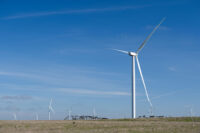
The AfD’s energy policy is one of the three main pillars of its programme. Coming after 43 measures on immigration and 33 measures on education, it comprises 30 measures, at the heart of which lies the issue of wind power. In Germany, the installation of wind farms has always been a divisive issue, but the debate has intensified since the government introduced a new policy to accelerate the energy transition in 2022. As part of this policy, the aim is to dedicate 2% of the national territory to onshore wind by 2032. Consequently, a planning process is underway across all federal states to determine the areas which will be allocated to this form of energy.
Despite the legal obligation to hold public consultations, this can nevertheless lead to frustration among local communities who feel trapped by infrastructure imposed from outside by the powers that be. In certain priority areas (Vorranggebiete), for example, landowners may sign contracts with energy companies with no regard whatsoever for their neighbours’ concerns. Opposition movements then form at the local level, but their demands are generally unmet as the turbine projects do not breach any regulations.
Don Quixote in Germany
Against this backdrop, the fourth energy-related measure in the AfD’s manifesto is explicitly to act as “the advocate for these initiatives” in Saxony-Anhalt. In line with the party’s national strategy, the aim is to oppose what far-right leader Alice Weidel referred to as “windmills of shame” (Windmühlen der Schande) during her famous speech at the AfD’s national congress in January 2025.
Over the past few months, the party has organised several information events to promote its policy, two of which were particularly significant as they took place in German parliaments. The first was held on January 23-24 2026 at the Bundestag in Berlin, and the second on May 9 2026 at the regional parliament of the Free State of Thuringia.

At these events intended for the general public, the aim is to highlight the negative consequences of wind farm expansion, with particular emphasis on the problems inherent in installing turbines in forests, and the impact of this type of infrastructure on soil and biodiversity. In fact, this is where the crux of the entire anti-wind power narrative lies since key organisations such as the German nature conservation association NABU (Naturschutzbund Deutschland) have themselves criticised current energy policy for breaching the European Union’s Birds Directive by contributing to the destruction of protected species.
In Germany, such stances therefore enable the AfD to reignite the “green dilemma” between climate protection and biodiversity conservation. Until wind power was prioritised in 2022, the roll-out of this technology was regularly held back by disputes in which opponents campaigned for the protection of endangered species. In a case study carried out with my colleague Reiner Keller, we were even able to identify more than 500 press articles focusing solely on the issues raised by a single bird of prey: the red kite.
Protecting forests and the biodiversity they harbour is indeed a deeply rooted concern in Germany. Thus, the information events organised by the AfD unite people not only around the party, but also in opposition to wind turbines. Their aim is to rally support beyond the AfD’s core voters by giving a political voice to sidelined causes.
An uncertain political outlook
The question now is how this anti-wind power rhetoric will be put into practice. Whilst the AfD won the regional elections in Saxony-Anhalt by a large margin, it does not hold an absolute majority. Falling 3 seats short of the 42 required, it needs an alliance to govern. Without one, the other parties could overtake it, as was the case in the Bundesland of Thuringia, where the AfD came out on top with 32% of the vote in 2024, only for an unlikely right-left coalition to form and block its path.
This situation may seem surprising at first glance, but it is less so when you realise that the AfD has built its platform in explicit opposition to the traditional right-wing Christian Democratic Union (CDU), which it repeatedly lambasts in its political programme. Furthermore, the “firewall” against the far-right (Brandmauer) has never before been breached to form a governing coalition in Germany. We will therefore have to wait for the election of the minister-president of Saxony-Anhalt – which could be several weeks after the initial vote – to find out whether the AfD will actually govern a federal state for the first time.
If the AfD wins, it will be able to implement its anti-wind turbine policy. Operationally, this policy relies on a measure known as “moratorium”, which is intended to halt the roll-out of wind farms. But what is a wind power moratorium? In theory, the concept of a moratorium refers to a measure suspending the law, rendering it temporarily inapplicable. In practice, however, federal states do not have the authority to override national regulations governing the acceleration of the energy transition. Why, then, use the term ‘moratorium’ to describe measures that are not really moratoriums?
The term is in fact often used to describe deadlock situations that rely on different levers but have comparable effects. For example, when a Bundesland exercises its planning powers to obstruct the energy transition. In this sense, the most likely scenario is that the AfD will introduce a planning moratorium, thereby restricting the zoning of wind farms.
Nevertheless, the current policy framework aimed at accelerating the German energy transition only allows such moratoriums until 2027. Prior to this deadline, the federal states are free to plan for the expansion of wind power. However, if the interim targets set by the national government for 2027 are not met, wind power development will shift towards a market-driven roll-out, with companies developing projects until the relevant Bundesland meets its targets. Consequently, a federal state that opposes wind power expansion too strongly could, paradoxically, find itself becoming one of the most permissive after 2027, despite its intentions.
Can the AfD halt Germany’s energy transition?
Ultimately, governing Saxony-Anhalt would allow the AfD to disrupt the energy transition, but not to halt it outright. In other Bundesländer that have experienced planning moratoriums, such as Brandenburg, it merely delayed the roll-out of infrastructure. With this in mind, such measures represent a hollow victory for those opposed to wind farm projects. In its election manifesto, the AfD itself admits, in this area as in others, its inability to act directly and its need to plead its case before the Bundesrat (the upper house of parliament in which the 16 Bundesländer are represented).
In fact, energy policy does not merely depend on regional control, but on a multi-level governance system combining European directives and national legislation. Yet Saxony-Anhalt holds only 4 out of 69 seats in the Bundesrat. Consequently, the real question raised by such a rise to power is what comes next: will the AfD’s inability to deliver on its political promises lead to further frustration, which could serve as a springboard for national and European elections, or will it breed mistrust amongst an electorate dissatisfied with this unworkable programme?

A weekly e-mail in English featuring expertise from scholars and researchers. It provides an introduction to the diversity of research coming out of the continent and considers some of the key issues facing European countries. Get the newsletter!





Meta is changing Instagram and Facebook to protect teens’ mental health. Are the new measures backed up by science?
The recent landmark ruling against Meta in the United States was the...
What is an ‘associate member’ of the EU? Nobody in Europe seems to have a clue
Canada's Prime Minister Mark Carney, EU Parliament President Roberta Metsola and European...
$1.4B of federal grants spent on research about Justin Trudeau’s speeches, Canadian dancefloors, and low-carbon videogames: CTF
Peace Tower on Parliament Hill in Ottawa on Wednesday, Aug. 19, 2026....

Yoni Goldstein: Macklemore’s cancellation is no victory for the pro-Israel crowd
American rapper, singer, dancer and DJ Benjamin Haggerty, a.k.a., Macklemore. Photo by...