Fed’s 2 Percent Inflation Ambition Is Misguided, Bill Ackman Says
 Naveen AthrappullyUpdated 31 minutes Ago2 Mins read
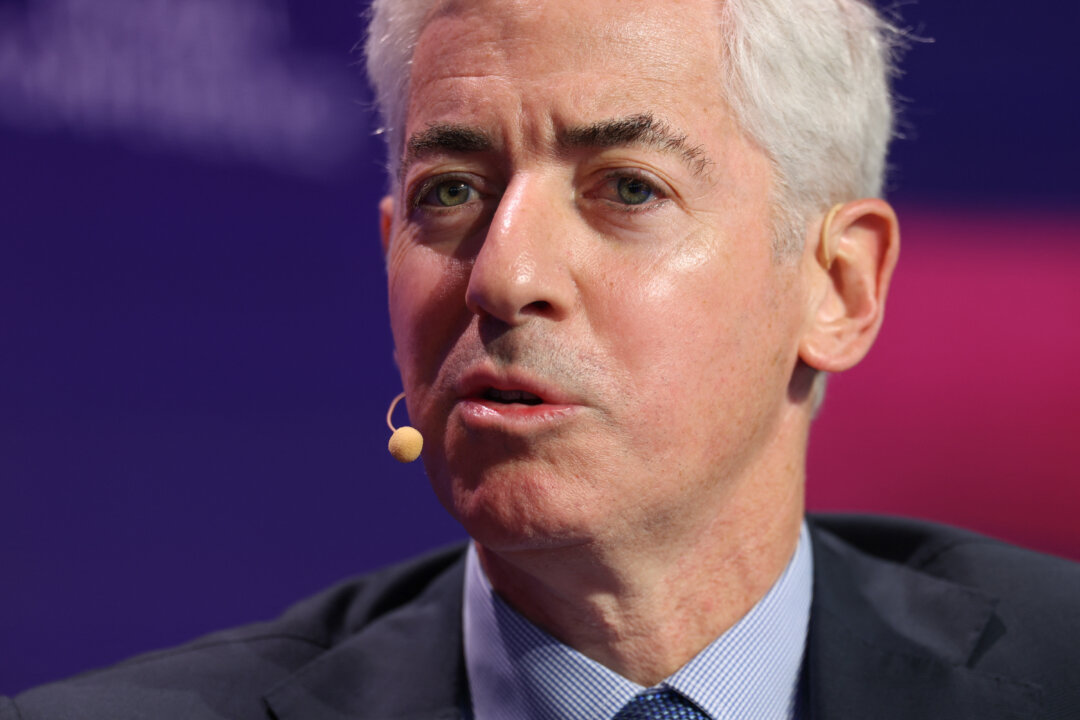

Bill Ackman, founder and CEO of Pershing Square Capital Management, speaks at the 28th annual Milken Institute Global Conference at the Beverly Hilton in Beverly Hills, Calif., on May 6, 2025. Patrick T. Fallon/AFP via Getty Images
The Federal Reserve’s attempt to bring inflation down to 2 percent could be an economic mistake, Bill Ackman, founder of Pershing Square Capital Management, warned.
“I think the Fed is about to make another mistake on December 9th,” Ackman said in a Nov. 22 post on X, referring to the meeting of Fed officials on Dec. 8–9 to decide benchmark interest rates.
At the last meeting in October, almost all Fed officials
agreed
that further rate hikes would likely be appropriate to bring inflation down to 2 percent.
Annual inflation, as measured by the Personal Consumption Expenditures (PCE) price index, the Fed’s preferred inflation gauge, was last below 2 percent in February 2021.
“The Fed’s 2 percent inflation ambition is misguided. Geopolitical risk and the required investment in global military spending, deglobalization and tariffs, and the massive AI infrastructure and related energy investment are features of the world that did not exist when the 2 percent target was set,” Ackman said.
“3 percent inflation is a more realistic ambition in the new world.
“The Fed will put the U.S. and world in recession if it continues to raise rates in a failed attempt to drive inflation to 2 percent.”
Ackman pointed to recent secured financing for SpaceX carrying a yield of 8.26 percent, compared with a weighted-average interest rate of less than 6 percent on the company’s unsecured bonds issued around its June IPO.
Higher Fed interest rates typically raise lending rates, such as for business loans. In a rising-rate environment, businesses may avoid taking on loans for investment or expansion, which can hurt economic growth.
A few participants in the October Fed meeting observed that inflation could prove more persistent than estimated, which could require a shift to more restrictive policies, according to the minutes released on Nov. 18. Such restrictive policies include raising interest rates.
A couple of participants said they could consider a rate hike of more than 25 basis points at the upcoming meeting if inflation data came out unfavorable.
The Federal Reserve explicitly adopted a 2 percent inflation target in 2012. Central banks have since widely adopted inflation targeting, pioneered by New Zealand in 1990.
Rate Hike Probability in December
John C. Williams, president of the New York Fed, stressed the need to tackle inflation in Nov. 23 remarks at the University of Mount Saint Vincent in New York, saying that while the U.S. economy was strong, it was 100 percent essential to bring inflation back to 2 percent.
“We must take actions over time that will ensure that we get inflation back to our 2 percent goal in a timely manner and on a sustained basis. There is still work to do to get that done,” Williams said.
The Fed left interest rates
unchanged
at the October meeting, in a range of 3.75 to 4 percent.
As of 9:50 a.m. ET on Tuesday, federal funds futures were pricing in an almost 96 percent probability that the Fed would raise its benchmark interest rate by 25 basis points to a range of 4 to 4.25 percent at its December meeting, according to CME FedWatch.
President Donald Trump
reiterated
that the central bank must lower the rates.
“Interest rates are too high because we have a very political Fed, and I’m not blaming the chairman, by the way,” Trump told reporters on Nov. 20. “I’m blaming the fact that we have a very political Fed.”
The Federal Reserve raises interest rates after positive economic data when “it should be the opposite,” Trump said.







High-Income Consumers Turning to Buy Now Pay Later: Block
Buy Now, Pay Later (BNPL) services have traditionally appealed to younger shoppers,...

End of Year Tax-Savvy Moves to Make
With the holiday season in motion and the year coming to a...
From Bank Runs to Market Stress—Fed’s Michael Barr Lists AI Risks to Financial Stability
Bank runs, market stress, and “herding” behavior are among the risks artificial...

5 Reasons Why It Might Be Time to Switch to Fiber Internet
By Choncé Maddox From Kiplinger’s Personal FinanceThe average home’s internet demands look...