As the world’s largest country that spans eleven time zones and shares land borders with fourteen countries, Russia’s geography has always posed a difficult problem for government: how to maintain economic activity, infrastructure and basic services across an enormous territory with a highly uneven population.
More than four and a half years of war against Ukraine, sanctions and disrupted international connections have made that challenge considerably harder.
One place where the response to these mounting pressures is becoming visible is Russia’s national spatial policy.
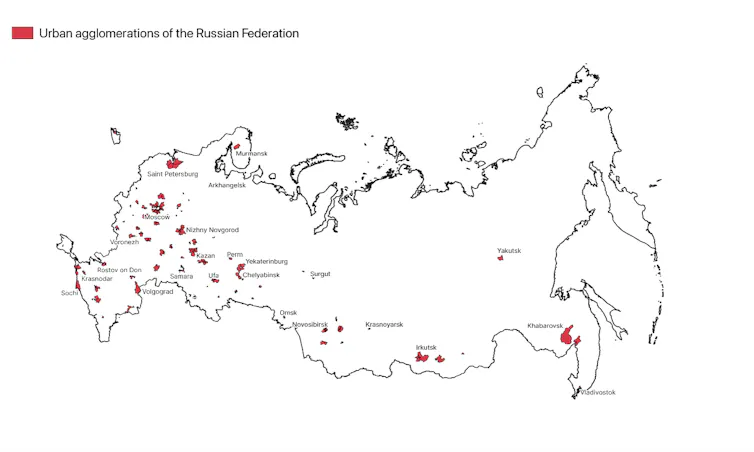
In my newly published research with Anton Gorodnichev, we compare Russia’s 2019 and 2024 spatial development strategies and trace a substantial change in how the state approaches territorial planning. These strategies render Russia’s political choices visible: which places are expected to grow, which should be supported, and for what purpose.
In 2019, national spatial policy centred on 41 large urban agglomerations, expected to drive economic growth nationwide. Five years later, the new strategy identified 2,160 “support settlements” spread across the country, with a task of retaining population, providing essential services and maintaining territorial continuity. The challenge of governing a vast and uneven territory did not disappear. What changed was the government’s idea of what spatial policy should achieve.
When big cities were the answer
Russia’s 2019 strategy belonged to an era when concentrating people and economic activity in large, well-connected cities was widely seen as a route to national prosperity. This was hardly a uniquely Russian idea: international organisations and urban economists had long promoted large metropolitan regions as engines of productivity and innovation, and Russia’s own turn toward agglomerations explicitly drew on European spatial policy, economic geography and the recommendations of international development institutions.
An urban agglomeration is essentially a large city and surrounding settlements linked through jobs, transport and services. The 2019 strategy identified 41 of them and expected them to concentrate investment, technology and population.
But the model assumed a particular set of conditions: available investment, access to international markets, and relatively free movement of capital, technology and people. The 2019 strategy still imagined development in those terms – competitiveness, international integration, connection to global economic networks. Following Russia’s invasion of Ukraine in 2022, many of those assumptions became much harder to sustain.
From growth to territorial stability
After the Russo-Ukrainian war escalated into a full-scale conflict, international sanctions intensified, foreign investment declined, trade and logistics were disrupted, economic links shifted away from Europe, and security and technological self-reliance became more prominent policy concerns. These pressures overlapped with longer-running problems, including demographic decline and large regional inequalities.
In this altered context, a previously peripheral idea – support settlements – became the organising principle of Russia’s 2024 Spatial Development Strategy. Instead of concentrating primarily on a few dozen large growth centres, the latest strategy seeks much broader territorial coverage. Its 2,160 support settlements are highly heterogeneous: most provide services to surrounding territories, while others have border security, scientific or strategic infrastructure functions.
The strategy is also more explicit than the previous one about where the government sees vulnerability. Its expanded category of “geostrategic territories” covers Kaliningrad, the Far East, the North Caucasus and the Arctic, and municipalities bordering countries Russia designates as unfriendly – in practice, mostly European Union member states. Together with the reorientation of trade and logistics corridors toward Asian markets, this reverses the prospects of regions whose development case had been shaped by their proximity to Europe. Places once presented as gateways are now treated as edges.
What ‘support settlements’ are meant to support
The Russian term opornyi punkt, translated here as “support settlement”, has no direct equivalent in international planning. Outside planning the term is used in military and policing contexts for a position that holds a line or anchors control over a district: a point that secures presence and basic functioning across a wider area.
That helps explain the 2024 strategy. Support settlements are meant to hold population and essential services in place across a far wider network than the agglomeration model covered. This has a practical rationale: it can preserve access to schools, healthcare and infrastructure where economic growth is weak. It also keeps the state present in parts of the country from which, on purely economic criteria, it would have been retreating.
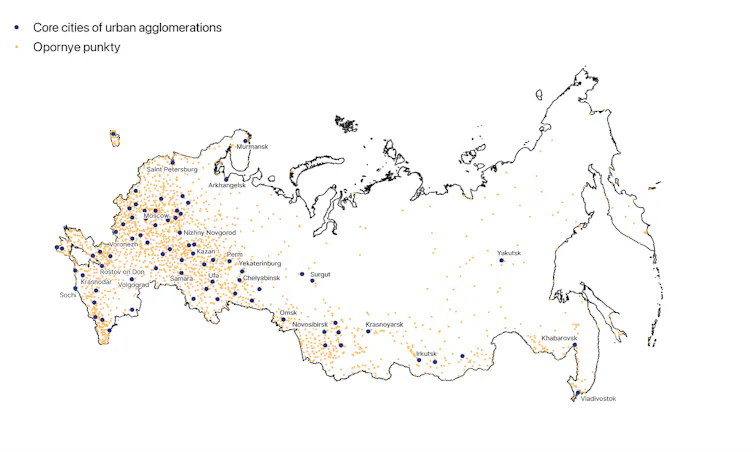
For residents this cuts both ways. Keeping a school, a clinic and a road open in a small town is a real gain, and one that a policy built around a few dozen large cities never promised. But maintaining basic services is not the same as creating jobs, raising incomes or expanding opportunities for social mobility. More than 1,500 support settlements already have persistently low living standards. The new approach therefore risks making ‘not getting worse’ an acceptable measure of success for many peripheral places.
More broadly, the Russian case shows that policy models often appear universal because the conditions behind them are taken for granted.
Agglomeration-led development spread during an era of expanding trade, mobile capital and confidence in metropolitan growth. When those conditions weaken, even deeply embedded planning ideas can lose their force. Russia is no longer asking only where growth can be generated, but what needs to be kept functioning when growth itself becomes harder to count on.

A weekly e-mail in English featuring expertise from scholars and researchers. It provides an introduction to the diversity of research coming out of the continent and considers some of the key issues facing European countries. Get the newsletter!





Strait of Hormuz crisis: how danger and uncertainty can affect the mental health of seafarers
Published: September 10, 2026 7:28am EDT Mariusz Bugno/Shutterstock As instability in the...
Sweden’s prison population has doubled in a decade, and is set to spike even further – here’s why
Sweden’s criminal justice system was once held up as an example of...
Chris Selley: Carney’s EU cuteness is an unwelcome return to Justin Trudeau’s playbook
Canadian Prime Minister Mark Carney speaks during a press conference during the...
10/3 podcast: Canada-U.S. trade war: How did two neighbours become rivals?
Flags of Canada and the United States fly across the international border...