Calisthenics has gained enormous popularity in recent years, particularly thanks to social media and the rise of workout areas in city parks. You probably know some of the moves already, like pull-ups, push-ups, dips and squats.
For the more advanced, it also includes eye-catching, gravity-defying moves like the muscle-up, planche (where the body is held horizontal, supported solely by the hands) or the front lever (where the body is held horizontally while hanging from a bar).
But is calisthenics an effective form of exercise, or just another fitness fad? To answer this question, we first need to clarify what it is.
Calisthenics is a form of training that mainly uses a person’s own body weight as resistance. Its name derives from the Greek terms kállos (“beautiful”) and sthenos (“strength”), though the word’s modern use only caught on during the 19th century, when it referred to various forms of physical exercise.
Today, it includes well-known exercises such as squats, lunges, push-ups, pull-ups and dips, but calisthenics is not inherently acrobatic. Anyone who starts by doing a simple wall push-up is using the same principle as someone doing a one-arm push-up on the ground: moving their body against gravity.
Our body weight is a considerable load. During a conventional push-up, for example, the arms can support around two-thirds of the body’s weight. Resting on your knees or elevating your hands can reduce the load, while elevating the feet will make it harder.
A portable gym
Its simplicity makes calisthenics a particularly attractive option for those looking to start exercising. It does not involve going to the gym, using machines, or spending a much money. You can do it at home, in a park, or practically anywhere.
The 2026 recommendations from the American College of Sports Medicine (ACSM) – which were made following an overview of 137 systematic reviews involving a total of more than 30,000 participants – support the idea that bodyweight training and home-based programmes can improve strength and physical function.
One study comparing progressive push-up and bench press exercise programmes found strength gains in both groups. Another trial adjusted the difficulty of the push-ups to make them comparable to the resistance used in the bench press. It observed similar improvements in both strength and muscle thickness of the pectorals and triceps after eight weeks.
The explanation is relatively simple: our muscles do not know whether the resistance comes from a dumbbell, a machine, or our own body. What they need is exertion that gradually increases over time
And this is where a vital concept comes in: progress.
Read more: Strength training can have unique health benefits, and it doesn’t have to happen in a gym
Not just more reps
Training with our own body weight does not mean simply doing more and more repetitions. We can vary levers, support points, the range of motion or the distribution of weight.
A push-up, for instance, can start against a wall, continue with the hands on a raised surface, then move to the floor and progress to increasingly challenging variations.
This way of making progress also has an additional feature: it forces us to learn how to move our own bodies. As we change positions and points of support, we must pay attention to core control, balance, range of motion and our ability to maintain proper technique.
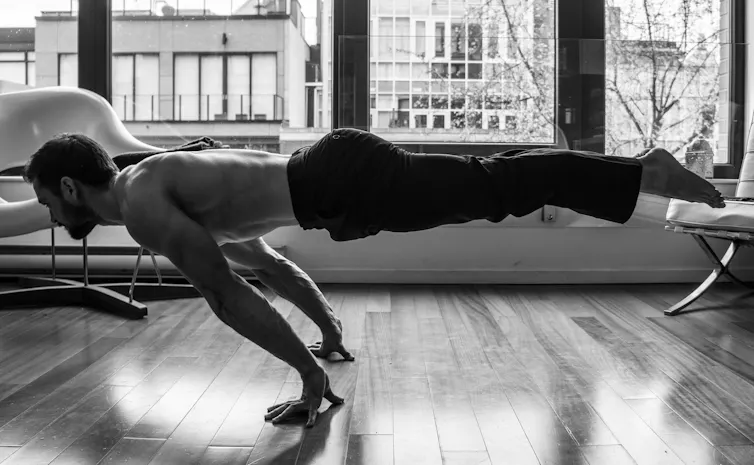
In this way, we can gradually recognise the extent to which we have control over a movement, when we lose stability, or which variation is still too difficult. This does not mean that calisthenics automatically develops better body awareness than other methods, but it does make the mechanics of the movement itself an important part of adjusting a workout’s intensity.
But this is also where one of its main limitations lies. A push-up may be easy for one person, but extremely demanding for another. A pull-up might just be a warm-up for someone with high relative strength, but practically impossible for a beginner. Weight-free does not necessarily mean “easy”.
That is why calisthenics, like any form of training, must be tailored to the individual. For some people, the starting point will be a squat, while for others, simply standing up and sitting down from a chair is enough. The key is to find a variation that presents a manageable challenge and to build on that.
Read more: Where does fat actually go when you lose weight? The answer is in your breath – and your sweat
A false dichotomy
So which is better, calisthenics or weights? In truth, this is the wrong question to be asking.
Weights allow you to increase the difficulty very gradually by simply adding a few extra kilos. In calisthenics, on the other hand, making progress usually involves changing your body position or moving on to a more challenging variation, and that change cannot always be made so gradually.
For example, a person might start by doing a TRX row, which involves pulling the body towards a pair of handles whilst keeping the feet flat on the floor. As they build strength, they can gradually lean their body further to increase the difficulty. However, progressing from this to a pull-up means lifting a much greater proportion of one’s body weight, making it far more demanding.
This difference is particularly evident in people with high strength levels and, more generally, during leg exercises. When our own body weight no longer provides enough resistance, adding external resistance through weights can allow us to keep making progress in the same exercise.
The ACSM’s recommendations suggest that, if we want to improve our ability to lift very heavy loads, we should also train with high resistance. However, to increase muscle size we don’t always have to train with very heavy weights: lighter loads can yield improvements, as long as the exercise itself is challenging enough.
A good starting point
Calisthenics and weight training should not be seen as opposing methods, but rather as complementary tools. When, for instance, pull-ups using only body weight become too easy, extra resistance in the form of weights attached to the body can increase the difficulty.
Ultimately, the principle remains the same. Calisthenics works not because our body has any magical properties as a training tool, but because it is, in itself, a form of resistance. Learning to move it, control it and gradually make it stronger is one of the simplest, cheapest ways to start training.
We don’t need to start by doing pull-ups or muscle-ups. For some people, doing their first push-up with their hands against a wall is already an excellent starting point.

A weekly e-mail in English featuring expertise from scholars and researchers. It provides an introduction to the diversity of research coming out of the continent and considers some of the key issues facing European countries. Get the newsletter!




Inside the Parti Québécois’ campaign, where smiles are in short supply
Article contentDuchesne said, despite the criticism of Santé Québec which the PQ...

Wins of the Week 142 with Ted Kuntz
Accountability, medical freedom, and institutional reform advanced across several fronts this week.In...

🔥 The Promethean Weekly · September 7–13, 2026
🔥 The Promethean WeeklySeptember 7–13, 2026 · Your week behind + the...

Trump says ‘whoever wins AI wins’ as tech CEOs hit the brakes
U.S. President Donald Trump has pushed back against calls to slow AI...