
Commentary
China’s ongoing economic deconstruction is like watching a train wreck in slow motion, with one boxcar after another coming off the track. The thing about train wrecks is that getting the train back on track isn’t easy or quick.
For years, China’s slowdown was said to be cyclical, just one more stimulus package away from recovery.
Nobody believes that anymore; certainly not the Chinese people.
What’s unfolding now in China is a structural collapse that’s self-reinforcing because the Chinese Communist Party (CCP) is incapable of correcting itself.
Domestic Demand Has Cratered
No one is more tuned in to China’s economy than the consumers living in it. China’s consumer price index rose just 0.5 percent year-over-year in July 2026, its slowest reading since January and well below forecasts. That statistic alone indicates weakness in the domestic economy.
Core inflation is also weak. This isn’t a fluke in economic statistics. China has seen about 10 consecutive quarters of deflationary pressure, the longest deflationary period since it became a market economy in the late 1970s.
As a result, consumer households are facing multiple challenges simultaneously. Home values are falling, income is stagnant, and job insecurity and unemployment are rising. As a result, Chinese consumers are spending less and saving more.
The Savings Rate Keeps Climbing Instead of Falling
That’s a big red flag.
A healthy consumer economy needs households to spend, not hoard, money. But even as real disposable income growth continued to decelerate, household savings hit
in early 2026.
That’s the exact opposite result that China’s stimulus plan was supposed to produce. But people struggling through the extended economic malaise in which they’ve lived for years now know the reality.
When they don’t trust the property market, the job market, or the safety net promised by the CCP, they save instead of buy. That single behavioral shift is strangling the demand side of the entire economy.

A bank employee counting 100-yuan notes at a bank counter in Nantong, in eastern Jiangsu Province, China, on June 13, 2023. STR/AFP via Getty Images
Fixed Asset Investment Isn’t Just Slowing—It’s Shrinking
Fixed-asset investment fell
in the first half of 2026, worse than forecast and accelerating from a 4.1 percent decline in May. That’s a huge negative for a manufacturing-based economy such as China’s.
But even if real estate is removed from the calculation, investment is still falling. This is a country whose entire growth model for three decades ran on building things. That engine is now in reverse.
Beijing’s Response? Overproduction
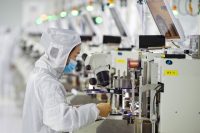
As a result, China’s daily output of integrated circuits topped
in the first half of 2026 alone, far beyond what domestic buyers can absorb.
Even the solar power sector, which China dominates, is underwater. Solar giants Tongwei, LONGi, and TCL Zhonghuan were projected to post combined
yuan in the first half of 2026, driven by oversupply alone.
Economists call this downward spiral of price reductions “involution,” in which companies slash prices to survive. The price cuts narrow profit margins, force wage and job cuts, and further weaken demand. This dynamic, in turn, triggers a new round of price cuts, and so on.
The outcome, of course, is predictable: companies’ profitability goes away. Today, more than a quarter of listed Chinese companies are now unprofitable, the
in 25 years.
The Export Lifeline Is Fraying
Unable to generate domestic demand, the CCP is relying on export manufacturing, the country’s primary advantage in the global economy. As a result, China posted a record $1.2 trillion trade surplus in 2025, with exports climbing even as imports stayed flat.
But that surplus exists only because Chinese exporters rerouted shipments away from a tariff-walled United States and
instead. China now accounts for roughly 30 percent of global manufacturing output while representing only 13 percent of global consumption.
This imbalance has not gone unnoticed. China’s practice of dumping underpriced goods could be destroying European manufacturers. China’s trade surplus with the European Union (EU) hit 360 billion euros in 2025 and rose another 24 percent in the first half of 2026.
The EU’s tolerance (and Japan’s) for such behavior has been exhausted.
Europe and Japan are actively de-risking their economies with respect to China. The EU is slashing tariff-free steel quotas by 47 percent and doubling out-of-quota duties to 50 percent through 2031, with
designed to stop Chinese steel from being rerouted through third countries.

Rolls of steel are seen at a steel market in Fuyang, in eastern Anhui province, China, on Feb. 10, 2025. AFP via Getty Images
In fact, the rest of
absorbing China’s underpriced goods and destructive policies. Recently, the Group of Seven leaders, without naming China directly, formally flagged the trade imbalance as a shared concern.
Furthermore, the EU faces slower growth and recession risk, shrinking the very markets Beijing needs to dump its surplus into.
The foreign markets Beijing has relied on to absorb its domestic overcapacity are erecting increasingly tough barriers.
Youth Unemployment High, Even as Youth Population Shrinks
As China’s population
, so does its youth population. This should make it easier to find jobs.
But that’s not the case.
Urban youth unemployment (ages 16–24, excluding students) was 14.9 percent in June 2026.
than the 14.5 percent recorded a year earlier, despite months of modest improvement. That number was actually above 21 percent in 2023, before the CCP changed the counting method.
The bottom line is that in the world’s largest manufacturing economy, too many young people can’t find work. That’s proof the economy isn’t generating enough opportunity even for even smaller numbers of young people.
As bad as it is now, the
can’t be ignored, either. Fewer workers mean permanently lower production and consumption.
The Deepest Problem Is Political, Not Economic
At the center of this downward spiral is the CCP. It is, after all, running the economy, even as it runs it into a ditch. The worse things get, the tighter the Party’s grip becomes. The tighter that grip, the less capacity the economy has to self-correct.
The picture isn’t pretty.
This isn’t a slowdown waiting for the next quarter’s data to turn around. It’s a system run by the CCP that is incapable of fixing its own mistakes as it drives the country to ruin.
Views expressed in this article are opinions of the author and do not necessarily reflect the views of The Epoch Times.