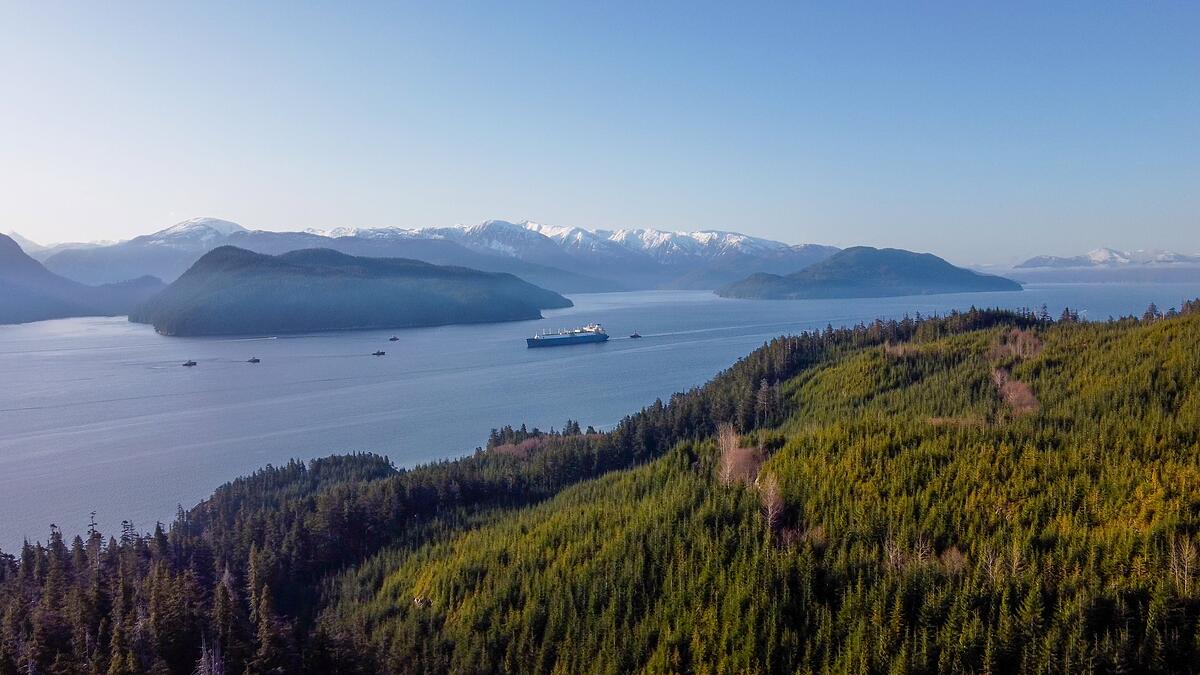
International oil and gas supermajor Shell has given the financial green light to the second phase of the giant LNG Canada export facility in Kitimat, BC, moving ahead a project that aims to double the capacity of the existing terminal and position Canada as one of the world’s biggest suppliers of the supercooled gas.
The final investment decision on the $33-billion project, being developed by the Anglo-Dutch energy company with Asian partners PetroChina, Petronas, Mitsubishi, and KOGAS, would raise capacity to 28 million tonnes per annum (mtpa) from 14mtpa by adding two additional LNG processing trains and new storage tanks at the site.
Commercial operations are targeted for the early 2030s. The enlarged LNG Canada project, which will be fed by TC Energy’s to-be-expanded 670-kilometre Coastal GasLink pipeline, represents more than a quarter of Ottawa’s ambition of expanding the country’s LNG export capacity to 100 million tonnes annually by 2040.
Prime Minister Mark Carney, speaking today in Vancouver at the announcement, said LNG Canada, which had been referred to the Major Projects Office 12 months ago, was an example of the government advancing industrial developments under its “one project, one review, one year” strategy.

“This project will connect low-cost, low-carbon Canadian energy to global markets, providing the secure supply our partners in Asia and Europe need,” he said.
“This is Team Canada at work. All levels of government are pulling in the same direction along with dozens of First Nations, five global energy companies, and thousands of skilled trades, contractors, and communities,” Carney said. “The speed of this project shows that now when Canadians want something built, we will get it built.”
Federal Energy and Natural Resources Minister Tim Hodgson framed the go-ahead as a transformational step for Canada’s national economic standing, calling it “a massive vote of confidence in Canada.”
“At a time when our country must build a stronger economy that allows us to be an energy superpower for the long term, this is exactly the kind of investment Canada needs [to] turn our world-class resources into Canadian lasting prosperity.”

LNG Canada’s CEO Chris Cooper said the project would advance the government’s “nation building” energy expansion strategy and “demonstrate Canada can build big things.”
The Phase 2 expansion is putting the facility “on a trajectory to become one of the largest LNG facilities in the world and helping move Canada toward becoming one of the world’s top five LNG exporting nations,” he said.
Construction jobs promise
Cooper noted that Phase 2 would create up to 4,000 construction jobs in Kitimat at peak construction, alongside 2,100 jobs building new pipeline compressor stations, and add roughly 90 full-time roles and 150 contractor positions to the operational workforce once the terminal is online.
Government and proponents of the project estimate it could yield over $50 billion in public revenues over its operational life cycle.
The investment decision also seals a landmark $1-billion equity stake for MNT Investments — representing the Gitga’at, Gitxaała, Haisla, Kitselas, and Kitsumkalum First Nations — to purchase the facility’s new storage tank, marking one of the largest Indigenous infrastructure ownership transactions in Canadian history.
Despite high-level backing, some energy finance analysts continue to raise warning flags about LNG Canada 2, highlighting that the project faces a more challenging economic landscape than Phase 1, which came online in 2025.
Mark Kalegha, an energy finance analyst at the market intelligence firm the Institute for Energy Economics and Financial Analysis (IEEFA), cautioned that go-head for Phase 1 of LNG Canada should not be taken as grounds for assuming that the second phase will automatically be economically viable.
“LNG Canada Phase 2 is not simply a duplication/twinning of Phase 1: it faces a materially different risk environment,” he said, in a new report on the project. “Construction of Phase 2 will have to contend with volatility and increases in prices of labour, steel, equipment, debt and other input costs.”
Meeting new natural gas demand
Doubling terminal output would require delivery of some 4.2 billion cubic feet per day of natural gas, tightening Western Canadian supply markets and jacking-up Alberta’s benchmark prices and pinching operating margins.

Kalegha also warned of a potential global supply glut, with 254 mtpa of new competing LNG capacity entering service in the US and elsewhere between 2026 and 2030, while spot-market trading is set to exceed 35 per cent. He added that Shell and Mitsubishi are reportedly reviewing their stakes.
“The motives behind these divestments are unknown, but the shift in ownership — with core members of the original consortium reducing their stakes at a critical time when new capital is needed — raises questions,” he said.
Sustainability and climate advocacy groups responded with sharp opposition to the announcement, citing the onerous taxpayer risks of the project, along with the negative environmental impacts of gas flaring from the terminal — an issue that continues to plague the facility built for LNG Canada.
Nichole Dusyk, lead of the Canada Energy Transition team at the International Institute for Sustainable Development’s (IISD) Energy program, criticized the public financial exposure and climate trade-offs.
“LNG Canada Phase 2 is putting Canada’s climate goals on the back burner for little public benefit and substantial taxpayer risk,” Dusyk said, noting that Phase 1 is on track to receive at least $1.36 billion in public support by 2030.

“Taxpayer dollars are being funnelled to this project in a moment of uncertain long-term demand. Whether it’s a question of long-term economic or environmental stability, this project is a risk.”
Dusyk added that LNG Canada Phase 1 is emitting 2.1 megatonnes of CO2 equivalent a year – equal to the exhaust from 450,000 cars – and that would double under Phase 2.
Richard Brooks, climate finance director at Stand.earth, delivered a blunt appraisal of the operating LNG export facility’s operational performance to date.
“LNG Canada, entirely foreign-owned, is already one of the largest sources of climate pollution in Canada,” Brooks said. “Since it started operating, it has continuously malfunctioned and won the coveted award for flaring the most gas of any LNG facility in the world.”
“Its flare stack puts Mordor to shame,” he said, comparing the terminal’s visual and environmental footprint to the fictional land ruled by the evil Dark Lord Sauron in author JRR Tolkien’s Lord of the Rings.
“Expanding malfunctioning LNG Canada is like betting on a concrete canoe at a sailing regatta,” Brooks said, adding that building Phase 2 would make it impossible for BC to reach its climate action target of reducing the province’s emissions by nearly 50 per cent by 2030.
“Real federal government leadership should be about ratcheting up investments to accelerate clean energy projects,” he added.
September 29th 2026