Macron Calls for Plan to Protect Against Russian Hybrid Attacks
 Guy BirchallUpdated 4 days Ago3 Mins read
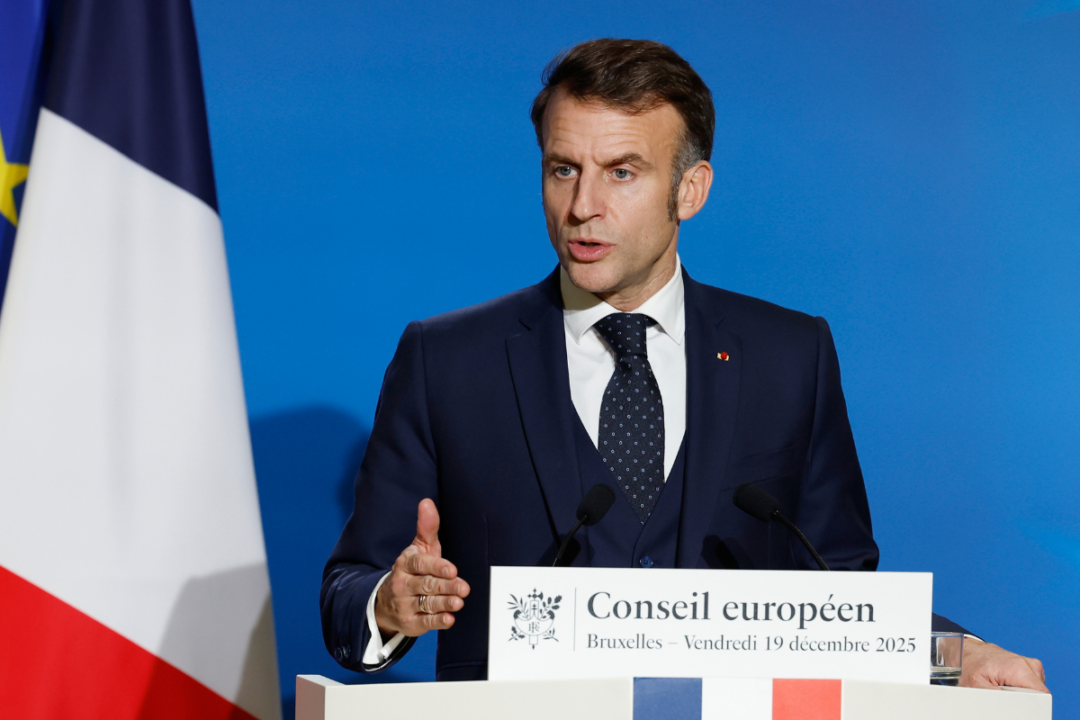
French President Emmanuel Macron on Friday called for a plan to protect France’s infrastructure from Russian hybrid attacks.
Macron said he had asked his government to begin formulating such a plan after holding a private meeting with members of the cabinet, the security services, and leading figures from all the parties represented in the French parliament at the Élysée Palace in Paris.
Speaking to the press after the meeting, Macron warned that “the nature of Russian aggression and threats in Europe is changing,” saying that the plan will cover “drone attacks” and “cyberattacks” as well as “the most sensitive sites in our defense industrial and technological base.”
“The Russian hybrid threat against Europeans and against France has intensified,” Macron said, citing the examples of the attempted drone attack on Leipzig/Halle Airport in Germany, and the strike on a passenger train travelling from Kyiv toward the Polish border, among other incidents.
Macron also revealed that France, itself, had been the target of hybrid war, saying the country had suffered information and cyber attacks, but stressed that the country, and the continent, would not waver in its support of Ukraine.
“The intention behind these attacks is to intimidate us and undermine the effort to support the Ukrainians. The result will be the opposite,” he said.
Macron’s remarks come just a day after Polish Prime Minister Donald Tusk warned that Russia is planning hybrid strikes with drones or rockets on European countries supporting Ukraine, including Poland.
“There is a real risk that drones or other types of missiles could enter the territory of one or more NATO countries on the eastern flank, even causing damage,” Tusk said in a speech to the Polish parliament, according to the Polish Press Agency (PAP).
Tusk added that Moscow would pretend such attacks were “accidental” to “paralyze or at least weaken the motivation of NATO countries” to defend the member state under attack.
“The official narrative will be that this is a coincidence and that there is no reason for anyone to think about any response from NATO,” he said, suggesting the goal of such actions is to prove NATO’s Article 5 is “more theoretical than practical.”
Macron described Tusk’s remarks as “solid and well-substantiated” when asked about them at the Élysée press conference.
The two leaders’ comments come at a time of heightened tensions between European NATO capitals and Moscow.
Germany pinned the blame on Russia for last month’s attempted drone attack on Leipzig/Halle Airport on Sept. 2, with Berlin announcing a string of diplomatic measures against Moscow in response, including the closure of the Russian Consulate General in Bonn and the Russian House in Berlin.
Moscow, which denies any part in the attack, responded in kind the following day, announcing the closure of three branches of Germany’s Goethe Institute in Russia.
On Sept. 13, a Russian drone struck a train on Ukraine’s border with Poland shortly after a group of American and European officials had left the station.
Former CIA Director David Petraeus, former British Prime Minister Boris Johnson, and former Swedish Prime Minister Carl Bildt were among the dignitaries who narrowly avoided the drone attack.
In a statement on Telegram, Ukrainian railway operator Ukrzaliznytsia said it was “quite likely that the target of this Russian drone could also have been the diplomatic train.”
While Russia did not deny responsibility for this attack, it did accuse Ukraine of using foreign dignitaries as “human shields” on Sept. 15.
Russian Ministry of Foreign Affairs spokesperson Maria Zakharova said that Moscow forces exclusively target “military installations and the Kyiv regime’s military-used transport and logistics infrastructure.”
She said that Russia has “repeatedly warned that railway junctions, depots, and rolling stock, particularly locomotives, which are actively used to transport Western weapons for the Ukrainian Armed Forces, are legitimate military targets” and labeled the outcry over this particular strike a “cheap PR campaign.”
Zakharova said that Moscow has tried to alert what she called “Western political tourists” to the “fact that the Zelenskyy regime is cynically using them as ‘human shields’ to protect its military convoys.”
Russia has consistently denied engaging in hybrid warfare against NATO countries.
The Epoch Times contacted the Russian Ministry of Foreign Affairs for comment but did not receive a response by the time of publication.






At UN, Trump threatens Iran with ‘hell,’ then after reveals the two sides had ‘very productive’ talks
U.S. President Donald Trump addresses the United Nations General Assembly at the...
EU tells Zelenskyy to strengthen rule of law in Ukraine before any more monetary aid comes
Ukraine's President Volodymyr Zelensky meets with European Commission President Ursula von der...
Republican senator calls for probe into Trump family’s financial dealings
U.S. President Donald Trump with his son Donald Trump Jr. in May...
EU Removes 2 Russian Oligarchs From Sanctions List
Ambassadors of the European Union’s 27 member states removed three people and...