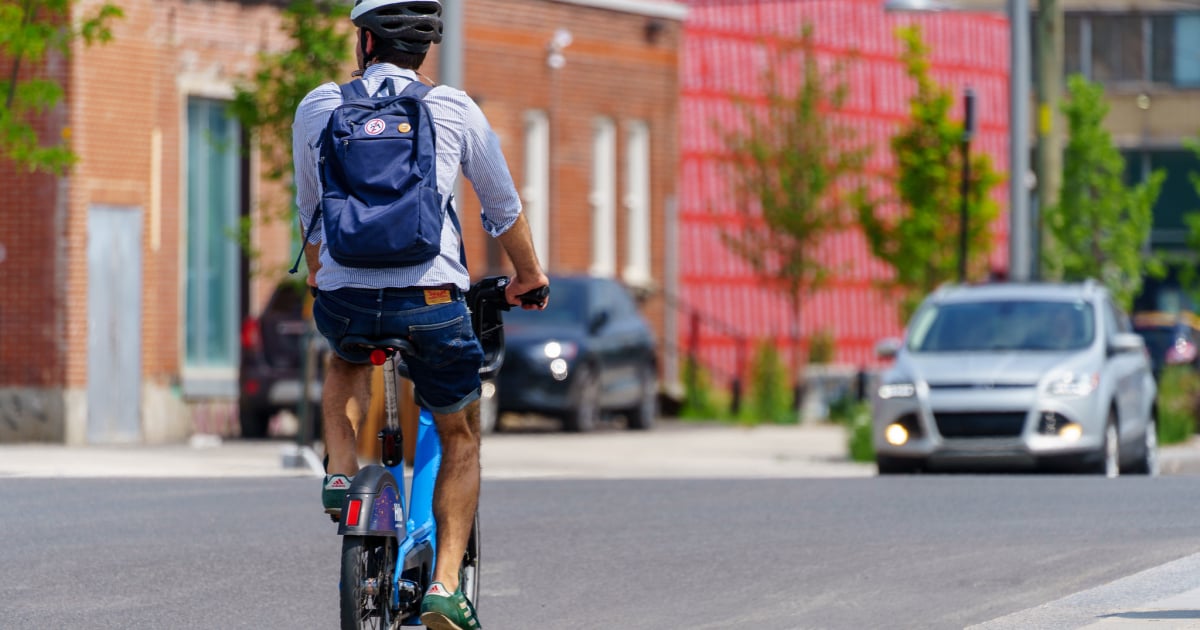
One day they are motorists, the next they are cyclists, and the day after that, they are taking the métro: Montrealers regularly or occasionally use an average of 3.6 modes of transportation. And three-quarters of people who own a car support expanding the cycling network — likely because they also sometimes cycle to school or work.
These findings come from a survey on transportation in the Mercier–Hochelaga–Maisonneuve (MHM) borough obtained by Le Devoir. The analysis debunks persistent myths surrounding the supposed “war on cars” said to be taking place in Montreal.
There are real tensions between cyclists, motorists and pedestrians sharing the road, but Montrealers believe traffic-calming measures — bike lanes, speed humps and curb extensions — can improve safety for all road users. This conclusion is not surprising, given that each resident travels in four ways on a regular or occasional basis: on foot (25 per cent of the time), by bus or métro (24 per cent), by bicycle (21 per cent) and by car (30 per cent).
“People use all modes of transportation and want to be able to use all modes of transportation safely. It is the responsibility of public authorities to provide them with all the options they need to get around,” said Sarah V. Doyon, a city councillor in the MHM borough.
The Projet Montréal elected official conducted an online consultation and held two workshops on mobility last June. A total of 410 people responded to the online questionnaire, while about 20 residents took part in each of the two in-person sessions.
Adding ashtrays and removing bike lanes?
Doyon conducted this exercise as a complement to a consultation carried out earlier this year by the MHM borough, led by Mayor Chantal Gagnon of Ensemble Montréal, the party of the city mayor Soraya Martinez Ferrada. The consultation is intended to update the borough’s Local Mobility Plan.
The borough’s consultation drew sharp criticism over questions that were deemed incongruous. For example, adding ashtrays near sidewalks was among the measures suggested to make it easier to get around on foot. Removing a bike lane was also offered as a response option, even though Soraya Martinez Ferrada has repeatedly said she rules out that possibility.
“I felt that some major pieces of information were missing for us to be able to develop a transportation plan that meets the needs of the population. I decided to launch this initiative as well because this is my area of expertise,” said Doyon, who headed the organization Trajectoire Québec for six years.
She said she hopes her findings will be incorporated into the new MHM borough Mobility Plan, which is expected this fall.
Some 46 per cent of respondents to the consultation conducted by the Projet Montréal councillor own a car, but barely half of them use their vehicle as their primary mode of transportation. Most car owners (77 per cent) support continuing to expand the cycling network.
‘Cars should not be demonized’
Projet Montréal elected officials are often portrayed as cycling activists, but Doyon defies that stereotype: she drives her two daughters to activities across the city. For her other trips, she is most often seen taking the bus or métro. Less often, she rides a bike.
“Cars should not be demonized. We haven’t reached the point where we no longer need cars. For some people, a car is essential. And that’s OK. We shouldn’t think that when we build cycling or pedestrian infrastructure, it’s to make life harder for motorists. We’re not taking anything away from anyone; we’re expanding people’s options for getting around safely,” the councillor added.
She does not understand why the borough has reduced by one-third the length of the proposed redesign of Hochelaga Street, which includes a protected bike lane in each direction and pedestrian crossings. Until recently, the thoroughfare looked more like a highway, with three lanes in each direction.
It was one of the city’s most dangerous streets: no fewer than 1,128 collisions involving motor vehicles occurred over six years along a 6.5-kilometre stretch. Three people were killed in those collisions and 348 were injured between 2015 and 2021. Most of the victims were travelling on foot or by bicycle.