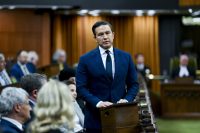

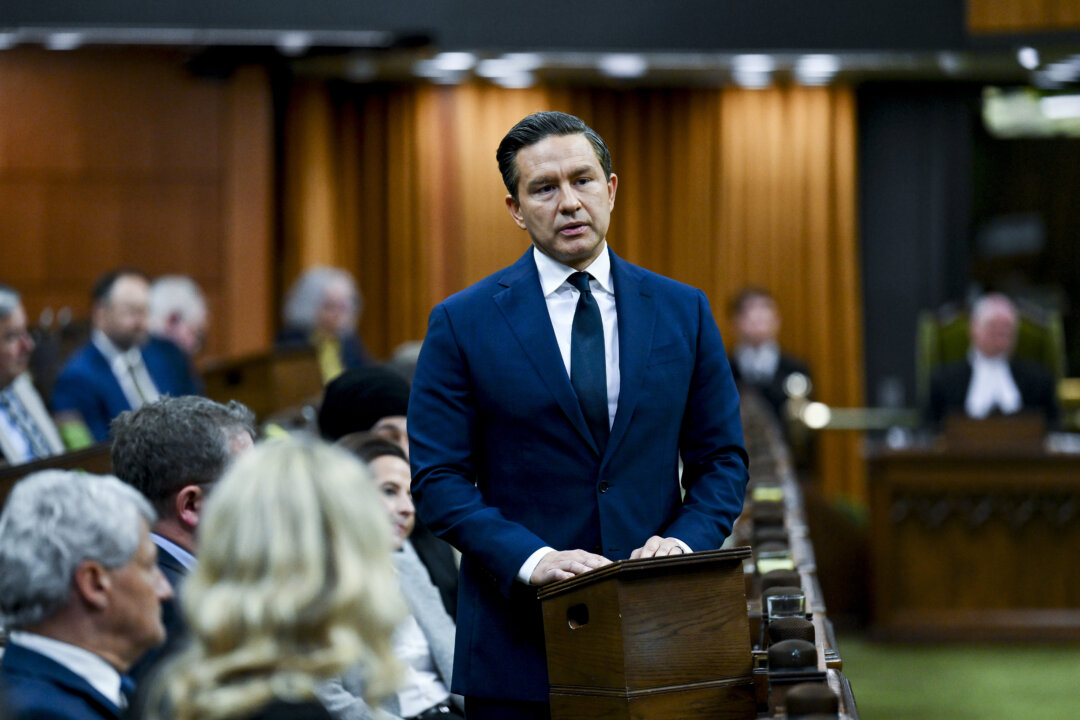

Leader of the Conservative Party Pierre Poilievre rises on a Standing Order in the House of Commons on Parliament Hill in Ottawa, on May 28, 2026. The Canadian Press/Spencer Colby
Conservative Leader Pierre Poilievre is urging the federal government not to reinstate the federal fuel excise tax on gasoline and diesel when the temporary suspension expires on Sept. 7.
“I am officially calling on Mark Carney to cancel his planned gas tax hike in September. Canadians cannot afford yet another 10 cents a litre at the pump,” Poilievre said during a press conference in St. John’s, Nfld., on Aug. 6.
The Conservative leader also repeated his call for the government to end all taxes on gasoline and diesel for the remainder of the year. The Tories estimate the measure would save Canadians about $20 per tank of gas, while a family of four would save roughly $500 over the rest of the year.
The Conservatives say that, after adjusting for exchange rates, Canadians pay nearly 20 cents more per litre than Americans.
“These taxes do not just punish drivers. They raise the cost of every meal, home and product shipped by truck or train. That means even higher grocery prices, which are already rising faster in Canada than in any other G7 country,” Poilievre said.
A recent Leger poll found 63 percent of Canadians oppose Ottawa reinstating the federal fuel excise tax in September, including 43 percent who strongly oppose its return.
The Tories tabled a motion on April 15 to remove all federal taxes on gas and diesel for the rest of the year, but the motion was defeated with the Liberals, Bloc Québécois, NDP, and Green Party voting against it.
On April 20, the federal government suspended the federal fuel excise tax on gasoline, diesel, and aviation fuel across Canada until Sept. 7. The government said this move was expected to reduce Canadians’ bills at the gas station by 10 cents per litre on regular gasoline and 4 cents on diesel.
The suspension of the gas tax came in response to the U.S.-Iran war that began in late February, which led to Tehran virtually closing the Strait of Hormuz, a waterway through which around 20 percent of global oil and gas supplies travel. The start of the conflict led oil prices to surge from US$70 to over US$100.
Oil prices fell in June after the United States and Iran implemented a ceasefire and signed a memorandum of understanding to begin negotiations to fully end the war. But the agreement broke down in July and the conflict resumed, leading to oil prices rising once again.
In March, members of the International Energy Agency (IEA) agreed to release 400 million barrels of oil from reserves to address rising oil prices, which was the largest release in history. Canada committed to release 23.6 million barrels, but because it does not have a strategic oil stockpile given its role as a global exporter of oil, it pledged to release barrels through additional exports.
Natural Resources Canada told The Epoch Times that Canada’s energy exports are also “set to expand, with increased liquefied natural gas exports in the near term and liquefied petroleum gas exports beginning in early 2027.” The agency said Canada also remains open to investment in “commercially viable energy projects” to expand production capacity.