

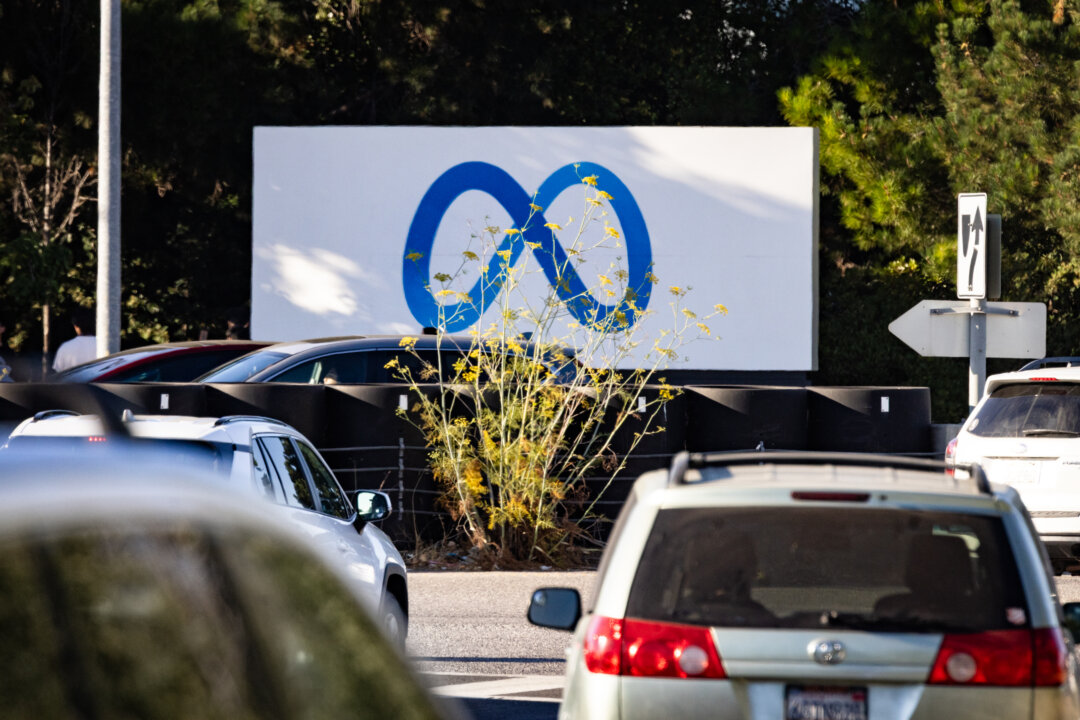

The offices of Meta in Menlo Park, Calif., on July 31, 2025. John Fredricks/The Epoch Times
Poland has asked the European Commission to impose a $291 million fine on Meta Platforms, saying that it repeatedly failed to remove fraudulent advertisements.
It follows Meta being ordered to pay $18 billion under an agreement with U.S. states announced Wednesday to resolve claims that it designed its social media platforms to addict children.
Polish Digital Affairs Minister Krzysztof Gawkowski urged the commission in an Aug. 26 letter to broaden its investigation into Meta’s compliance with the European Union’s Digital Services Act and to use its enforcement powers against the company.
Gawkowski said during an Aug. 27 press conference that the government had evidence that Meta was prioritizing its own commercial interests over user safety.
The minister cited tests by CERT Polska, Poland’s national cybersecurity team, which identified 122 advertisements it classified as fraudulent.
In his letter, Gawkowski said Meta left 106 of those advertisements online, about 86 percent of the reports. The company removed 10 advertisements, while six reports received no response, he said.
Gawkowski also cited a complaint filed in May by BEUC, the European Consumer Organisation, which documented nearly 900 reports of scam advertisements and other fraudulent content across 13 countries.
According to Gawkowski, the platforms removed only 27 percent of the reported content, while more than half of the reports were rejected or received no response.
The appeal to Brussels followed an earlier warning sent directly to Meta.
In an Aug. 18 letter to Jakub Turowski, Meta’s head of public policy for Central and Eastern Europe, Gawkowski said he found it unacceptable that Meta continued to distribute fraudulent advertisements while victims spent months trying to have them removed.

Meta Platforms at a booth during the AI+ Expo Special Competitive Studies Project in Washington on June 2, 2025. Madalina Vasiliu/The Epoch Times
“Meta cannot profit from advertisements whose result is fraud and then claim that responsibility for user safety rests solely with an anonymous advertiser,” he wrote.
The minister said that Facebook and Instagram, which are designated as very large online platforms under the Digital Services Act, have legal obligations to identify and reduce systemic risks, including those arising from their advertising systems.
Meta, in a statement provided to media outlets, said it was making every effort to stop fraud on its platforms.
“Scammers are persistent criminals who use increasingly sophisticated tactics. That’s why we continue to invest heavily in technologies and partnerships—with industry and law enforcement—to find, remove, and ultimately stop scammers,” the statement said.
In an Aug. 25 letter to Gawkowski, Meta said that it regularly cooperates with European regulators under the Digital Services Act and plans to expand advertiser verification so that 90 percent of its global advertising revenue comes from verified advertisers by the end of 2026.
The company also invited Polish officials to meet to discuss closer cooperation against online fraud.
The European Commission has been investigating Meta since April 2024 over possible breaches of the Digital Services Act, including whether Facebook and Instagram did enough to tackle deceptive advertising and other risks on their platforms.
The act requires major online platforms to assess and mitigate systemic risks, including the spread of illegal content, fraud, and other harms. The European Commission can impose fines of up to 6 percent of a company’s global annual turnover for violations of the regulation.