
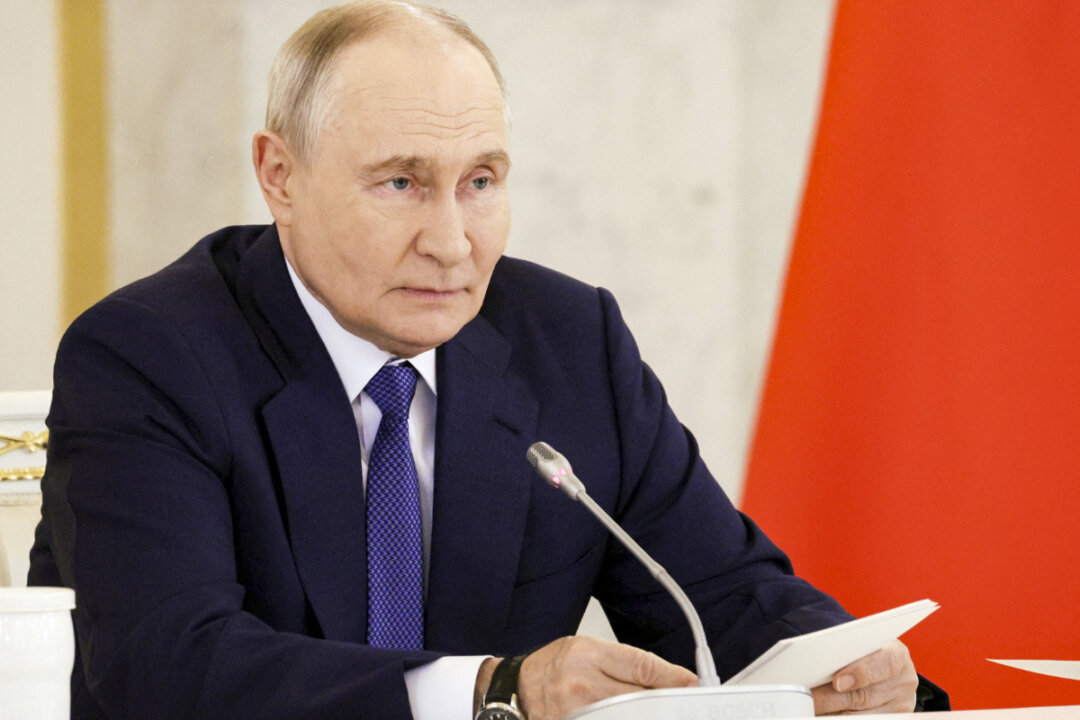

Russian President Vladimir Putin chairs a meeting of the Council for Strategic Development and National Projects at the Kremlin in Moscow, on Aug. 19, 2026. Sputnik/Gavriil Grigorov/Pool via Reuters
Russian President Vladimir Putin signed on Aug. 24 a decree allowing the state to temporarily take over critical infrastructure if private owners are considered to have failed to properly protect their assets against the risk of damage by drone attacks.
The decree, which came into effect on Monday, also allows the Russian state to administer an entity if an owner fails to restore its functioning in a timely manner.
Critical infrastructure named within the measures includes fuel and energy complexes, industrial facilities, communications facilities, logistics infrastructure, “and other facilities that are of particular importance for ensuring the security, economic stability, and livelihoods of the Russian Federation.”
Assets which can be taken over include property, shares, financial assets, and property rights “with the exception of the power to dispose of the property.”
The decree cites the “increasing threats to the security of critical infrastructure facilities” during the ongoing war.
Ukraine has been
intensifying
its long-range drone attacks on energy and other critical infrastructure, most recently on Tuesday by striking the Afipsky oil refinery in Krasnodar.
Ukrainian forces have hit the Afipsky plant several times in the past few months, as part of Kyiv’s wider campaign of targeting Russia’s oil refineries and other critical infrastructure in an attempt to undermine Moscow’s war efforts and reduce its revenues.
They have also struck several processing plants across Russia, including the Ryazan oil refinery—which is one of the country’s largest—as well as oil platforms including the Filanovsky oil platform in the Caspian Sea and oil depots in the Tver and Stavropol regions.
Warehouses belonging to online Russian retailers including Wildberries and Ozon have also been hit several times.
Not Nationalization
First Deputy Prime Minister Denis Manturov said that government management under the terms of the decree would be temporary and applied selectively, and does not signal nationalization.
“This mechanism does not envisage widespread application—targeted and carefully considered decisions will be made at the highest level,” Manturov told reporters on Aug. 24, according to state-run news agency TASS.
He said that private as well as state-run enterprises are vital for the national economy, but that business owners approach handing current threats with varying levels of responsibility.
The deputy prime minister said that “in some cases, unfortunately, ensuring the safety of their facilities and employees is not a priority for them.”
“I emphasize that this is not about nationalization or a change in ownership—the decree implies the state’s involvement in the management of the enterprise to address specific security issues,” Manturov said.

Kremlin spokesman Dmitry Peskov attends an annual end-of-year news conference of Russian President Vladimir Putin, in Moscow on Dec. 23, 2021. Evgenia Novozhenina/Reuter
Kremlin spokesman Dmitri Peskov told reporters on Aug. 25 that Russia was facing “an obvious threat of drone attacks against both critical infrastructure and facilities that are essential to our country’s economic and social well-being.”
Reiterating remarks the previous day from Manturov, Peskov said, according to TASS, “Facility owners often fail to pay proper attention to security and anti-drone protection measures.”