
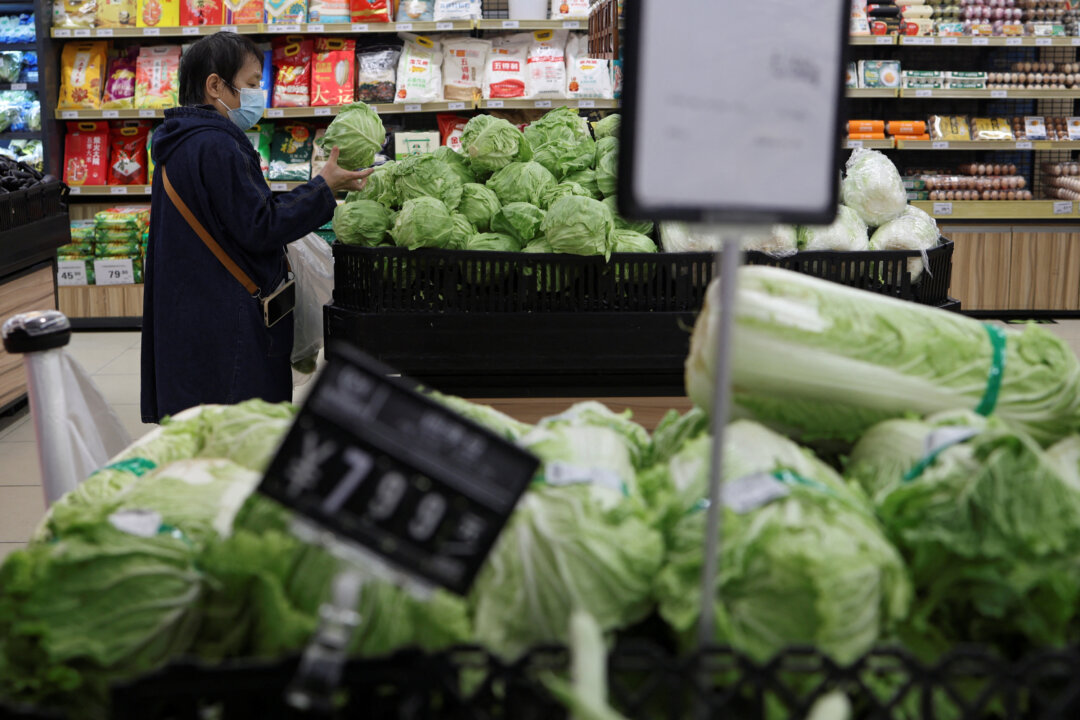
Formaldehyde contamination in foods has returned to the spotlight in China after a recent video went viral showing heads of Napa cabbage being soaked in formaldehyde solution as a preservative before long transit, causing public concerns that extend to nearby countries including South Korea, which imports tons of Chinese kimchi and cabbage every year.
In the video, posted on Chinese social media by vlogger “Yuhou Qige,” who was making random checks on several trailers loaded with Napa cabbages in Kangbao County in Hebei Province, farm workers were seen dipping Napa cabbages in barrels filled with formaldehyde solution before being loaded for shipment to wholesale markets across the country. The county is one of China’s largest Napa cabbage-producing regions supplying markets in various provinces.
The citizen investigator said the practice has been common in the industry for treating Napa cabbages destined for farther away places.
When asked by the vlogger, some workers said that the Chinese cabbages will be transported to a farmers’ market in Suqian, Jiangsu Province, and can be kept fresh for two to three more days after being dipped in the solution.
Formaldehyde, classified as a Group 1 carcinogen, is highly harmful to the human body and could cause abdominal pain, vomiting, kidney and liver damage, and even cancer, according to the American Cancer Society.
The video quickly drew widespread attention, with major Chinese media outlets’ follow-up reports. Facing public pressure, the Kangbao County government announced on the same day that a preliminary investigation had confirmed the facts shown in the video. Public security authorities said they have taken measures against the individuals and vehicles involved, while also tracing the distribution of the formaldehyde-treated Napa cabbages and launching an inspection of vegetable purchasing, transportation, and sales operations across the county.
Although local governments across various regions claim that contaminated cabbages were not found in their markets the following day, many netizens are concerned that treated Napa cabbages have been in the market.
Li Linyi, a China analyst, told The Epoch Times that local governments are inevitably trying to disassociate themselves to avoid being implicated, and the results of official inspections lack credibility. In reality, Li said, incidents of formaldehyde-treated cabbages have long been an open secret within the industry.
The Epoch Times has reported the issue of China’s formaldehyde-treated cabbage back in 2012.
“Spraying produce with formaldehyde is common nowadays,” said Mr. Ma, a cabbage wholesaler in Dongxia Township, China, told The Epoch Times in a phone interview at the time.
“As soon as a head of cabbage is cut from the ground, it is dipped in a formaldehyde solution before being shipped. It guarantees freshness for about a week.”
Some Chinese media outlets have also reported “formaldehyde-treated Napa cabbage” multiple times since then, but the solution is still being used. Regional Chinese media outlet Xiaoxiang Morning Herald reported in May 2012 that some vegetable vendors said that the practice of spraying formaldehyde to preserve freshness had been in use for three or four years.
Concerns Beyond China
The viral video has sparked significant attention and public concerns in Taiwan and South Korea about potential contamination of Napa cabbages.

Kimchi, Korean fermented Napa cabbage. Samira Bouaou/Epoch Times
Over 99 percent of kimchi imported by South Korea comes from China, according to South Korean media outlets.
South Korea imports more than 300,000 tons of Chinese kimchi and Napa cabbage annually, according to the Korean Times. Last year, imports of Chinese cabbage reached 20,000 tons, while kimchi imports amounted to 310,000 tons. Moreover, kimchi imports from China through July of this year exceeded 194,000 tons, the highest ever for the same period, according to South Korean SBS News.
Korea’s Ministry of Food and Drug Safety said on Aug. 24 that it was working through the Korean Embassy in China and other channels to determine whether Napa cabbage involved in the formaldehyde case had been exported to Korea.
An Aug. 24 report by Chinese media outlet Bandao Media stated that the majority of finished kimchi exported from China to South Korea originates in Shandong Province. To ensure a year-round supply, the factories involved employ a sourcing strategy that draws raw Napa cabbages from across the country, with Hebei and Inner Mongolia serving as key supplementary sources.
Chinese-made kimchi is also exported to countries such as Thailand and Vietnam. Many new kimchi factories have been built in Hebei and Henan.
Kangbao County, a major vegetable-producing area that was featured in the video, yields significant quantities of cabbages, some of which are transported to regions such as Jiangsu and Anhui, among others, according to a September 2024 report by Chinese digital media outlet Jiupai News.
Taiwan’s Food and Drug Administration under the Ministry of Health and Welfare stated on Aug. 24 that Chinese Napa cabbage falls under the category of prohibited imports. To date this year, there have been no records of imported Napa cabbage from China.
Hong Kong’s Centre for Food Safety stated on Aug. 24 that between January 2023 and July 2026, it collected over 51,000 samples of vegetables and vegetable products for testing, including checks for formaldehyde. The overall compliance rate was 99.8 percent, with no samples failing the formaldehyde test.
Tang Bing, Zhong Yuan, and Hong Ning contributed to this report.