S&P 500 Nears Record High as Oil, Bond Yields Extend Slide
 Andrew MoranUpdated 8 hours Ago3 Mins read
Falling crude oil prices and Treasury bond yields helped lift the broad-market S&P 500 closer to a record high during the Sept. 22 trading session.
The S&P 500 rose 11 points, or about 0.2 percent, to 7,780 at the opening bell—just shy of the record 7,798 registered in August.
The index—a popular benchmark that tracks the performance of 500 of the largest publicly traded companies in the United States—has climbed about 13 percent this year.
While U.S. stocks have slipped this month amid the ongoing conflict in the Middle East, the leading stock market index averages have been clawing back.
The blue-chip Dow Jones Industrial Average reclaimed 52,000 to kick off the trading week and rose more than 100 points on Sept. 22. Year-to-date, the Dow is up about 8 percent.
The tech-heavy Nasdaq Composite Index rocketed 600 points to start the trading week and blew past 27,000, also a record high. It changed little the next day but remained up 17 percent this year.
China, Iran in Focus
Geopolitics—primarily the upcoming Trump–Xi meeting and the war in Iran—supported U.S. stocks so far this week, says Linh Tran, market analyst at XS.com.
U.S. President Donald Trump and Chinese leader Xi Jinping will be meeting this week, and investors are optimistic that Washington and Beijing can extend a trade truce.
“Any indication that the trade truce could be extended or tensions in the technology sector could ease may provide additional support to major industrial and consumer companies in the Dow Jones,” Tran said in a note emailed to The Epoch Times.
“However, this impact remains expectation-driven, and the market could experience significant volatility if the outcome of the meeting fails to match the current level of optimism.”
Traders are also responding to a Reuters report that a senior Iranian official outlined conditions to reopen the Strait of Hormuz within seven days. The official told Reuters that Tehran could allow traffic to flow freely throughout the Gulf channel if the United States eases military pressure and lifts its blockade on Iranian ports.
The narrow waterway between Iran and the Arabian Peninsula, which handles about 20 percent of the world’s oil and liquefied natural gas shipments, has been at the center of the conflict.
Crude oil prices extended their losses following the news.
A barrel of West Texas Intermediate—the U.S. benchmark for oil prices—declined more than $2, or around 2.4 percent, to below $94 on the New York Mercantile Exchange. U.S. oil prices have tumbled more than 11 percent over the past week.
Brent, the international benchmark for oil prices, slipped nearly $2, or 1.8 percent, to below $99 per barrel in overseas trading.
“Signs of diplomacy could ease oil prices and inflation fears, while further escalation or disruptions to regional exports could send crude higher, pressure consumers and complicate the Fed’s next move,” Jay Woods, chief market strategist at Freedom Capital Markets, said in a note emailed to The Epoch Times.
Fed Outlook
Since last week’s meeting, investors have been split on whether the Federal Reserve will follow through on another interest rate hike at the October policy meeting.
Officials voted unanimously to raise the benchmark federal funds rate—a key policy rate that influences borrowing costs for businesses and households—by a quarter point, the first in more than three years.

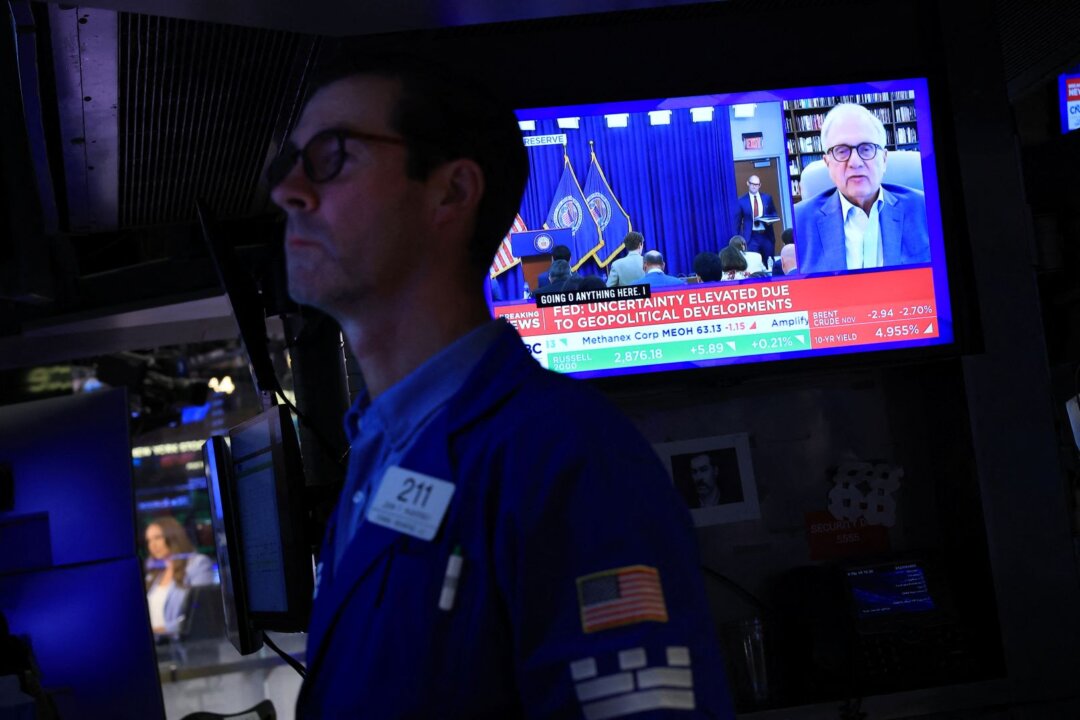
A trader looks on as Federal Reserve Chair Kevin Warsh is displayed on a television screen on the floor of the New York Stock Exchange on Sept. 16, 2026. Timothy A. Clary/AFP via Getty Images
Fed Chairman Kevin Warsh, in his post-meeting press conference, said inflation is still too high.
Like the European Central Bank, the Fed raised rates as insurance against potential second- and third-order effects of the war-driven oil supply shock.
In a Sept. 21 speech, Chicago Fed President Austan Goolsbee argued that monetary policymakers need to avoid the standard monetary intuition of looking through price shocks.
“Lately, though, supply shocks have come more frequently, hit harder, and lasted longer. And once supply shocks to inflation become persistent, some of the logic behind ‘looking through’ no longer holds,” Goolsbee said in prepared remarks.
“A cost shock that lasts multiple years forces us to revisit the rationale for looking through. No one said to automatically look through persistent inflationary supply shocks.”
Futures market data suggest a 53 percent chance of a quarter-point increase next month, according to the CME FedWatch Tool.
Treasury bond yields, meanwhile, have eased a bit so far this week.
The benchmark 10-year yield dipped below 4.95 percent, while the 30-year declined to around 5.28 percent. The 2-year yield, which is sensitive to Fed policy expectations, slowed to 4.74 percent.
This could be a signal that traders believe in the Fed, says Jesse Marre, senior portfolio manager at Hilbert Group.
“That is the market beginning to believe the Fed’s resolve in containing inflation,” Marre said in an emailed note to The Epoch Times. “With long-end Treasury yields having been the stress point in the market, seeing tens stop screaming higher was a significant relief.”
Michael Zhuang and Reuters contributed to this report.






ABC’s Four Corners Program Found in Breach of Standards Over Use of Anonymous Sources
The Australian Broadcasting Corporation (ABC) logo is seen in the press gallery...
Kalshi Seeks Approval to Allow Some Users to Borrow Funds to Place Bets
Kalshi, the popular prediction market platform, is seeking federal approval to allow...
Newsom Signs 7 Bills to Regulate Data Centers
An aerial view of a 49.5-megawatt three-level data center under construction in...

Apple Opens Claims in $250 Million Siri Settlement for iPhone 16, 15 Pro Buyers
Apple iPhone 16 on display at an Apple store in New York...