
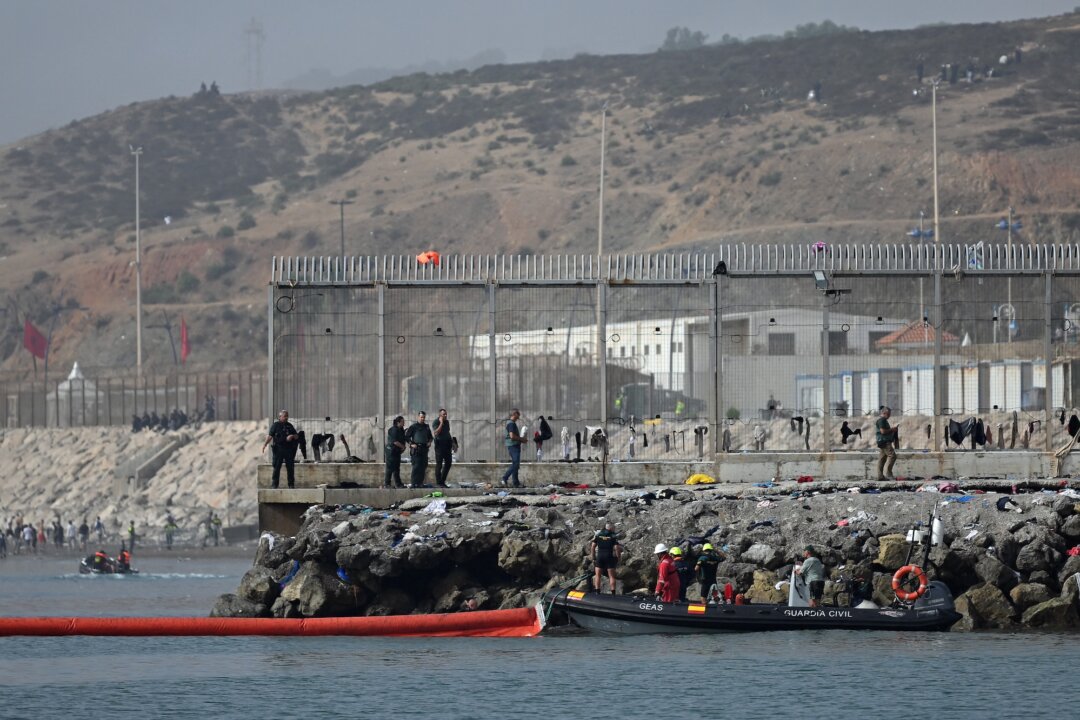

Spanish police began installing a floating barrier along Ceuta’s sea border with Morocco on Aug. 1 after an unprecedented mass crossing left at least 67 people dead, overwhelmed the tiny Spanish autonomous city, and renewed fears of uncontrolled migration.
Officers from Spain’s Civil Guard began laying the 1,640-foot pneumatic barrier just before 8 a.m. local time along the Tarajal breakwater, one of the main routes used by migrants swimming into Ceuta, a Spanish territory on the tip of North Africa, just across the Strait of Gibraltar.
The barrier will stand between 12 and 28 inches above the water and extend up to 3 feet below the surface, officials said. A line of anchored naval buoys will provide a second obstacle, while a channel between the barriers will allow Civil Guard vessels to patrol the area.
According to Spanish authorities, about 50,000 people crossed into Ceuta by land and sea beginning Thursday in an unprecedented surge at one of the European Union’s only land borders with Africa.
Ceuta’s regional government put the number as high as 60,000—equal to nearly three-quarters of the city’s population of about 83,000.
More than 48,000 returned to Morocco within 48 hours without major incident, Spain said, while surging military assets to the area to bolster security and deter unlawful entry.
The deployment came after the government of Ceuta declared the city was facing an “absolute humanitarian and social emergency” following the illegal immigration surge. The city asked the Spanish government to declare a national emergency, deploy the army to the city, and fully close the borders.
At least 67 bodies have been recovered on the Spanish side of the border. Some migrants drowned while attempting to swim around the breakwater, while others were crushed as crowds tried to climb the border fence or force their way across.
Several migrants told The Epoch Times that they had entered Ceuta in hopes of finding better economic prospects in Europe.
Ceuta residents who spoke to The Epoch Times said that their concern is that, while a large portion of the migrant wave has left, many others appear to want to stay.
City Overwhelmed
The surge began on July 30, when tens of thousands of people—mostly young men—crossed from Morocco as Spanish security forces struggled to contain the influx.
Ceuta Mayor-President Juan Jesús Vivas told reporters on Friday that the situation was “absolutely unsustainable.”
Spain deployed troops and armored vehicles to reinforce the Civil Guard. Moroccan authorities also used water cannons to push crowds back from the border overnight.

Spanish Army vehicles and soldiers deploy along the coastal road on Avenida Martínez Catena in the Spanish territory of Ceuta, on July 31, 2026, as part of the response to the migrant crisis. Etienne Fauchaire/The Epoch Times
By July 31, columns of migrants stretched for roughly two miles along the road leading back to Morocco. Many said they were returning because they had received no food or water after entering Ceuta.
Others continued swimming around the maritime barrier into Friday evening, although their numbers had fallen sharply.
Spanish Prime Minister Pedro Sánchez visited Ceuta with Interior Minister Fernando Grande-Marlaska on July 31 and was met by crowds calling for his resignation.
Sánchez described the mass entry as “an attack on Spain’s territorial integrity,” blamed human smuggling networks, and pledged the full support of the national government. He stopped short of declaring a national emergency.
Juan Serio Redondo, president and spokesperson for VOX Ceuta, a conservative political party, said that Spanish immigration law should be amended to bolster border security, while accusing Spain’s leftist government of inaction.
“The migrant crisis here has not been solved,” he told The Epoch Times in an interview. “My political group, Vox, has asked countless times for the border to be reinforced, for the breakwaters to be extended, and for real containment barriers to be installed.”
Redondo added that the formula for stopping illegal immigration is “well known, yet they have done absolutely nothing.”

Moroccan migrants continue swimming across the sea border into Ceuta, July 31, 2026, as arrivals persist. Etienne Fauchaire/The Epoch Times
Pressure Within the EU
Twenty-two European Union governments on Saturday called for an emergency meeting of interior ministers, warning that the crossings challenged the bloc’s external border and could encourage further illegal immigration.
The countries called for a coordinated response, including possible additional support from the EU border agency Frontex and a review of the bloc’s cooperation with Morocco.
Italy suspended passport-free Schengen arrangements with Spain for one month, while France increased controls along its border with Spain.
Sánchez criticized calls to exclude Spain from the Schengen zone as “selfish, polarising and unlawful.”
The Spanish government said those who entered Ceuta illegally would not be permitted to travel onward to mainland Spain or elsewhere in Europe.
Spain also rejected claims that its recent program offering legal status to some illegal immigrants encouraged the surge, noting that applicants must have lived in the country before Jan. 1 and prove at least five months of continuous residence.
Etienne Fauchaire and Reuters contributed to this report.