Taiwan’s Local Elections: 5 Things to Know About the China Factor
 Arthur ZhangUpdated 7 hours Ago5 Mins read
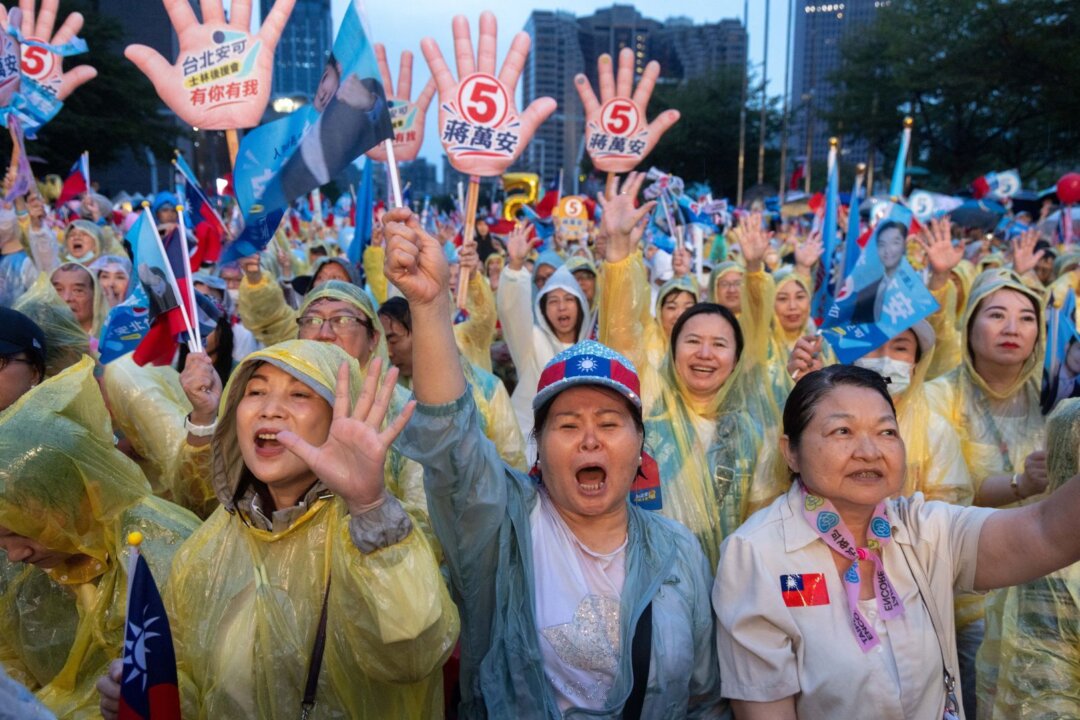
Nearly 19.6 million Taiwanese are eligible to vote for mayors and county leaders on Saturday in local elections that have drawn Beijing’s attention ahead of the island’s 2028 presidential race.
Although Taiwan’s local leaders do not determine its foreign or defense policies, the Chinese regime has offered economic incentives to Taiwan, sanctioned businesses belonging to a mayoral candidate’s father, and been accused by Taiwanese authorities of attempting to influence the elections.
Voters will elect 11,051 local officials across 22 cities and counties, from mayors to village chiefs, in what Taiwan calls its “nine-in-one” elections. They will also vote in a national referendum on nuclear energy.
The Chinese Communist Party (CCP) claims Taiwan as its territory despite never having ruled the island and has not ruled out the use of force to bring it under its control.
Here are five things to know about Saturday’s elections.
Why Beijing Is Watching
Beijing views Taiwan’s local elections as an early indication of the island’s political direction ahead of the 2028 presidential election, according to Emma Y. Liu and Edgard D. Kagan of the Center for Strategic and International Studies (CSIS).
The two researchers wrote on Nov. 25 for CSIS that Beijing would watch for changes in public attitudes toward China, the strength of competing political parties, and the emergence of new political leaders.
Taiwan’s major cities have historically produced national leaders. Four of its five directly elected presidents previously served as mayors.
Lee Teng-hui, Chen Shui-bian, and Ma Ying-jeou led Taipei, the capital city, while incumbent President Lai Ching-te was mayor of Tainan.
However, local election victories have not necessarily translated into presidential election success.
The opposition Kuomintang (KMT) won 15 of Taiwan’s 22 mayoral and county leadership positions in 2018 and 14 in 2022. The ruling Democratic Progressive Party (DPP) subsequently won the presidential elections in 2020 and 2024.
Local campaigns tend to focus on housing, transportation, and economic development, while presidential elections place greater emphasis on national security, relations with China, and national identity.
The U.S.–China Economic and Security Review Commission noted in its November report to Congress that widespread public opposition to coming under Beijing’s control limits the options of Taiwan’s elected leaders.
“Even electoral outcomes in 2026 and 2028 that Beijing favors may fail to produce the political movement toward unification it expects,” the commission said.
A Taipei Mayoral Race Under Chinese Pressure
In Taiwan’s capital, KMT Mayor Chiang Wan-an is seeking reelection against DPP legislator Puma Shen, a former criminology professor specializing in Chinese influence operations.
One point of disagreement is Taipei’s long-running exchange forum with Shanghai, through which the two cities have pursued cooperation in areas such as healthcare and urban governance.

People carrying green election flags stand outside a campaign storefront featuring a large portrait of DPP Taipei mayoral candidate Puma Shen (Shen Pao-yang) in Taipei, Taiwan, on Oct. 28, 2026. Known for opposing Chinese disinformation and political interference, Shen is among the Taiwanese politicians targeted by Beijing sanctions. Jimmy Beunardeau/Hans Lucas/AFP via Getty Images
Chiang has advocated continued dialogue to reduce tensions. Shen has questioned the forum’s effectiveness and warned that it could provide an opening for the CCP’s infiltration. He has proposed expanding Taipei’s exchanges to more international cities, without excluding Shanghai.
Shen, who co-founded the civilian preparedness organization Kuma Academy, has himself been a target of Beijing’s punitive measures.
Beijing blacklisted him in 2024. In October 2025, police in the Chinese city of Chongqing opened a criminal investigation against him on suspicion of secession.
On Oct. 14 this year, Beijing sanctioned a company owned by Shen’s father, following similar measures against another of his businesses last year.
Taiwanese prosecutors also indicted four private investigators in October over allegations that they conducted weeks of surveillance of Shen and his family in 2024 on behalf of two Hong Kong residents.
Opposition Cooperation and Relations With China
Saturday’s vote is the first islandwide electoral test for KMT Chairwoman Cheng Li-wun since she met Chinese leader Xi Jinping in Beijing on April 10.
Beijing subsequently announced 10 measures involving tourism, transportation, agricultural imports, and other exchanges with Taiwan. Taiwan’s intelligence chief warned that Beijing was using economic incentives to influence the local elections.

Taiwan’s Kuomintang Chairperson Cheng Li-wun (C) leaves after a press conference in Beijing on April 10, 2026. Adek Berry/AFP via Getty Images
A survey of 1,195 respondents conducted shortly after Cheng’s visit found that about 47 percent viewed the meeting negatively and 35 percent positively. KMT and Taiwan People’s Party (TPP) supporters generally viewed it more favorably than DPP supporters.
The KMT and the smaller TPP have sought to cooperate in local elections. Both are backing KMT candidate Lee Shu-chuan in New Taipei, Taiwan’s most populous city, but failed to reach a similar agreement in Hsinchu County.
The two parties have distinct approaches to China.
The KMT favors dialogue based on the so-called 1992 Consensus, under which it maintains that both sides of the Taiwan Strait belong to one China but can interpret its meaning differently. Taiwan’s official name is the Republic of China, but Beijing regards Taiwan as part of the People’s Republic of China, a claim Taiwan’s DPP government rejects.
The TPP’s platform calls for a new basis for dialogue that safeguards Taiwan’s sovereignty. It also calls on Beijing to end its military activities targeting the island.
Suspected Chinese Election Interference
Taiwan’s Criminal Investigation Bureau said on Nov. 18 that police had identified more than 30 cases of suspected foreign election interference.
On Nov. 20, prosecutors indicted TPP city council candidate Chou Hsiao-yun over allegations that she received Chinese campaign funding and assistance from a team operating 20,000 fake Facebook accounts.
Taiwan’s Mainland Affairs Council told The Epoch Times on Nov. 25 that the CCP has long collected Taiwanese citizens’ personal information through various channels for use in influence operations, political infiltration, and transnational repression.
A Nov. 25 investigation by German broadcaster Deutsche Welle identified manipulated content targeting DPP Taipei mayoral candidate Shen and misleading videos suggesting that the United States was abandoning Taiwan.
Preparing Taiwan for a Potential Chinese Blockade
Taiwan relies heavily on imported fuel, leaving the island and its globally important semiconductor industry vulnerable to a Chinese blockade that disrupts maritime shipments.
Saturday’s nationwide referendum asks voters whether the government should use nuclear power to revitalize the economy and abandon its nuclear-free energy policy.
Taiwan shut down its last operating nuclear reactor in May 2025. If the referendum passes, Taiwan’s Referendum Act requires the government to take steps to end its nuclear-free energy policy and restore the use of nuclear power. However, individual nuclear plants would still require safety inspections and regulatory approval before restarting.
Local governments would also play a critical role during a blockade, according to Katie Sizemore, a national security fellow at the Council on Foreign Relations (CFR).
Sizemore wrote on Nov. 25 for CFR that city and county governments decide how to allocate their civil defense budgets, including funding for resident training, evacuation planning, emergency shelters, and stockpiling equipment.
Taiwan tested those capabilities in August during its urban resilience exercises, conducted alongside the annual Han Kuang military drills.
The exercises included communications tests in which authorities deliberately slowed mobile internet speeds for 30 minutes across seven counties and cities in central Taiwan on Aug. 10 and seven in northern Taiwan on Aug. 13 to test emergency response capabilities while keeping voice calls, text messages, and emergency lines available.



China’s Space Program Could Hand Its Military an Edge in Future Wars, Analysts Warn
Beijing’s space program is closely tied to its armed forces and could...
US Bars 2 Logistics Firms From USPS Over Counterfeit Postage on Packages From China
A federal court in Brooklyn on Nov. 25 permanently barred two U.S....
Xi Jinping Accelerates Military Leadership Reshuffle Amid Expanding Purge
Chinese leader Xi Jinping is accelerating a reshuffle of the military’s top...
Analysts Welcome New Australia-Solomons Defence Pact, but Warn of Next Battleground
Security analysts have welcomed the Australia-Solomon Islands defence treaty but warned Beijing...