Article content
Universities are back in session across the country. Students are finding their way to their classes, meeting their teachers and co-students, participating in frosh activities, joining campus groups and being presented with free student handbooks meant to serve as study planners featuring important dates for the academic year. These are all normal activities for Canadian university students, unless you attend Concordia University in Montreal.

THIS CONTENT IS RESERVED FOR SUBSCRIBERS
Enjoy the latest local, national and international news.
- Exclusive articles by Conrad Black, Barbara Kay and others. Plus, special edition NP Platformed and First Reading newsletters and virtual events.
- Unlimited online access to National Post.
- National Post ePaper, an electronic replica of the print edition to view on any device, share and comment on.
- Daily puzzles including the New York Times Crossword.
- Support local journalism.
SUBSCRIBE FOR MORE ARTICLES
Enjoy the latest local, national and international news.
- Exclusive articles by Conrad Black, Barbara Kay and others. Plus, special edition NP Platformed and First Reading newsletters and virtual events.
- Unlimited online access to National Post.
- National Post ePaper, an electronic replica of the print edition to view on any device, share and comment on.
- Daily puzzles including the New York Times Crossword.
- Support local journalism.
REGISTER / SIGN IN TO UNLOCK MORE ARTICLES
Create an account or sign in to continue with your reading experience.
- Access articles from across Canada with one account.
- Share your thoughts and join the conversation in the comments.
- Enjoy additional articles per month.
- Get email updates from your favourite authors.
THIS ARTICLE IS FREE TO READ REGISTER TO UNLOCK.
Create an account or sign in to continue with your reading experience.
- Access articles from across Canada with one account
- Share your thoughts and join the conversation in the comments
- Enjoy additional articles per month
- Get email updates from your favourite authors
Sign In or Create an Account
or
Article content
Article content
By now, most students will have received the campuses latest iteration of Concordia’s handbook, produced by its student union and paid for with student fees, which features a manifesto that suggests universities are not what they seem, disparages the West, Canada and Quebec, suggests electoral participation may be less worthy than direct action, including constructing an alternative policing system and encourages students to mobilize to free Palestinian prisoners arrested in connection with terrorism.
Article content
Article content
By signing up you consent to receive the above newsletter from Postmedia Network Inc.
Article content
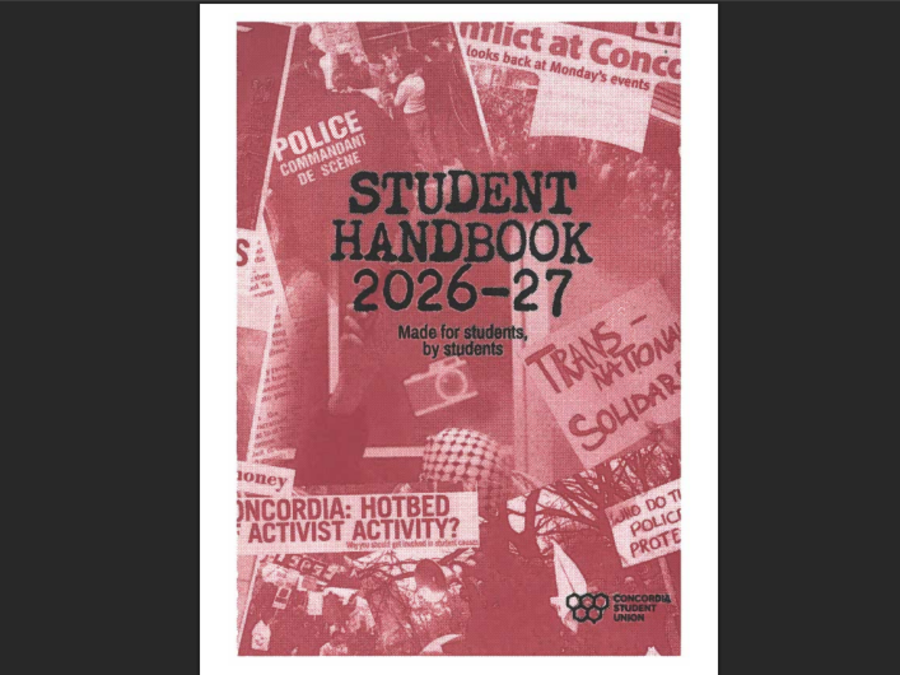
The cover of the 2026-2027 Concordia student handbook is red and white, features a collage of images including a police officer with his back turned, three signs with the phrases; “transnational solidarity,” “who do the police protect?” and another, posing the question: “Concordia: hotbed of activist activity?” and then in much smaller print, “why you should get involved in campus causes.” Centred on the cover is the image of what appears to be a man dressed in black wearing a keffiyeh over this face and raising his arm to hold up a smartphone to record something.
Article content
Article content
Underneath 2026-2027, is a declaration: “made for students, by students.”
Article content
Article content
The handbook opens with a “manifesto for the people’s university.” Most Canadians probably think that a university education prepares citizens to become valuable, contributing and law-abiding members of society. Not so, according to the manifesto. Students, it says, are essentially “cash cows,” educated with the purpose of driving the economy, and they are informed that the university’s “primary function” is “to serve the extracative settler colonial project of so-called Canada.”
Article content
The manifesto seems to suggest to these students that they have just signed up for a misleading and immoral illusion. It tells them they need to be able to “see through… every university in the so-called Global North” as selling “the possibility of future comfort at the cost of participating in the genocidal and ecocidal death march of the status quo.”
Article content
It paints university administrators as seeking to immediately delegitimize action on campus “that even remotely threatens to disrupt campus life as usual.” It then suggests to these same students that they are “the only legitimate political actor in these negotiations.” It appears to object to Canada’s law and order, telling these new young minds on campuses that it “refuses the insistence that safety and protection necessitate policing and criminalization.” It suggests the university boardroom decisions are not legitimate because the university should instead be governed “by and for the people.” The manifesto ends by encouraging students to “abandon the university as it stands” and “create a People’s University in (their) own image.”
Article content
Under a section titled, All about Concordia,” the handbook tells students that the board of governors is the university’s “highest authority,” which it implies is against them. The handbook tells students: “It’s clear that a board composed of the wealthy and powerful serves the interests of investors and not Concordia’s workers or students.”
Article content
Instead of ensuring that new and returning Concordia students feel comfortable about contacting Concordia’s campus security for protection, a section called, “Security, surveillance, and the cats,” suggests to students that campus security may not be trustworthy, because they may be policing, profiling and politically repressing them, despite the fact that they seem friendly because they sometimes allow students to pet their dogs.
Article content
The next part of the handbook is called a “Survival Guide.” The first section is titled, “Ni Canada, ni Quebec” (neither Canada, nor Quebec). It criticizes Prime Minister Mark Carney of evoking Canada’s “glorified settler colonial past” in his recent forward guidance video, and accuses the Liberals’ of passing a “massive anti-immigration bill giving the state powers to abandon due legal process and to cancel immigration status for migrants at will.”
Article content
Article content
The handbook also has strong words for two Quebec political parties. It complains that both the Coalition Avenir Québec (CAQ) and Parti Québécois (PQ) parties in Quebec are moving toward more right-wing policies, including the CAQ’s banning prayer in public institutions and the PQ’s call for a referendum. It also complains that: “The Quiet Revolution-era promise of a Québcois welfare state and shared prosperity for all is now more or less a thing of the past, abandoned in favour of xenophobic rhetoric and the so-called “defence of Quebecois and Western culture and values.”
Article content
The federal government doesn’t escape the handbook’s criticism either. The handbook tells students that the federal government is only more tolerant of minorities than Quebec “on the surface,” and frames the plight of migrants as one in which they are required to accept that “money rules the land, that you’ll be blamed for the political and economic failures of the government, and that your immigration status can be revoked at any time, resulting in your deportation, especially if you protest in solidarity with Palestine.”
Article content
Article content
In a section titled “Against electoral politics,” the handbook paints the democratic process of voting for candidates as “limited” in terms of its possibility to affect change. While this section claims it isn’t arguing for political disengagement, it turns around and asks them if voting is actually “worth” their energy. Instead, it appears to try to sell students on participating in community actions, suggesting they have been successful in halting pipelines, resisting deportations and constructing “alternatives to policing through collective direct action.”
Article content
Perhaps most disturbing is the section that asks Concordia students to mobilize to have Palestinian prisoners, including some who have either been involved in or have perpetrated acts of terrorism against Israelis, released. This section suggests that Hussam Abu Safiya, who was arrested in 2024 by the IDF under suspicion of terrorist activity and for being a colonel in Hamas’s medical military services, and Walid Daqqa, who was arrested in 1986 for having commanded a Popular Front for the Liberation of Palestine cell that killed an Israeli soldier. Daqqa died of cancer in prison. The handbook features a poem he wrote to an unborn daughter, meant to tug at heartstrings.
Article content
This isn’t the first time a Concordia handbook has raised eyebrows. Last year, the handbook was bizarrely absent of Canadian holidays, including Christmas. Instead, it featured Nakba Day, May 15, 1948 — the day that the Arab-Israeli war began as a result of Egypt, Jordan, Syria, Iraq and Lebanon invading Israel in response to it declaring its independence the day before. It commemorated pro-Palestinian events, including 45,000 students going on “strike” for Palestine in 2024 and swapped New Year’s to commemorate the 1959 Cuban Revolution, calling it “victorious.” It also normalized masked demonstrations, blocking classrooms and confrontations with campus security, and featured a “strike guide” that broke Concordia’s rules. This later iteration is similar, with the exception of the fact that the “strike guide” appears to have been reworded and softened in a way that avoids breaking Concordia’s rules.
Article content
It’s hard to know how many Concordia students agree with the sentiment that this handbook was made for them, but it appears to serve the interests of a narrow group that would like the university’s students to become disillusioned with their entire academic experience, nihilistic about democracy and harnessed in support of anti-Israel Palestinian objectives.
Article content
National Post
Article content