
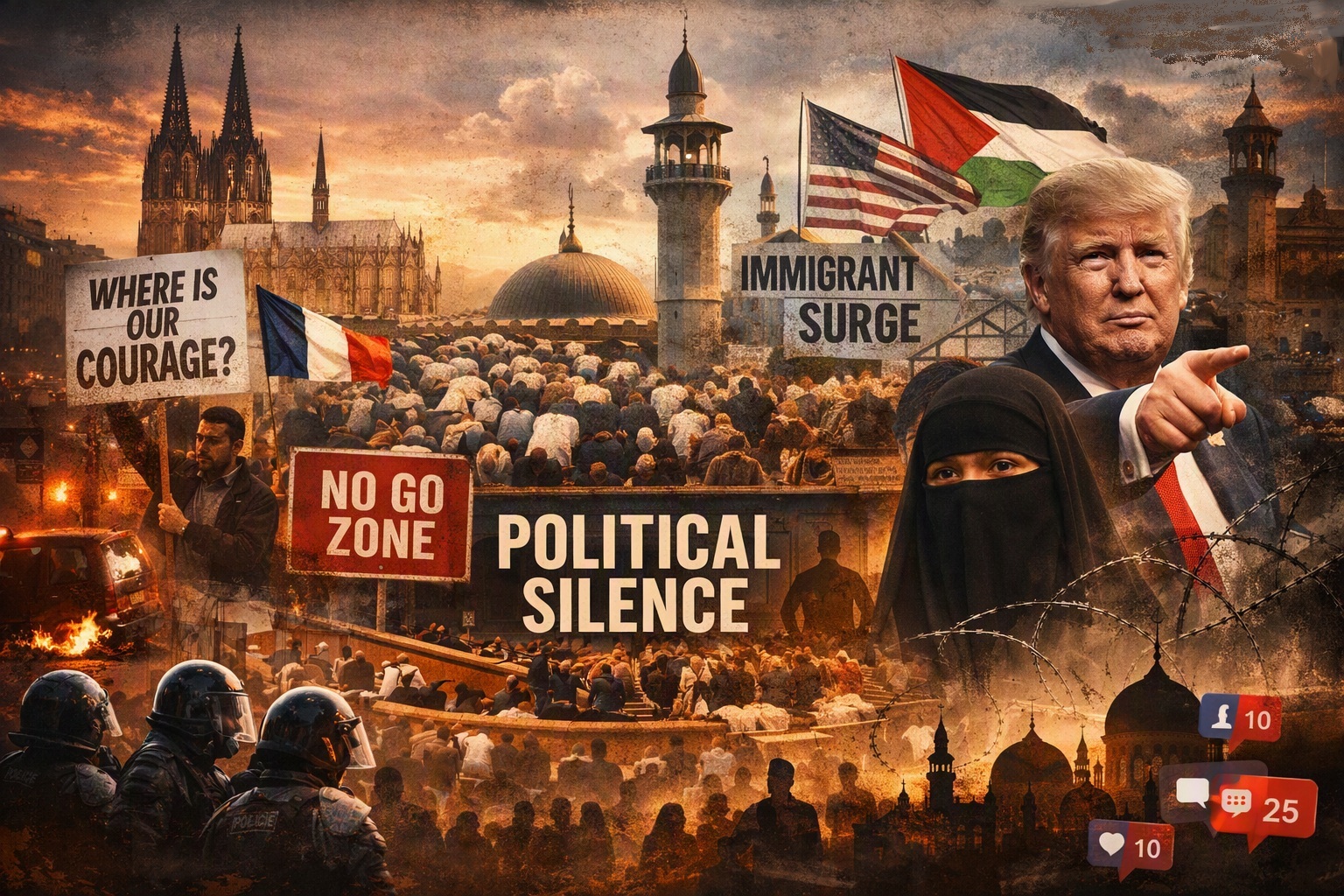
Courage is a rare mineral in our age — mined not from speeches, nor from the polished marble of parliaments, but from the quiet conviction that truth must be spoken even when it trembles the room. And today, across Europe and the United States, courage is precisely what is missing.
Something is shifting.
Something is swelling beneath the surface.
Something that everyone sees, yet few dare to name.
Not because the facts are hidden — they are everywhere: in media, in social feeds, in demographic reports, in the lived experience of neighborhoods that have changed faster than governments can comprehend. The rise of Islam as a cultural force in Europe and the U.S. is not a secret, not a rumor, not a fringe theory. It is a visible transformation, unfolding in real time.
But the silence around the consequences is deafening.
I. The Forceful Truth: A Change Too Fast for Politics
Across Europe — France, Sweden, Belgium, Germany, the Netherlands — and across pockets of the United States, migration from Muslim‑majority regions has accelerated for decades. People arrive seeking safety, opportunity, or simply a future. That part is human. That part is understandable.
But the scale, the speed, and the lack of integration strategy have created a pressure that no amount of political optimism can dissolve.
Parallel societies form.
Cultures run beside each other, not into each other.
Neighborhoods transform without conversation.
Religious institutions expand without integration.
Schools adapt — or fracture.
And yet, politicians remain silent.
Not because they don’t see the tension — but because they fear the cost of acknowledging it.
II. The Poetic Reality: A Continent Holding Its Breath
Europe feels like a continent holding its breath.
Cities where church bells once marked the rhythm of life now echo alongside calls to prayer. Streets that once carried a single cultural identity now carry several, each with its own gravity. None of this is inherently wrong — diversity can enrich. But diversity without cohesion becomes fragmentation.
And fragmentation without leadership becomes instability.
People sense it.
They feel the shift in the air.
They feel the weight of unspoken truths.
They ask:
Why is it acceptable to move to a new country and not adapt to its culture?
Why do parallel communities grow without political concern?
Why do leaders avoid discussing integration openly?
Why does every question get labeled instead of answered?
These questions are not hatred.
They are warnings.
They are signals.
They are the pulse of a society asking for courage.
III. The Analytical Core: A Crisis of Governance, Not a Clash of Civilizations
The danger is not Islam as a religion.
The danger is political paralysis.
For decades, governments embraced immigration without building the structures needed for integration:
clear expectations
cultural orientation
language requirements
community blending
enforcement of shared civic norms
Instead, they relied on hope — hope that integration would happen naturally, automatically, effortlessly.
But hope is not policy.
Hope is not strategy.
Hope is not courage.
And when leaders avoid difficult conversations, mistrust grows.
When institutions ignore pressure, pressure becomes instability.
When problems are denied, they harden.
This is why the situation feels like a “silent threat” — not because of any group of people, but because of decades of political avoidance.
IV. The Combined Warning: Silence Is the Most Dangerous Policy of All
Europe and the U.S. are not facing an invasion.
They are facing a predictable crisis created by:
rapid demographic change
failed integration policies
political fear
social fragmentation
rising extremism on all sides
communities living beside each other, not with each other
This crisis was not planned decades ago — but it was allowed to grow for decades.
And now, the consequences are arriving.
Not with armies.
Not with declarations.
But with the slow, steady erosion of cohesion — the kind that makes nations brittle.
V. The Call for Courage
Courage is not loud.
Courage is not hateful.
Courage is not reckless.
Courage is the ability to say:
“We must live together — but to live together, we must speak honestly.”
Courage is the refusal to let fear dictate policy.
Courage is the willingness to protect both cultural identity and human dignity.
Courage is leadership that does not hide behind labels or silence.
The rise of Islam in Europe and the U.S. is a reality.
The consequences of political silence are a reality.
The need for courage is a reality.
And the longer leaders avoid these truths, the louder the consequences will become.
VI. The Few Who Speak
In every era, there are only a handful who dare to speak when silence becomes dangerous. Most politicians choose caution, calculation, and comfort. But a few — whether one agrees with them or not — refuse to look away from uncomfortable realities. One of those figures, is Donald Trump, who has repeatedly positioned himself as someone willing to confront issues others avoid. His approach is polarizing, his tone often controversial, but his willingness to address topics many politicians sidestep is part of why he commands attention. Whether people support him or oppose him, his presence underscores a larger truth: when leaders stay silent, someone else will fill the silence.
And today, the silence around the consequences is exactly what demands to be broken.




House committee moves to codify Trump’s Strategic Bitcoin Reserve
A House committee advanced a bill to create a strategic bitcoin reserve,...
Clarity Act preliminary vote falls short in Senate amid ethics fight over Trump’s crypto wealth
The Senate’s preliminary vote on the Clarity Act collapsed late Monday, derailed...
Where the Clarity Act stands ahead of Tuesday’s Senate vote
The Senate heads into a consequential vote Tuesday on sweeping cryptocurrency legislation,...
President Trump says he wants Hyperliquid to enter the US — here’s how it could happen
President Trump says his administration is working to bring Hyperliquid into the...