Wall Street Review: Stocks Rebound in Holiday Week as AI Trade Revives
 Panos MourdoukoutasUpdated 16 minutes Ago3 Mins read
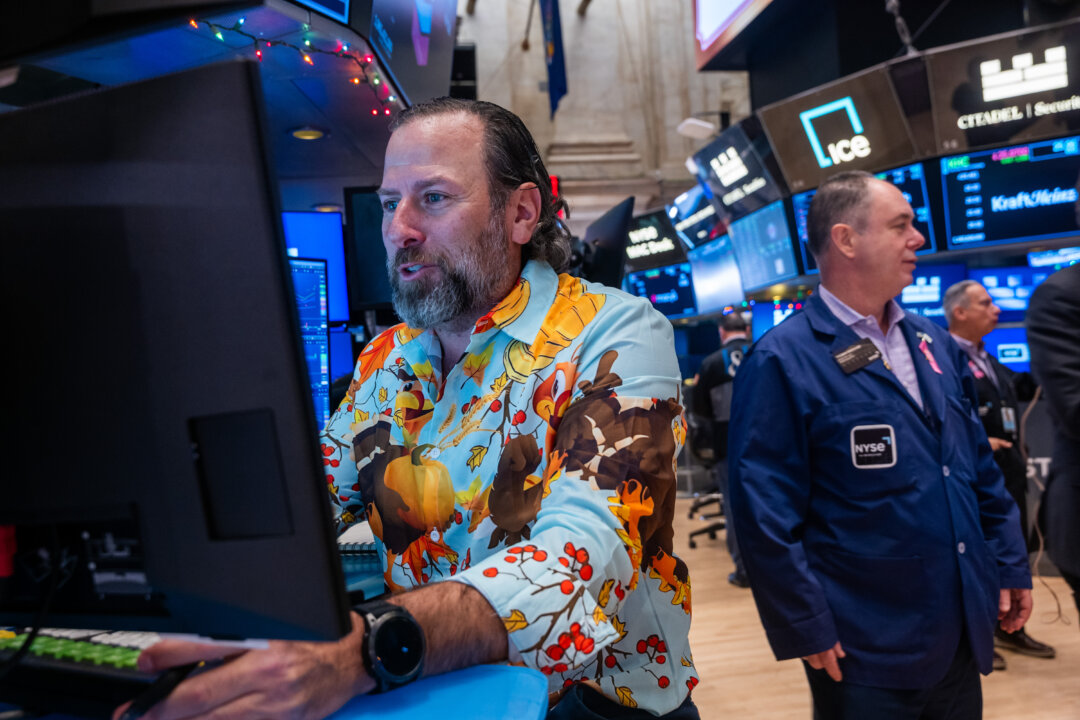
The AI trade returned during Thanksgiving week to power a rally in U.S. stocks, helping the major indexes recover much of their recent losses. But sharp swings in technology shares underscored a lingering concern among investors about the profitability of AI projects and the sustainability of the rally in AI-related stocks.
The Nasdaq Composite led the advance, gaining 6.68 percent for the week, to close at 24,129.50. This marked the index’s largest weekly percentage gain since the week ending April 17.
The S&P 500 rose 5.60 percent, and the Dow Jones Industrial Average added 5.5 percent, recovering much of the ground lost in the previous week’s broad decline. The gains represented the indexes’ largest weekly percentage advances since the weeks ending April 11, 2025, and Oct. 28, 2022, respectively.
The Cboe Volatility Index, Wall Street’s so-called fear gauge, fell 33.66 percent to 23.81.
The rebound was driven in part by investors buying stocks after the previous week’s sell-off and by a pause in the rise of Treasury yields. The yield on the 10-year Treasury note started the week at about 4.92 percent on Monday, fell to around 4.85 percent on Wednesday and finished Friday slightly above its opening level, at 4.93 percent. The calmer bond market helped support equities, but the week’s trading suggested that investors remained wary of betting too heavily on the technology rally.
That tension was clearest in semiconductor shares. After leading the market higher on Monday, chip stocks plunged the next day as investors took profits. They then rallied again on Friday, when gains among Asian chipmakers helped renew demand for U.S. technology shares.
A Sharp Turn in AI Trade
The week’s first session brought a broad rebound after the previous week’s losses, which had marked the market’s longest losing streak since 2020. Technology shares surged as bargain hunters returned and interest in artificial-intelligence companies revived.
Reports involving Nvidia Chief Executive Jensen Huang helped spark renewed enthusiasm for the AI trade. Nvidia shares jumped 31.48 percent during Monday’s session, while the iShares Semiconductor ETF rose 13.63 percent. The Nasdaq advanced 6.51 percent.
The rally extended beyond technology, with the S&P 500, Dow and Russell 2000 all posting strong gains.
But the strength did not last. On Tuesday, investors locked in gains in technology shares. The semiconductor ETF dropped 8.27 percent, and the Nasdaq fell 1.48 percent. The broader market performed better, supported by gains in healthcare and consumer staples stocks. The S&P 500 lost 0.50 percent, while the Dow Jones and Russell 2000 advanced 0.85 percent and 0.57 percent, respectively.
A decline in Treasury yields offered some support. The 10-year yield fell below 4.9 percent, reaching its lowest level in about two weeks. That move came even as data showed a sharp improvement in consumer confidence. The Conference Board’s index climbed to its highest level since January 2025, topping expectations by more than 10 points after several months near multiyear lows.
“This is a reassuring report ahead of the all-important holiday shopping season,” Bret Kenwell, a U.S. investment analyst at eToro, told The Epoch Times. “Consumer resilience has been a theme all year, and recent commentary from retailers and credit card companies has reinforced that picture.”
“Confidence doesn’t guarantee spending,” he added, “but consumers heading into the holidays in a better mood is a welcome sign.”
The market’s hesitation continued Wednesday. Stocks initially fell amid questions about whether Nvidia could sustain its leadership in the AI trade, despite strong earnings from Dell Technologies the previous evening. A late-session recovery left the major indexes mixed for a second day.
Investors sought the relative safety of government bonds during the day’s volatility, pushing the 10-year Treasury yield down to 4.845 percent, its lowest level since Nov. 5. The drop came despite a stubborn inflation reading: The personal-consumption expenditures price index rose 3.8 percent in October from a year earlier, compared with 3.7 percent in September. The result was in line with expectations, but remained well above the Federal Reserve’s 2 percent target.
The Bigger Question
After the Thanksgiving holiday, stocks resumed their climb. A 4.34 percent gain in South Korea’s Kospi helped lift technology shares, with memory-chip manufacturers among the strongest performers. The semiconductor ETF gained 4.76 percent.
The Nasdaq rose 2.31 percent on Friday, leading the major U.S. indexes. The S&P 500 gained 1.60 percent, the Dow added 1.18 percent, and the Russell 2000 rose 1.71 percent.
Even after the week’s recovery, some investors said the rally had not answered the central question hanging over AI-related stocks: whether companies’ heavy spending on computing infrastructure will deliver the revenue and profits investors are counting on.
“Investors are still nervous, and none of the fundamental questions about AI’s return on investment from the heavy capex spending have been resolved,” Chris Brigati, chief investment officer of San Antonio-based investment firm SWBC, told The Epoch Times.
He said the market remained exposed to further declines as support for the AI trade faded.
Brigati said he expects the S&P 500 to fall close to 6,500 by year-end. He also said the index’s Oct. 6 closing level of 7,818.93 could be its peak for calendar 2026, and sees little prospect of a traditional Santa Claus rally ahead of the Federal Reserve’s expected December interest-rate decision.
“The fundamental support for a year-end rally simply isn’t there,” he said.
“The AI-inspired rally continues to run out of steam, and without evidence that massive capex spending will deliver the profit and revenue goals the market expects, there is little incentive for a rebound.”
Brigati said volatility was likely to persist. Investors who had reduced oversized technology positions, he added, could be better positioned to add to stocks if prices weaken and a market bottom forms.







Neither Inflation nor Bad Weather Deters Black Friday Shoppers From Seeking Deals
NEW YORK—Shoppers migrated from Thanksgiving meals to Black Friday deals as predictably...
Inside Nvidia’s Ecosystem—and Why It Matters
News AnalysisWall Street and the rest of the world know Nvidia for...

Thanksgiving Online Spending Hits Record $7.1 Billion: Adobe
Families passed the gravy for the turkey and mashed potatoes—and credit cards...

Sheinbaum Says DEA Tiplines in Mexico Are ‘Clearly a Matter of Interference’
Mexican President Claudia Sheinbaum has accused the U.S. Drug Enforcement Administration (DEA)...