What the Data Show About the Reality of Canada-China Trade
 James YangUpdated 38 minutes Ago2 Mins read
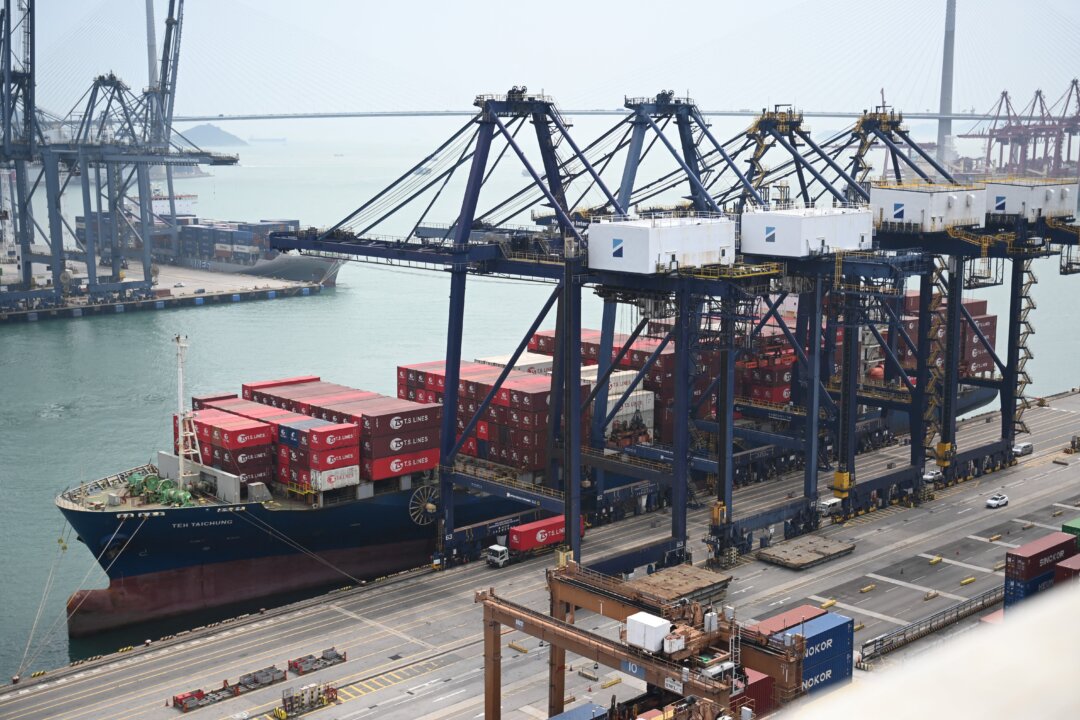

A container ship unloads its cargo at Kwai Chung Container terminal in Hong Kong on April 10, 2025. Peter Parks/ AFP via Getty Images
As Canada seeks to deepen trade ties with China amid ongoing trade tensions with the United States, data show that the United States remains a far larger market for Canadian goods, while Canada imports nearly three times as much from China as it exports there. Canadian exports to China are also heavily concentrated in resource sectors that account for a relatively small share of Canadian employment.
Statistics Canada data show that exports to China accounted for a relatively small share of sales in most Canadian industries in 2025, including some of the largest employers. The United States remained Canada’s top export market by far, with Canada recording a trade surplus with Washington and a deficit with Beijing.
China ranked fourth among Canada’s export markets in 2025, at about $35 billion, behind the United States, the United Kingdom, and the European Union. The United States was Canada’s largest trading partner by far, taking in more exports than all other destinations combined, at about $561 billion.
Canada has consistently run a trade deficit with China, meaning it imports more than it exports. The deficit peaked in 2022 and has narrowed since, to $55.5 billion in 2025. With the United States, Canada ran a surplus in every year, which also peaked in 2022 and stood at $198.9 billion in 2025.
Canada’s largest exports to China in 2025 were energy products, followed by metal ores and non-metallic minerals, and farm, fishing, and intermediate food products. Those were the only three categories in which exports exceeded imports. On the import side, consumer goods led, at about $29 billion, followed by electronic and electrical equipment and industrial machinery.
Across nearly every major Canadian industry shown, the share of sales exported to China was a small fraction of the share exported to the United States. The exception was the metal ores and non-metallic minerals sector, where China accounted for a larger share of exports than the United States did, the only case among the industries shown where China outweighs the U.S. as an export market.
Canada’s larger employers generally had low exposure to the Chinese market. Consumer goods, the largest employer among the export industries shown with about 447,000 workers, sent less than 1 percent of its sales to China as exports. The auto sector sent about 0.5 percent. The sector most exposed to China, metal ores and non-metallic minerals, employed far fewer workers than the larger industries shown.






Analysts Say Trump–Xi–Putin Summit Exposed Deep Divide
The first-ever trilateral summit between the leaders of the United States, China,...

2 Former Montreal Police Officers Charged with Assault and Criminal Harassment
An SPVM police shoulder patch is seen on an officer in Montreal,...

Denmark Says It Thwarted Russian Plot to Assassinate US-Ukrainian Rapper
Head of PET Rasmus Kieffer-Kristensen and National Police Chief Lasse Boje Nielsen...

Brazil Ex-president Jair Bolsonaro Taken to ICU
Former Brazilian President Jair Bolsonaro arrives home to begin serving house arrest...