Kerri O’Shaungnessy occasionally acts like a beaver, stomping down mud, hauling branches and forming them into a human-made equivalent of a beaver dam. “It is messy, mucky is right, and it is fun,” she says. It’s part of her job as a riparian specialist for the Alberta conservation group Cows and Fish, which works to improve the health of greenbelts (riparian zones) beside waterbodies.
Maintaining these greenbelts, though, has become increasingly difficult, as climate change causes longer periods of heat and drought. It was after learning that Utah State University was using beaver dam analogues (BDAs) that Cows and Fish decided to try them out. “We thought, well – hey, if they’re doing it, maybe it’s a tool we could bring up here,” O’Shaughnessy says.
Beaver ponds naturally store water, replenishing both surface and underground water sources. Dams spread the water out over the landscape, keeping it moist and resilient to drought and even wildfire. During the 2016 Beaver Creek Fire in Colorado, the riparian zones around beaver dams within the fire perimeter showed substantially less damage than those without beaver activity.
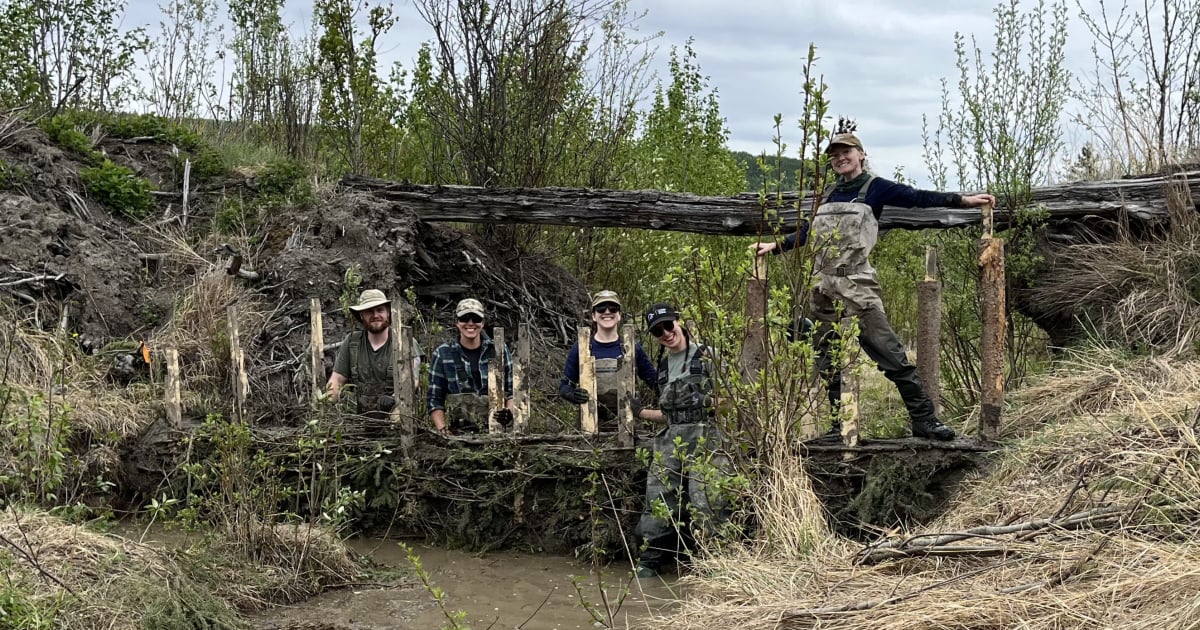
Where beavers are not present, a BDA is the next best thing. Using mud, cedar, willow, spruce, or pine boughs (the same materials a beaver would) and layering them as a lasagna, a BDA can be constructed in less than an hour, depending on how many people get involved. In some instances, posts are driven into the ground and spaced evenly along both sides of the structure to act as a loose basket that gives the dam greater durability.
Approximately 100 BDAs have been built by Cows and Fish and local organizations they have partnered with throughout Alberta.
Mimicking beaver
Among them, 20 have been constructed along Pine Creek within the Ann and Sandy Cross Conservation Area (ASCCA) southwest of Calgary. According to Anna Aldridge, director of communications and programs for the conservation area, the BDAs were located where there hadn’t been beaver activity for many years, primarily due to changes in vegetation. Like much of Alberta’s landscape, Pine Creek was once shaped by beavers who built dams, had families and transformed the valley into a mosaic of ponds and wetlands. As their population grew, so did their consumption of the woody vegetation they needed to survive. As the food supply dwindled, the beavers left.
Putting beavers back onto the landscape to build dams may at first flush seem a great idea, but according to Neil Fletcher, director of conservation stewardship for BC Wildlife Federation (BCWF), this has had mixed success. They move slowly, and without the food or material they need to protect themselves and survive, they can, according to Fletcher, become “walking hamburgers for coyotes.” There is also beaver-human interaction to be considered. Beavers are big eaters, and for landowners — especially ranchers and farmers — they can compete with grazing animals, such as cattle and bison, for the same vegetation. BDAs avoid this conflict and do the same job as a naturally made dam.

The BDAs constructed at ASCCA have already slowed the flow of water and enabled sediment to settle and lift the stream bed, which over time will cause water to spread further across the landscape.
This is the kind of success story that’s made Fletcher a BDA fan, as well as how cost-effective they are. “You’re probably looking at a quarter to a tenth of the cost of the traditional project for a similar footprint,” he says. Wetland restoration typically involves removing large amounts of gravel and soil, using heavy equipment and can cost upward of $15,000.
Already proven as a nature-based solution for riparian and wetland landscapes, the next step for BDAs is to be used as a tool for restoring wildfire-ravaged land. For the next three years, BCWF will work with the Lower Similkameen Indian Band on a BC government-funded project determining the effectiveness of beaver-inspired structures in wildfire-impacted areas. In 2023, the Crater Creek Complex Fire burned over 44,000 hectares in the area. Dams will be built along the Lower Similkameen River to raise the water table, reconnect floodplains and rehydrate wetlands.
Here, beavers may return to continue the restoration.
Starting kit for beavers
“It’s sort of a starter kit,” Fletcher says. Water is put back onto the landscape, and the vegetation the beavers need for food and building returns. In 2025, BCWF reported freshly packed mud and beaver-chewed branches on three of the BDAs they had constructed on Earl Ranch in BC’s Kootenay region a year earlier.
This is also the hope of Kasey McKenzie, a biologist and project manager for Ducks Unlimited Canada (DUC)
In late May of this year, DUC installed six BDAs along 300 metres of stream just south of Dawson Creek, BC. The surrounding wetland had been ravaged by repeated flash floods between 2016 and 2018. Void of vegetation, it was now prone to drought and soil erosion.
Before the BDAs were built, permitting was required, and the location had to be carefully selected. “We have to think ahead,” says McKenzie, “what if they blew out?” Not meant to be sturdy, if a BDA were to fail, knowing where the debris and water could go makes a difference in choosing the right location and avoiding damage to property and infrastructure downstream.
DUC will be monitoring the BDAs at Dawson Creek for the next three years, but McKenzie, already convinced of their benefits, has started training other DUC teams across Canada on how to install BDAs, with plans to build several in Northern Ontario.
It is, O’Shaughnessy says, still early days for BDAs, and there isn’t much research indicating long-term effects on the landscape. She’s impressed, though, by what she’s already observed. “If you can see a little water in the stream, as soon as you put that BDA in, you have more water instantaneously,” she says. It’s proof that stomping in the mud is not only fun but makes a positive difference.
September 14th 2026