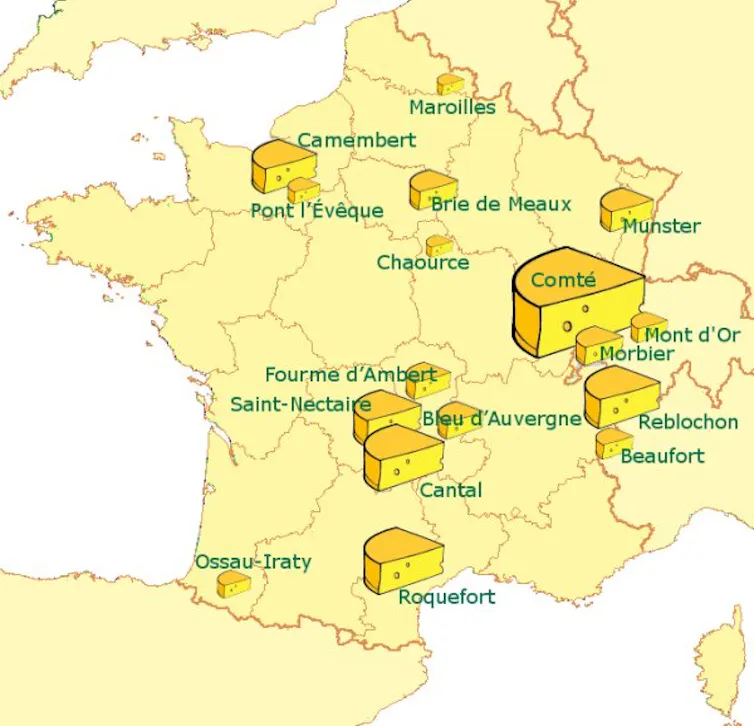
The famous words of General de Gaulle – “How can you govern a country where there are 246 varieties of cheese?” – show just how closely regional identities are linked to a country’s cheesemaking heritage that seems to be rooted in ancient history. And yet this is both true and false, as this tradition that the French are so proud of only dates back five or six generations.
Exploring the subject of cheese produced by the distant and not so distant ancestors of modern-day France, proves difficult for various reasons. On the one hand, cheeses discovered in an archaeological context are rare: those from the Bronze Age are the exception that proves the rule and were only able to have been preserved thanks to specific climatic conditions. The cheeses of the past were, in actual fact, different from the cheeses we know today and they belonged to societies with gastronomic values and tastes distinct from our own.
Cheese chauvinism
When Émile Zola wrote Le Ventre de Paris (1873), a novel in which he writes about “a cacophony of foul odours” to describe the stinky cheeses of the time, the map of the cheeses consumed by urban (and affluent) populations had only just begun to take shape. It was at the dawn of France’s Third Republic, at the very time when the industrialisation of rural France gradually led to the slow but inevitable disappearance of family-based craftsmanship and traditional utensils used in cheesemaking, such as wood, wickerwork and ceramics.
Among the various elements that contribute to French identity, cheeses are held in high esteem, as they symbolise the country’s diverse regional characteristics, and we deign to only accept a few noble and rare foreign varieties already mentioned by Zola on our tables:
“A golden-coloured Chester, a Gruyère that looked like a wheel that had fallen off some barbarian chariot, and some Dutch cheeses, round as severed heads.”
Cheese patriotism (or chauvinism) can make us unbearable to the Italians, the Swiss, the Dutch and even our neighbours in Great Britain and Ireland, who also have a rich history of dairy farming and cheesemaking. This history stretches back a long way and is as technical as it is social and cultural, with plenty of stigma attached, linking the qualities (and flaws) of dairy products to the people who make and consume them.
In this respect, in ancient times, the Roman encyclopaedist Pliny the Elder (1st century AD) wrote in his Natural History that the barbarians were unfamiliar with cheese and processed milk solely to make butter and fermented milk. Part of this assertion is true – the Celts had a particular fondness for butter – but we have ample evidence that they also produced cheese: ceramic cheese strainers discovered at various sites and from different periods across Celtic Europe, and analyses of the fossilised faeces of a 5th-century BCE miner from a salt mine in Hallstatt (Austria), which revealed that he had eaten blue cheese (and drank beer).
Not only were the Celts familiar with cheesemaking techniques, but it turns out that they had domesticated strains of Penicillium roqueforti, whereas we had thought that blue-veined cheeses only came about a millennium later, in the Middle Ages.
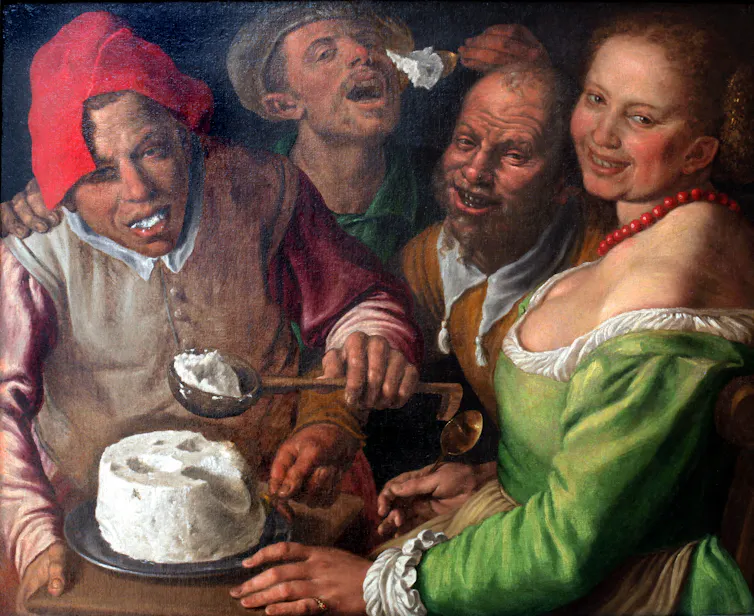
Pliny’s assertion is not based on historical fact but on a value judgement intended to contrast civilised people with barbarians according to what food they ate. On one side stood civilisation: olive oil, wine and cheese; and on the other, barbarism: animal fats (butter and lard) and beer. Barbarians’ intake of fermented milk was said to explain their pale complexion and childlike simplicity, for adult men must not drink milk – that suspicious liquid derived from a woman’s body…
A history full of fabrications
From ancient times to the present day, the history of cheesemaking and cheeses has been peppered with exaggerations, fabrications and forgeries – what we now call ‘fakes’. On the Wikipedia page dedicated to Brie, it states that Brie existed before the Roman invasion… without a shred of evidence; but the aim is to enshrine it as the oldest cheese in France, and thus to trace its origins back to ‘the earliest antiquity’, regardless of historical reality.
To find one’s way out of the labyrinth of cheese myths, cross-referencing historical, archaeological and ethnographic sources is a must. What emerges is not a static map of unchanging cheese-producing regions, but diverse realities that have shifted over time, until, in certain regions, popular cheeses – sought after by an urban clientele – came to dominate. Soft cheeses such as Brie and then, Camembert much later, in the white-rind category.
Just as the ‘tree hides the forest’, these fine specimens make us forget that there once existed an extraordinary variety of home-made cheeses produced using animal and plant-based rennet (including carnivorous plants), cheeses that were either low-fat, full fat, creamy, fresh or matured using a wide variety of methods, smoked, with rinds washed in wine, beer, cider or spirits, and flavoured with aromatic herbs such as cumin (or even coffee grounds in the 19th century). Cheeses that varied from one locality to another and from one farm to another, with many specialities that have disappeared over the years. In the late Middle Ages Bréhémont, clayn, chalamon and craponne were renowned cheeses, some of whom were considered luxury products.
The tables of the wealthy were graced with the most prized produce, the finest available. Among these were cheeses renowned for their nutritional qualities, including salted cheese from Auvergne and cheese hailing from Lombardy in Italy (Parmesan). But what about their flavour? It is actually difficult to say, given that most of these cheeses were intended for cooking – hard cheeses were grated, while soft, full-fat cheeses were melted. As for very fresh cheeses, such as ‘jonchée’ or ‘caillebotte’, they were used to make tarts or eaten as a dessert (with honey and, later, jam) and served with alcohol for the men.
It was only gradually that the practice of serving cheese as a separate course (served as it is at the meal table) became established, a development which signalled a shift in the status of certain cheeses: they were no longer merely ingredients in various dishes, but became a food in their own right, worthy of being presented at the end of a meal. In terms of flavour and appearance, cheeses from the past differed from those we know today, in both technical and cultural respects. This was the case with Brie in Medieval times, but also with Camembert in the 19th century, whose rind ranged from bluish-grey to greenish-grey with ochre-coloured patches.
Accustomed as we are to clearly defined categories of cheese, we would be perplexed by the infinite diversity of the rustic cheeses of old, which were far more numerous than the quote by General de Gaulle would lead us to believe.






Trump’s latest trade actions are ‘not an escalation,’ economist says
U.S. President Donald Trump speaks to reporters before boarding Air Force One...

Even this U.S. tariff advocate is urging Canada and the U.S. to drop retaliatory duties
'The tariff war is bad. We do not support retaliation. We don’t...

Trump’s latest trade threat weighs on Canadian firms with U.S. contracts
Share prices for Canadian companies dropped by more than two per cent...

John Ivison: Swapping U.S. trade for Europe could move Canada from the Titanic to the Hindenburg
Carney is due to join European Union president Ursula von der Leyen...